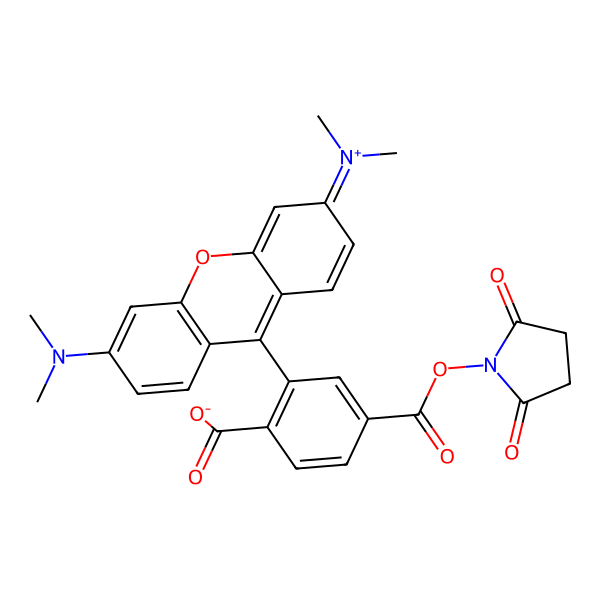
CAS: 150810-69-8; 6-Carboxytetramethylrhodamine N-Succinimidyl Ester
该化合物是一种荧光标志试剂,广泛用于改变生物分子,包括蛋白质,和核酸,其主要优点包括:与初级氨的高度反应性,产生稳定的氨化联结,以及亮的橙红荧光(ex/em~555/580 nm),使之适合基于荧光的检测和成像应用. 氨米介质酯组确保在温和条件下高效的共聚物,而TAMRA氟磷则提供极好的光度和与普通荧光探测系统的兼容性. 这种试剂在荧光显微镜显微镜,流动细胞测量和FRET研究中特别有用,为分析和诊断应用提供可靠和一致的标签.
- 英文名称6-Carboxytetramethylrhodamine N-Succinimidyl Ester
- 中文名称6-羧基四甲基罗丹明琥珀酰亚胺酯
- IUPAC名称2-(6-(dimethylamino)-3-(dimethyliminio)-3H-xanthen-9-yl)-4-(((2,5-dioxopyrrolidin-1-yl)oxy)carbonyl)benzoate
- 其它别名6-TAMRASE
- CAS编号150810-69-8
- MFCD编号:MFCD01073639
- EINECS号:634-901-0
- 分子式:C29H25N3O7分子量:527.53
- 产品CID: 733130
- 产品分类化学试剂 → 有机试剂 → 酯类
MSDS等安全信息

欧盟法规
C&L通报合成工艺路线路线简述
📜6-羧基四甲基罗丹明,丁二酰亚胺三氟乙酸酯 以 N,N-二甲基甲酰胺 用作溶剂,以85%的收率获得6-羧基四甲基罗丹明琥珀酰亚胺酯
参考文献:一种罗丹明活化酯的制备方法
标题:一种罗丹明活化酯的制备方法
摘要:本发明提供了一种罗丹明活化酯的制备方法,包括如下步骤:首先,将n‑羟基琥珀酰亚胺和三氟乙酸酐反应制备出三氟乙酸‑n‑羟基琥珀酰亚胺酯;其次,将罗丹明类染料和三氟乙酸‑n‑羟基琥珀酰亚胺酯溶解于有机溶剂中,充分反应,去除有机溶剂,提纯,制备出纯净度高的罗丹明活化酯.应用本申请所述的制备方法,副产物少,制备出的罗丹明活化酯不含有dcu杂质,产品纯度高,产率高,降低了生产成本.
海关参考信息
- 2905110000-甲醇
2906210000-苄醇
2912110000-甲醛
2912120000-乙醛 - 💡 提示:海关信息按照顺序优先匹配,如需确认的海关信息,请参考相关资料。
- 详情请参考:📖 海关编码查询和海关进出口税则
专利信息
专利号:US-8071132-B2
优先权日:2004-06-01
标 题:Unagglomerated core/shell nanocomposite particles
发明人:ADAIR JAMES H; ROUSE SARAH M; WANG JUN; KESTER MARK; SIEDLECKI CHRISTOPHER; WHITE WILLIAM B; VOGLER ERWIN; SNYDER ALAN; PANTANO CARLO G; RUIZ-VELASCO VICTOR; SINOWAY LAWRENCE
权利人:ADAIR JAMES H; ROUSE SARAH M; WANG JUN; KESTER MARK; SIEDLECKI CHRISTOPHER; WHITE WILLIAM B; VOGLER ERWIN; SNYDER ALAN; PANTANO CARLO G; RUIZ-VELASCO VICTOR; SINOWAY LAWRENCE; PENN STATE RES FOUND
摘要:The present invention provides a method for the synthesis of unagglomerated, highly dispersed, stable core/shell nanocomposite particles comprised of preparing a reverse micelle microemulsion that contains nanocomposite particles, treating the microemulsion with a silane coupling agent, breaking the microemulsion to form a suspension of the nanocomposite particles by adding an acid/alcohol solution to the microemulsion that maintains the suspension of nanocomposite particles at a pH of between about 6 and 7, and simultaneously washing and dispersing the suspension of nanocomposite particles, preferably with a size exclusion HPLC system modified to ensure unagglomeration of the nanocomposite particles. The primary particle size of the nanocomposite particles can range in diameter from between about 1 to 100 nm, preferably from between about 10 to 50 nm, more preferably about 10 to 20 nm, and most preferably about 20 nm.
专利号:BR-PI0719923-B1
优先权日:2006-12-05
标 题:METHODS FOR SEQUENCING A TARGET NUCLEIC ACID, FOR CONVERTING A NON-NATURAL OCCURRING COMPONENT TO A NUCLEIC ACID MOLECULE TO A NATURAL OCCURRING COMPONENT, TO COMPLETE A SYNTHESIS OF NUCLIC ACID TO DEGER, AND TO SANITATION TO SANITATION AND COMPOUNDS
专利号:US-8969535-B2
优先权日:2006-12-05
标 题:Photocleavable labeled nucleotides and nucleosides and methods for their use in DNA sequencing
发明人:WU WEIDONG; LITOSH VLADISLAV A; STUPI BRIAN P; METZKER MICHAEL L
权利人:WU WEIDONG; LITOSH VLADISLAV A; STUPI BRIAN P; METZKER MICHAEL L; LASERGEN INC
摘要:Provided are novel nucleotides, nucleoside, and their derivatives described herein, that can be used in DNA sequencing technology and other types of DNA analysis. In one embodiment, the nucleotide or nucleoside with an unprotected 3′-OH group is derivatized at the nucleobase to include a fluorescent dye attached via a linker to a photocleavable terminating group. The photocleavable-fluorescent group is designed to terminate DNA synthesis as well as be cleaved so that DNA oligomers can be sequenced efficiently in a parallel format. The design of such rapidly cleavable fluorescent groups on nucleotides and nucleosides can enhance the speed and accuracy of sequencing of large oligomers of DNA in parallel, to allow rapid whole genome sequencing, and the identification of polymorphisms and other valuable genetic information, as well as allowing further manipulation and analysis of nucleic acid molecules in their native state following cleavage of the fluorescent group.
专利号:US-7759470-B2
优先权日:2006-02-20
标 题 :Labeling reagent
发明人:HEINDL DIETER; BERGMANN FRANK; JOSEL HANS-PETER; KESSLER DIRK; LAMPERT GUNTER; WEILKE CHRISTIAN
权利人:ROCHE DIAGNOSTICS OPERATIONS
摘要:The current invention restates substituted indole nucleosides as both terminal as well as internal building blocks of labeled oligonucleotide probes for the detection, analysis and quantitation of nucleic acids. The substituent comprises a linker and a detectable group or a linker and a reactive group for post synthesis coupling. These modified nucleosides grant access to a wide application area. These new substituted indole nucleosides can be used as labeling reagents for the facile preparation of e.g. optimized hybridization probes, Taqman-probes, or molecular beacon probes.