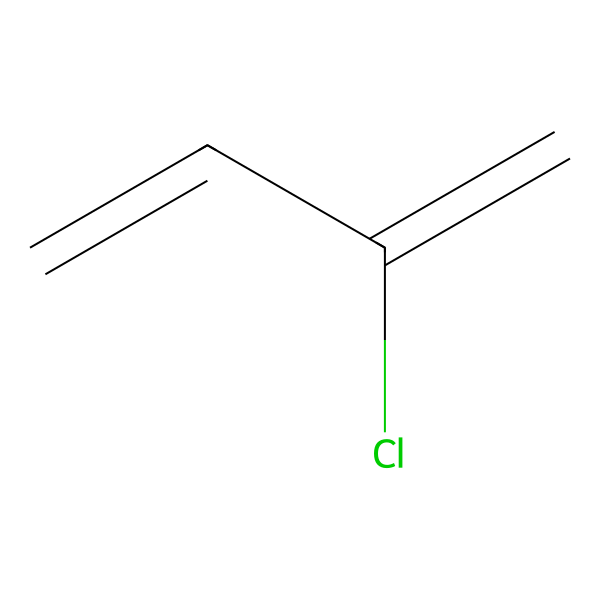
CAS: 126-99-8; Chloroprene
该化合物是一种高度活性化合物,被归类为diene,允许其进行聚合,形成具有适当特性的聚合物;该物质溶于二烯等有机溶剂中,经常用作含有氯丙烯的配方的溶剂;其沸点相对较低,由于其易燃性和潜在健康影响,包括呼吸刺激和皮肤敏化,可能具有危害性;氯丙烯还被列为一种可能的人类致癌物质,需要在工业环境中进行谨慎处理和采取适当的安全措施;其50%的浓度在二苯乙烯中,该物质通常用于各种用途,包括粘合剂,涂料和密封剂,可以有效利用其独特的特性;适当的储存和处置对于最大限度地减少环境影响和确保安全至关重要.
- ⚠️危险化学品目录(2015年版)易燃液体,类别2 《化妆品禁用原料目录》
- 英文名称Chloroprene
- 中文名称2-氯-1,3-丁二烯
- IUPAC名称2-chlorobuta-1,3-diene
- 其它别名2-chloor-1,3-butadieen; 2-chlor-1,3-butadien
- CAS编号126-99-8
- MFCD编号:MFCD00014928
- EINECS号:204-818-0
- FDA UNII编号:42L93DWV3A
- 分子式:C4H5Cl分子量:88.54
- 产品CID: 2504780
- 产品分类分析化学 → 标准品 → 农业和环境标准品
物理性质
- 熔点-130 °C
- 沸点59.4 °C at 760mmHg
- 闪点11 °C
- 密度0,958 g/cm3
- LogP:1.9249
- 折射率1.445
- 蒸汽压215 mm Hg @ 25 °C
- 溶解性溶于丙酮,苯和乙醚(Weast,1986)
- 敏感性1.刺激性极强,主要表现在对中枢神经系统及呼吸道等的损害。在浓度为100*10-6下中毒时能引起头痛、全身无力、嗜睡、记忆力减弱,也能引起肝、肾损害、血压下降、脱毛、秃发,并损害生殖细胞。因此,有2-氯-1,3-丁二烯蒸气存在的工序不允许女工参加。2-氯-1,3-丁二烯蒸气除能被吸入外,也能经皮肤吸收。空气中最高容许浓度90mg/m3。应特别强调远距离仪表控制操作,严防跑、冒、滴、漏。加强防护措施,强制排风。操作人员应穿戴防护用具。2.稳定性 稳定3.禁配物 强氧化剂、酸类4.避免接触的条件 受热,接触空气5.聚合危害 聚合6.分解产物 氯化氢
- 外观形态透明无色液体
- 储存条件储存注意事项通常商品加有阻聚剂。储存于阴凉、通风的库房。远离火种、热源。库温不宜超过29°C。包装要求密封保存,不可与空气接触。应与氧化剂、酸类、食用化学品分开存放,切忌混储。不宜大量储存或久存。采用防爆型照明、通风设施。禁止使用易产生火花的机械设备和工具。储区应备有泄漏应急处理设备和合适的收容材料。
- 产品应用制造氯丁橡胶的单体.
- 性质描述无色可燃液体,易挥发.沸点59.4°C,6.4°C(13.3kPa),47°C(66.5kPa),熔点-130°C±2°C,相对密度0.9583(20/4°C),闪点(开杯)-20°C,折射率1.4585.与空气形成爆炸性混合物,爆炸极限2.5%-12%(体积).溶于乙醇,苯,微溶于水.具辛辣气味.能发生加成,聚合反应.
MSDS等安全信息
- GHS象形图


- GHS符号GHS02 & GHS08 & GHS06 & GHS09;
注释: Flame & Health hazard & Skull and crossbones & Environment - 危险类别易燃液体 类别2
致癌性 类别1B
急性毒性 类别4(吸入)
急性毒性 类别3(经口)
特定目标器官毒性 - 单次接触 类别3
特定目标器官毒性-重复接触 类别2
皮肤腐蚀/刺激 类别2
严重眼刺激 类别2
水生慢性毒性 类别2
急性毒性 类别4(经口)
水生慢性毒性 类别3
STOT SE 2 - 警示词Danger(危险)
- 危险描述H225 |高度易燃液体和蒸气.
H350 |可能致癌.
H332 |吸入有害.
H301 |吞咽会中毒.
H335 |可能引起呼吸道刺激.
H373 |长期或反复接触可能损害器官.
H315 |造成皮肤刺激.
H319 |造成严重眼刺激.
H411 |对水生生物有毒并具有长期持续影响.
H302 |吞咽有害.
H412 |对水生生物有害并具有长期持续影响.
H371 |可能损害器官. - 防范说明P203, P210, P233, P240, P241, P242, P243, P260, P261, P264, P264+P265, P270, P271, P280, P301+P317, P302+P352, P303+P361+P353, P304+P340, P305+P351+P338, P317, P318, P319, P321, P330, P332+P317, P337+P317, P362+P364, P370+P378, P403+P233, P403+P235, P405, and P501
- UN编号1991.0
- 危险品标志F,T
- 安全声明S16-S45-S53-S36/37-S7
- 危险类别码R10
- WGK Germany3
欧盟法规
统一分类与标签压力设备指令-第1组危险流体REACH注册ECHA物质欧盟气雾剂指令-标签制度ECHA物质食品接触材料-禁用CMR物质化妆品禁用物质清单C&L通报工作场所安全标识要求REACH预注册废弃物危险特性清单上下游产品
CAS号689-97-4 乙烯基乙炔 | CAS号74-86-2 乙炔 | CAS号310447-99-5 3,4-dichlorobut... | CAS号109391-96-0 (2-chloro-3-but... | CAS号926-57-8 1,3-二氯-2-丁烯 | CAS号4461-41-0 2-氯-2-丁烯 | CAS号67003-20-7 1,1-dibromo-2-(... | CAS号1790-22-3 1,2,4-Trichloro... | CAS号25790-55-0 4-Chloro-1,2-bu... | CAS号14737-08-7 4-Chlorotetrahy... | CAS号926-57-8 1,3-二氯-2-丁烯 | CAS号22539-47-5 1,4-dibromo-2-c... | CAS号2431-52-9 1,2,2,3,4-penta... | CAS号2431-55-2 1,1,2,2,3,4-hex... | CAS号253276-02-7 ethyl 4-chlor°C... | CAS号930-66-5 1-氯环己烯 | CAS号89809-64-3 2-氰基-5-氯吡啶 | CAS号19235-89-3 4-氯-2-氰基吡啶 | CAS号27705-05-1 4-氯-3-环己烯-1-羧酸甲酯合成工艺路线路线简述
📜乙烯基乙炔置于盐酸体系中,化学反应生成2-氯-1.3-丁二烯
参考文献:Zelinsky; Koslow; Ster,1934,P. 150
标题:Zelinsky; Koslow; Ster,1934,P. 150
海关参考信息
- 2901210000-乙烯
2901220000-丙烯
2901241000-1,3-丁二烯
2903210000-氯乙烯 - 💡 提示:海关信息按照顺序优先匹配,如需确认的海关信息,请参考相关资料。
- 详情请参考:📖 海关编码查询和海关进出口税则
专利信息
专利号:US-2013196019-A1
优先权日:2010-03-18
标 题:Silicon-containing block co-polymers, methods for synthesis and use
发明人:WILLSON C GRANT; BATES CHRISTOPHER M; STRAHAN JEFFREY; ELLISON CHRISTOPHER JOHN; MUELLER BRENNEN
权利人:WILLSON C GRANT; BATES CHRISTOPHER M; STRAHAN JEFFREY; ELLISON CHRISTOPHER JOHN; MUELLER BRENNEN; NAT UNIVERSITY OF SINAPORE
摘要:The present invention describes the synthesis of silicon-containing monomers and copolymers. The synthesis of a monomer, trimethyl-(2-methylenebut-3-enyl)silane (TMSI) and subsequent synthesis of diblock copolymer with styrene, forming polystyrene-block-polytrimethylsilyl isoprene, and synthesis of diblock copolymer Polystyrene-block-polymethacryloxymethyltrimethylsilane or PS-b-P(MTMSMA). These silicon containing diblock copolymers have a variety of uses. One preferred application is as novel imprint template material with sub-100 nm features for lithography.
专利号:US-6512081-B1
优先权日:1997-07-21
标题:Synthesis of dithioester chain transfer agents and use of bis(thioacyl) disulfides or dithioesters as chain transfer agents
发明人:RIZZARDO ENZIO; THANG SAN HOA; MOAD GRAEME
权利人:E I DUPONT NEMOURS AND COMPANY; COMMW SCIENT IND RES ORG
摘要:This invention relates to the synthesis of dithiocarboxylic acid esters by reaction of bis(thioacyl) disulphides, thioacetals or vinylidane bis(thioether) with free-radicals (optionally in the presence of monomers). The invention also relates to processes for the synthesis of polymers utilising these dithioesters as polymerisation regulators (chain transfer agents) or to the use of bis(thioacyl) disulphides to generate dithioester chain transfer agents in situ.
专利号:US-5420237-A
优先权日:1991-08-29
标 题:Enzymatic synthesis of polyaniline
发明人:ZEMEL HAYA; QUINN JOHN F
权利人:ALLIED SIGNAL INC
摘要:This invention relates to a process for the enzymatic synthesis of electrically conductive substituted and unsubstituted polyanilines. Aniline monomer(s), an oxidizing agent, which comprises an enzyme and an electron acceptor, and an acidifying agent are reacted together to form polyanilines.
专利号:US-4136136-A
优先权日:1976-06-14
标题:Graft copolymers of hydrocarbons and small ring heterocyclic compounds and process for the preparation thereof
发明人:DREYFUSS PATRICIA; KENNEDY JOSEPH P
权利人:UNIV AKRON
摘要:Disclosed are novel graft copolymers comprising hydrocarbon backbones and polymerized small ring heterocyclic compounds. The backbones are devoid of O, N or S in the main chain and include SBR, polybutadiene, butyl rubber, neoprene, EPDM, EPM, PVC, and the like. The hetero atom of the graft branches may be O, S or N as well as combinations thereof and include compounds such as ethers, formals, lactones, sulfides and amines. The invention also relates to a process for cationic grafting of the heterocyclic monomers from the backbone which includes the steps of: substituting a plurality of halogen groups onto the backbone; charging a reaction vessel with the halogenated backbone and the heterocyclic monomer in the presence of a suitable solvent where necessary; mixing the contents thereof to allow at least a portion of the backbone to dissolve in the monomer; adding a suitable salt, which in the presence of an organic halide, such as the halogenated backbone, will polymerize the heterocyclic compound; agitating the contents of the reaction vessel so as to disperse the salt throughout the contents facilitating polymerization; and finally, terminating polymerization and extracting the graft copolymer from the remaining contents via conventional techniques. n BACKGROUND n The present invention relates to graft copolymers containing a halogenated saturated or unsaturated backbone, such as a diene rubber, poly(styrene-co-butadiene) (SBR), butyl rubber, poly(ethylene-co-propylene-co-diene) (EPDM), polyvinylchloride (PVC), polychloroprene (neoprene) and the like, from which are grafted branches of small ring cationically polymerizable heterocyclic compounds such as formals, lactones, amines, sulfides and ethers, particularly tetrahydrofuran (THF). The invention also relates to a process for the cationic preparation of the graft copolymers described herein. n Heretofore, it has not been possible to synthesize well-defined graft products free from gel, degradation, or ill-defined materials and having a predicted microstructure, comprising otherwise incompatible polymers such as PVC and polytetrahydrofuran (PTHF) or butyl rubber or ethylene-propylene rubber and PTHF. Given the incompatability of the polymers, a possible synthesis of a product having both would involve the graft polymerization of THF from a polymer backbone of the olefin. Thus, the backbone must carry a site capable of initiating polymerization of THF or other monomer which is to be grafted therefrom. n A discussion of known cationic initiators for THF is presented in U.S. Pat. No. 3,824,197, which discloses a method for the preparation of a terminally cationically active or living polymer by the known reaction of THF as well as certain prepolymers with a monobasic acid such as trifluoromethane sulfonic acid or derivatives thereof. This patent and related references are, however, directed toward producing a polycationically active polymer, i.e., a linear straight or branched polymer, having terminally active groups capable of initiating the polymerization of THF or entering into various alkylating and acylating reactions. Notwithstanding the recognition of others in the art that certain monobasic acids can initiate polymerization of THF, there are no references known to us which disclose a method for grafting THF and other heterocyclic monomers from a plurality of halogenated sites, rather than terminal sites on an olefinic polymer backbone, otherwise incompatible with polytetrahydrofuran (PTHF). n SUMMARY OF THE INVENTION n It is therefore an object of the present invention to provide novel graft copolymers containing halogenated saturated or unsaturated backbones and graft branches comprising cationically polymerized small ring, heterocyclic compounds, the hetero atoms of which are selected from the group consisting of O, S, N and combinations thereof. n It is another object of the present invention to provide a cationic process for the preparation of the novel graft copolymers disclosed herein. n These and other objects of the present invention will become apparent from the following description and claims. n In general, the graft copolymers of the present invention comprises a backbone derived from a halogenated saturated and unsaturated hydrocarbon polymer which is devoid of oxygen, nitrogen or sulfur in the main chain, such as chlorinated butadiene, chlorinated butadiene-styrene, PVC, chlorinated ethylene-propylene rubber, chlorinated EPDM, neoprene, chlorobutyl and the like, and graft branches comprising polymers of small ring heterocyclic compounds wherein the hetero atoms are selected from the group consisting of O, S, N and combinations thereof. n The novel graft copolymers described herein are prepared by the steps of substituting a plurality of halogen groups onto the backbone followed by charging a reaction vessel with both the halogenated backbone and the heterocyclic monomer in the presence of a suitable solvent where necessary. The two are thereafter mixed to allow some, if not all, of the backbone to dissolve in the monomer at which time a suitable cationic initiator solution is added. The initiator is formed from a soluble salt which, upon reaction with the halogen from the backbone, produces an entity capable of polymerizing THF. Final steps include agitating the contents of the vessel to disperse the initiator solution throughout the contents; terminating the polymerization and extracting the graft copolymer. Alternatively, one may commence preparation by selecting a halogenated backbone and then proceeding with the foregoing steps. n The process disclosed herein is readily controlled to produce well-defined graft products. One of the important features of the process is that it enables one skilled in the art readily to combine polymers such as PVC and PTHF which have been otherwise incompatible or if synthesized via free radical processes, have not been obtained as well-defined products. The product, poly(vinyl chloride-g-tetrahydrofuran) would be useful as a high impact resin. Also, nonpolar rubbers such as butyl or ethylene-propylene may now be combined with polar rubbers such as PTHF. Such products would be soluble in solvents for either polymer. Another product, poly(butadiene-g-tetrahydrofuran) could be utilized in tread stocks wherein it would be expected to impart better traction between a tire and wet road surfaces. Neoprene grafted with PTHF is expected to find use as an adhesive, the product exhibiting improved adhesion to polar materials. Many other utilities are expected as various graft products are synthesized according to the process set forth herein. n DESCRIPTION OF THE PREFERRED EMBODIMENT n Suitable saturated and unsaturated polymer backbones have been listed hereinabove and generally include nearly all hydrocarbons which are devoid of O, N or S in the main chain. Thus, epoxides, isocyanates, acrylics, nylons, and polysulfides may not be employed. The number average molecular weight of the backbone polymer may range from 500 to about 5,000,000 with 2,500 to 200,000 being preferred. In order for the grafting to proceed, it is necessary for the backbone to contain halogens, preferably Cl or Br, in allylic, benzylic or tertiary positions. If the halogenation is not inherent, e.g., PVC, and an unhalogenated polymer is selected for a desired product, the halogen functionality may be imparted to the polymer backbone by a suitable post-polymerization technique. Generally, chlorination with t-butylhypochlorite or elemental chlorine may be employed for substitution of chlorine upon the backbone. Other halogens such as bromine or iodine may also be employed. n One suitable procedure for halogenation of an unsaturated backbone, e.g., polybutadiene or SBR, with an alkylhypohalite has been set forth in a copending application of our assignee, Ser. No. 611,716, now abandoned. Halogenation via elemental halogens may be readily facilitated by procedures set forth in reference books directed toward organic syntheses. Although halogen functionality on the backbone is necessary to practice the invention disclosed herein, it is to be understood that the particular route selected to impart such functionality is within the skill of those in the art and, as such, is not intended to constitute a portion of the invention. n Suitable cationic initiators which may be employed are those reported in the literature for the polymerization of THF. A comprehensive listing of such compounds is presented in the aforementioned U.S. Pat. No. 3,824,197 to which reference should be made as desired. For the purposes of our work, a suitable cationic initiator would be one which is formed from any soluble salt which, upon reaction with a suitable organic halide compound, produces an entity capable of effecting the polymerization of THF. The organic halide referred to will, in the synthesis of graft copolymers according to the process set forth herein, be the halogenated polymer backbone. Alternatively, alkyl, olefinic, or aryl halides having tertiary, allylic or benzylic halogens, may be present in lieu of the backbone where it is desirable only to evaluate the performance of a particular salt rather than prepare a graft product. So long as the salt, with the organic halide, polymerizes THF, it is believed to be suitable for the process of the present invention. The halide salt which is formed from the cation of the soluble salt and the halogen of the backbone must be less soluble than the salt employed. n Particularly useful in the graft syntheses described herein have been compounds such as the silver salt of trifluoromethanesulfonic acid (AgOSO 2 CF 3 ), as well as AgPF 6 , AgBF 4 , AgClO 4 , AgSbCl 6 , AgSbF 6 , and AgAsF 6 . Suitable metals other than silver which could be employed would include cadmium, copper, lead, lithium, mercury, and sodium. For convenience, the salt may be dissolved in a solvent such as THF, dichloromethane or dichloroethylene prior to addition to the reaction vessel. n The monomers utilized to form the novel graft copolymers of the present invention are grafted from the backbone as opposed to being grafted onto or grafted through the backbone. The terminology 'grafted from' is indicative of the polymerization wherein a reactive site on the backbone interacts with the monomer and a salt to give a site from which the polymer thereafter continues to grow to a size determined by the number of sites, the amount of monomer and somewhat by the reaction conditions. A more detailed discussion of grafting techniques is presented by J. P. Kennedy, Recent Advances in Polymer Blends, Grafts and Blocks, L. H. Sperling Ed., Plenum Press, N.Y., 3, (1974). Number average molecular weight for the graft branches will generally range from about 100 to 200,000 per branch. In terms of weight percent, the branches may account for from about 1 to 99 percent of the weight of the graft copolymer product n The small ring heterocyclic monomers which may be grafted from the various backbones in which the hetero atom is oxygen include epoxides, ethers, formals and lactones. Similarly, several of the more common cyclic sulfides and amines may be grafted from the various backbones and, it is believed that cationically polymerizable compounds containing combinations of the O, N and S hetero atoms, e.g., lactams, oxathiolanes, thiazole and the like, may also be grafted from the backbones disclosed herein. n A ready listing of suitable heterocyclic compounds which will polymerize and therefore may be employed to form the novel graft copolymers of the present invention may be found in the book Ring-Opening Polymerization, K. C. Frisch and S. L. Reegen Ed. Marcel Dekker, Inc., N.Y., 8-9 (1969) (hereinafter referred to as the Ring-Opening Polymerization text). n Regarding suitable cyclic ether monomers, it is reported at page 112 of the Ring-Opening Polymerization text that four and five-membered rings, but not six-membered, e.g., 1,5-epoxides, should polymerize. Additionally, the three-membered rings, as well as some larger than six-membered, are also expected to undergo grafting from the backbones disclosed herein. Included hereinbelow are examples of synthesized copolymers comprising grafts of cyclic ethers having 2, 3 and 4 carbon atoms per ring, the most frequent example being the four carbon species, tetrahydrofuran (THF). n Suitable cyclic formals are also listed in the Ring-Opening Polymerization text at page 164 wherein it is indicated that five-, seven- and eight-membered rings, i.e., those having 3, 5 and 6 carbon atoms per ring, are polymerizable. One in particular, 1,3-dioxolane, a five-membered ring, has been successfully grafted to PVC and neoprene backbones and is also reported hereinbelow. n Suitable cyclic esters or lactones are also discussed and listed in the Ring-Opening Polymerization text at pages 256-9 wherein it is reported that four-, seven- and eight-membered rings always polymerized while less than all five- and six-membered rings polymerized. Thus, it is believed that lactones having 2-6 carbon atoms per ring may be employed herein, with the understanding that known nonpolymerizable five- and six-membered rings are to be excluded. The successful grafting of a seven-membered ring, ε-caprolactone from PVC and neoprene back-bones has been reported hereinbelow as exemplary of the grafting of cyclic lactones. n Suitable cyclic sulfides are generally discussed in the Ring-Opening Polymerization text between pages 191-215. Most common are the three- and four-membered rings, particularly the four-membered thietanes an example of which has been reported hereinbelow. It is believed that cyclic sulfides having 5 and 6 carbon atoms per ring could also be employed. n Suitable cyclic amines or alkylenimines are generally limited to ethylenimine, a three-membered, two carbon atom ring which is readily polymerizable and is discussed at pages 219-245 of the Ring-Opening Polymerization text. n It is to be understood that the foregoing discussion of suitable heterocyclic monomers is not intended to be totally inclusive of every monomer capable of being grafted from the various backbones disclosed herein according to the process of the present invention, but is rather indicative of the types of small ring monomers which may be employed. In this respect, monomers having small side chain substituents should not be disregarded; so long as they are known or at least expected to be cationically polymerizable, they could be grafted according to the present invention. And, as mentioned hereinabove, cationically polymerizable known heterocyclic monomers having combinations of O, N and S atoms per ring may also be employed. Also, bicyclics may be grafted as exemplified by the grafting of 7-oxabicyclo[2.2.1]heptane onto PVC and neoprene backbones set forth hereinbelow. n I Grafting of PTHF from Various Backbones n In a typical laboratory synthesis of the novel graft copolymers of the present invention, the procedures employed were as follows: n Tetrahydrofuran was refluxed under nitrogen over sodium or potassium until sodium naphthalene complex turned green (about 24 hrs.), thereafter distilled and stored in Teflon lined capped pop bottles until used. Polymers were thrice dissolved in a suitable solvent, reprecipitated into a nonsolvent before use and were dried in a vacuum oven. Table I presents the solvents and precipitants used for the various polymers. n n TABLE I n n n ______________________________________ nSolvents and Precipitants for the Polymers nPolymer Solvent Precipitant n______________________________________ nChlorinated polybutadiene n heptane acetone nChlorinated SBR ' ' nPolyvinyl chloride n THF methanol nNeoprene toluene 95% ethanol nChlorinated EPDM benzene acetone nChlorobutyl rubber n heptane acetone n______________________________________ n n Silver trifluoromethane sulfonate (AgSO 3 CF 3 ), obtained from Aldrich Chemical Co., was used as received. All experiments were conducted at room temperature in a dry box under dry nitrogen atmosphere. n The preparation of poly(vinyl chloride-g-tetrahydrofuran) is indicative of the several syntheses carried out utilizing a cyclic ether, THF as the heterocyclic monomer. n Geon 109 (5 g) purified by dissolving in THF and precipitating in methanol three times was dissolved in dry THF (100 ml) and 0.13M AgOSO 2 CF 3 in THF (5 ml) was added. (Geon is a registered trademark of the B. F. Goodrich Co. for a group of PVC polymers). The viscosity of the solution increased slowly. One day later an additional 5 ml of silver salt solution was added. The polymerization was terminated 48 hours after the first silver salt addition by adding methanol. The unreacted THF was evaporated and the resulting polymer film was dried in a vacuum oven at 40° C. to give 6.67 g product which corresponds to an overall composition of 75% PVC and 25% PTHF. n The crude product was found to be completely soluble in dimethylformamide (DMF), 21% soluble in dioxane, and 10% soluble in ethyl acetate. Inasmuch as DMF is not a solvent for PTHF, all the PTHF formed must have been grafted, i.e., pulled into solution by the DMF soluble PVC backbone. n The presence of graft was further demonstrated by the solubility experiments with ethyl acetate and dioxane, solvents for PTHF but nonsolvents for PVC. Thus, ethyl acetate and dioxane extracts of the product described above were shown by infrared spectroscopy to contain both PVC and PTHF. In those instances the soluble PTHF branches pulled the PVC moiety into solution. n The gel permeation chromatogram of the unfractionated polymer (after removal of only the silver salt) had a high molecular weight tail and its maximum was slightly shifted toward lower count (higher molecular weight) relative to the PVC backbone which indicates the absence of appreciable amounts of ungrafted (unreacted) backbone. n The tensile behavior of the PVC-g-PTHF was found to be distinctly different from that of the backbone, i.e., elongation of the graft was greater and the yield point and ultimate tensile strength were about 25% lower than those of the backbone. n Syntheses involving several other polymer backbones and THF are presented in Table II. Solubility studies enabled the weight percent of PTHF in the graft product to be determined. n n TABLE II n n n ______________________________________ nPolytetrahydrofuran Grafts From Various nHalogenated Polymer Backbones n Reaction n Time % PTHF in nPolymer Symbol (Days) Crude Product n______________________________________ nChlorinated polybuta- n ClPBd 2 38 ndiene nChlorinated SBR n ClPBdSty 2 35 nPolyvinylchloride n PVC 2 25 nChlorinated Nordel-1 a n Cl 2 EPDM n 3 21 nChlorinated Nordel-2 b n ClEPDM 1 9.3 nNeoprene Neoprene 1 34 n(polychloroprene) nChlorobutyl ClBut 1 14 n______________________________________ n +hu a Chlorine introduced by reaction with elemental chlorine n b Chlorine introduced by reaction with (CH 2 CO) 2 NCl n n In each synthesis, approximately 5 g of polymer was dissolved in purified tetrahydrofuran (50 ml for neoprene, ClPBdSty, and ClBut, 100 ml for ClPBd, PVC, Cl 2 EPDM, and ClEPDM). Then 5 ml of an 0.13M solution of AgSO 3 CF 3 in tetrahydrofuran was added. An additional 5 ml of the silver salt solution was added after 1 day to the PVC and Cl 2 EPDM. The reactions were finally terminated by the addition of a 90 percent by volume solution of THF in distilled water. The resultant products were thereafter dried in an oven for subsequent characterization. n Solvent extraction data was first collected by dissolving both the homopolymers of the reaction, i.e., backbone and PTHF graft, and the products of the attempted grafting reactions. Solvents employed were dioxane, ethyl acetate, heptane, benzene, toluene, THF, 3-pentanone, dimethylformamide, and CH 2 Cl 2 . Data obtained indicated that most of the PTHF had been grafted from the backbone. Graft products, PVC-g-PTHF, Cl 2 EPDM-g-PTHF and ClBut-g-PTHF were completely soluble in either dimethylformamide or heptane, both of which are nonsolvents for PTHF, thus ruling out the presence of that homopolymer. Also, the percent of insoluble material determined from either solvent was different than the percent of PTHF in the crude product. n For three of the products, ClPBd-g-PTHF, ClPBdSty-g-PTHF and ClEPDM-g-PTHF, the insolubles far exceeded the PTHF content suggesting that much of the backbone is kept out of solution by grafted PTHF. Thus, in these systems the presence of homopolymer cannot be ruled out. n Lacking knowledge of a differentiating solvent for neoprene, i.e., a solvent for neoprene that is not also a solvent for PTHF, conclusions regarding ungrafted PTHF cannot be reached for neoprene-g-PTHF. The absence of unreacted backbone is, however, clearly demonstrated by the ethyl acetate solubility of neoprene-g-PTHF, and the complete dioxane solubility of ClPBd-g-PTHF and ClPBdSty-g-PTHF. n Solubility data alone are insufficient to determine the amount of unreacted backbone for PVC-g-PTHF, Cl 2 EPDM-g-PTHF, ClEPDM-g-PTHF, or ClBut-g-PTHF inasmuch as the percents soluble do not correlate well with the percents of PTHF obtained from conversions. n Infrared and nmr analyses revealed that even in those instances where material was extracted into solvents for PTHF but nonsolvents for the backbone, the extracts contained both polymers. This indicates that pure homopolymer, if any, was always contaminated with some graft, which was pulled into solution by the soluble moiety, or left behind because of the insoluble component. Such behavior has often been observed with graft copolymers during related investigations conducted in the laboratories of our common Assignee herein, The University of Akron, and reported, e.g., J. P. Kennedy, J. J. Charles and D. L. Davidson, 'Recent Advances in Polymer Blends, Grafts and Blocks,' L. H. Sperling, Ed., Plenum Press, N.Y., 157 (1974). In all grafts (except neoprene-g-PTHF), the presence of PTHF was evident from the strong infrared ether absorption at about 1115 cm -1 . Unfortunately, the 1115 cm -1 band in PTHF and a similar band in neoprene overlapped and, therefore, infrared analysis was not useful for this graft. However, the proton resonances in the nmr were widely separated and from the integration of the spectrum obtained, a composition of 70 wt % neoprene and 30 wt % PTHF was calculated. This compared quite well with the composition of 66 wt % neoprene and 34 wt % PTHF obtained gravimetrically from the product isolated. (The wt % PTHF in the crude product was calculated on the basis of the increase in weight of the backbone after evaporation of the solvent and, therefore, contains the residual silver salt. The nmr spectrum was run on purified polymer.) n Solvent extraction data obtained has been set forth in Table III wherein various solubilities for the graft PTHF, the backbones, and the crude graft products are presented. The percentage of PTHF in each crude product has been set forth in Table II hereinabove. n n TABLE III n n n __________________________________________________________________________nComparison of Solubilities of Homopolymer and Products of Grafting nReactions n Solvent a n Ethyl Tetra- Dimethyl- nPolymer Dioxane n Acetate n Heptane n Benzene n Toluene n Hydrofuran n 3-Pentanone n formamide n CH 2 n Cl 2 n__________________________________________________________________________nPTHF s s i s s s s b n i s nClPBd i i s V.sw -- s s b n -- -- nClPBd-g-PTHF n s 7 9 V.sw -- s s -- -- nClPBdSty i s b n s V.sw -- s s -- -- nClPBdSty-g-PTHF n s 24 c n 4 s b n -- s s b n -- -- nPVC i i -- -- -- s -- s b n -- nPVC-g-PTHF n 21 10 -- -- -- s -- s -- nCl 2 EPDM n i i s s -- s i -- -- nCl 2E PDM-g-PTHF n 15 9 s s -- s i -- -- nClEPDM i i s s -- s i -- -- nClEPDM-g-PTHF n 59 18 41 -- -- s -- -- -- nneoprene s i i s s s -- -- s nneoprene-g-PTHF n s s i V.sw 45 s -- -- s nClBut i i s -- -- s -- -- -- nClBut-g-PTHF n 9 3 s -- -- s -- -- -- n__________________________________________________________________________n +hu as = 100% soluble; i = insoluble; sw = swollen; V.sw = highly swollenn but still insoluble. Usually the amount dissolved did not change n significantly after 1 day. The numbers indicate the percentage of the n total product that was soluble. n b About a week was required to achieve solubility. n c After 3 days. n n II Grafting Various Heterocyclic Monomers from a PVC Backbone n Polymerizations for these experiments, as well as those which follow in Section III, were conducted at room temperature, in Teflon-lined screw-capped bottles, in a dry box. The backbone was contacted with the monomer by letting the mixture remain in the dry box for four days with occasional shaking. The backbone swelled greatly but did not actually dissolve except in one of the monomers, ε-caprolactone. Following the four-day period, AgPF 6 in CH 2 Cl 2 was added to the bottle which was then shaken to disperse the silver salt solution throughout the contents of the bottle. AgPF 6 , obtained from Alfa Inorganics Ventron, was used as received. The reactions were terminated by adding 1 ml of concentrated ammonium hydroxide. n The charges for each synthesis comprised: 20-30 ml of the desired monomer; approximately 1.5 g of Geon 109; and 1.5 ml of a 0.13 M AgPF 6 solution of the salt dissolved in CH 2 Cl 2 . In all syntheses, the monomer was first refluxed under N 2 over a suitable drying agent for 2-4 hours and then distilled under N 2 . The monomers were subsequently stored in a dessicator over P 2 O 5 until used. Monomers employed and compositions obtained have been summarized in Table IV which follows. All percentages which follow are by weight. n n TABLE IV n n n __________________________________________________________________________nHeterocyclic Monomers Grafted From PVC n Color Product Composition n Vol. Used n During Poly- n Days Poly- n % Monomer n (by wt) nMonomer (ml) merization n merized n Reacted n % PVC n % Branch n__________________________________________________________________________npropylene oxide n 24 Yellow Orange n 3 1.8 81.5 18.5 nstyrene oxide n 28 Bronze 3 20 21.1 78.9 nε-caprolactone n 19.5 Grey almost Black n 3 96 6.5 93.5 ndioxolane n 20.5 Grey 1.75 96 8.1 91.9 n7-oxabicyclo- n[2 . 2 . 1 ] heptane n 22 Bronze 3 2.7 73.2 26.8 n__________________________________________________________________________n n The polymers from dioxolane and 7-oxabicyclo[2.2.1]-heptane were isolated by evaporation and drying in a vacuum oven. Methanol extraction of unreacted monomer was attempted in the experiment with ε-caprolactone but the product solidified on addition of methanol. The product from styrene oxide polymerization was separated into methanol soluble and insoluble fractions prior to evaporation. The yield is based on the sum of the weights of both fractions. As reported in the table, polymerization occurred with each of the monomers. The polymers were characterized by solubility, nmr, and GPC. The results indicate that graft copolymer formed in each instance and that considerable homopolymer also formed with propylene oxide, styrene oxide, and ε-caprolactone. n Each of the methanol insoluble fractions was dissolved in THF and/or CCl 4 and filtered through a Celite filtering aid mat for removal of silver salts. The solvents were subsequently evaporated and the polymers were dried in a vacuum oven. Portions of the isolated polymer were utilized for analysis by GPC and nmr spectroscopy. Methanol soluble fractions were also analyzed by nmr. n The polymerization product of propylene oxide, a 3-membered ring cyclic ether, and PVC was found to be 99% soluble in THF and less than 1% soluble in CCl 4 . By nmr, the soluble portion was found to comprise 7% polypropylene oxide and 93% PVC. PVC is insoluble in CCl 4 while polypropylene oxide is soluble; thus, solubility alone would indicate that graft copolymer was formed. n The polymerization product of styrene oxide, another 3-membered ring cyclic ether, and PVC was found to be 73% methanol soluble which fraction was found to contain 100% polymer from styrene oxide by nmr. The methanol insoluble fraction soluble in THF was 97% and nmr analysis revealed approximately a 79% content of PVC and 21% of polystyrene oxide. The methanol insoluble fraction was also largely insoluble in CCl 4 and that which did dissolve was polymer from styrene oxide. The GPC trace indicated formation of a graft copolymer with a very small peak corresponding to homopolymer and a main peak shifted slightly to a higher count (49.0) corresponding to the graft product. n The polymerization product of ε-caprolactone and PVC was found to be 61% soluble in THF and largely insoluble in CCl 4 ; the soluble fraction (THF) was homopolymer of ε-caprolactone by nmr. The GPC had three peaks, e.g., one at 58.7, 56 and 48.0 counts. n The polymerization product of dioxolane, a formal, and PVC was found to be 99% solution in THF which alone evidences the formation of a graft copolymer inasmuch as the homopolymer of dioxolane is insoluble in THF and the wt % composition of the product (from Table IV) indicates 91.9% of polydioxolane present. The sample was largely insoluble in CCl 4 and the small soluble fraction showed peaks for both PVC and the homopolymer of dioxolane. The GPC tracing revealed a single symmetrical peak having the same maximum as PVC but a somewhat narrower molecular weight distribution. n Finally, the polymerization product of 7-oxabicyclo-[2.2.1]heptane and PVC was found to be 86% soluble in THF and largely insoluble in CCl 4 precluding the obtainment of an nmr spectrum. The GPC tracing revealed a single symmetrical peak with the maximum shifted slightly to a higher count (49.0) and having small but definite high and low molecular weight tails, indicative of a graft copolymer. n III Grafting Various Heterocyclic Monomers from a Neoprene Backbone n As stated hereinabove, conditions under which the following experiments were conducted were the same as in the experiments involving the PVC backbone. The charges for the eight syntheses which follow comprised: 15 ml of the desired monomer with the exception of oxetane and thietane as appears in Table V; 1.5 g of neoprene; and 1.5 ml of a 0.13 M AgPF 6 solution of the salt dissolved in CH 2 Cl 2 . n n
供应商参考报价(招募中)
品牌试剂参考报价(招募中)
📌 第三方产品分析报告
合成参考文献
摘要:Molander, G. A.; Beaumard, F., Science of Synthesis Knowledge Updates, (2013) 3, 114.
摘要:Müller, T., Science of Synthesis Knowledge Updates, (2013) 3, 36.
摘要:Bubnov, Yu. N.; Kolomnikova, G. D., Science of Synthesis Knowledge Updates, (2012) 3, 257.
摘要:Sbornik Lekarsky. Collection of Medical Works., 44(63), 1942
摘要:Toxicometric Parameters of Industrial Toxic Chemicals Under Single Exposure, Izmerov, N.F., et al., Moscow, Centre of International Projects, GKNT, 1982, -(38), 1982



📝 需求与反馈
尽可能描述清楚需求与问题信息