CAS: 1003-99-2; 2-Bromo-5-Fluoroaniline
该化合物是属于芳香氨类的有机化合物,其特点是以二位的溴原子和五位的氟原子替代苯环,以及第一位置的氨基(-NH2),该化合物一般在室温下是固体的,其特点是其熔点相对较高,有机溶剂中的溶解度中等,卤素替代成分(溴和氟)的存在影响其再活动,使其成为有机合成的有用中间体,特别是在制药和农用化学物的开发方面.此外,氨基化合物可参与各种化学反应,如核分裂替代和组合反应.在处理该化合物时,应采取安全防范措施,因为其潜在的毒性和反应性可能会对健康造成危害.
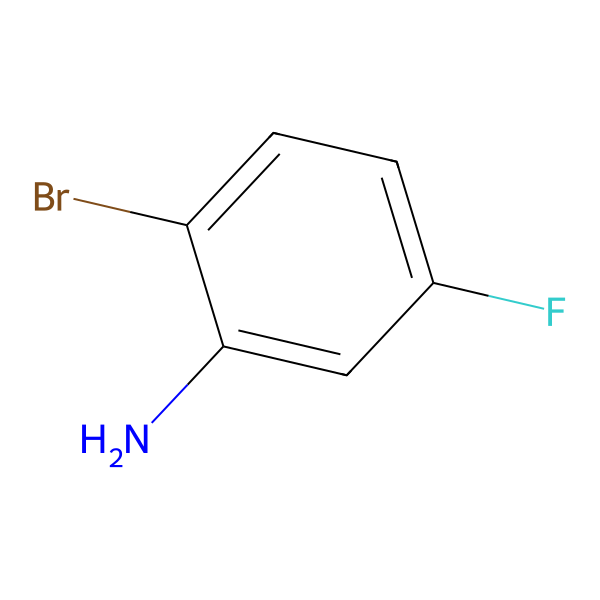
相似化合物
446-09-3 111721-75-6 500357-40-4物理性质
MSDS等安全信息
- GHS象形图

- GHS符号GHS07;
注释: Exclamation mark - 危险类别特定目标器官毒性 - 单次接触 类别3
皮肤腐蚀/刺激 类别2
严重眼刺激 类别2
急性毒性 类别4(吸入)
急性毒性 类别4(经皮)
急性毒性 类别4(经口)
严重眼刺激 类别2A - 警示词Warning(警告)
- 危险描述H335 |可能引起呼吸道刺激.
H315 |造成皮肤刺激.
H319 |造成严重眼刺激.
H332 |吸入有害.
H312 |皮肤接触有害.
H302 |吞咽有害. - 防范说明P261-P264-P271-P280-P302+P352-P304+P340-P362-P405-P501
- 危险等级6.1
- UN编号UN2811
- 危险品标志Xi,T
- 风险等级Toxic
- 包装等级III
- 安全声明26-36
- 危险类别码36/37/38
- WGK Germany3
欧盟法规
ECHA物质C&L通报REACH预注册上下游产品
CAS号446-09-3 1-溴-4-氟-2-硝基苯 | CAS号909274-50-6 Benzene, 2-azid... | CAS号372-19-0 3-氟苯胺 | CAS号364-78-3 4-氟-2-硝基苯胺 | CAS号460-00-4 对氟溴苯 | CAS号147460-43-3 2-溴-5-氟硫代苯甲醚 | CAS号917251-99-1 8-溴-5-氟喹啉 | CAS号776239-07-7 (2-溴-5-氟苯基)肼 | CAS号655236-30-9 4-氯-5-氟喹啉-3-羧酸乙酯 | CAS号885609-84-7 N-(2-Bromo-5-fl... | CAS号477983-59-8 5-fluoro-2-prop... | CAS号60481-35-8 (2-溴-5-氟苯基)肼盐酸盐合成工艺路线路线简述
- 合成目标产物 2-Bromo-5-Fluoroaniline 主要起始原料 1-Bromo-4-Fluoro-2-Nitrobenzene
- (文献来源)合成步骤主要原料 1-Bromo-4-Fluoro-2-Nitrobenzene
4-氟-2-硝基苯胺置于镍 盐酸,氢气,Sodium Nitrite体系中,化学反应生成2-溴-5-氟苯胺
参考文献:High Affinity Central Benzodiazepine Receptor Ligands. Part 3: Insights Into The Pharmacophore And Pattern Recognition Study Of Intrinsic Activities Of Pyrazolo[4,3-C ]Quinolin-3-Ones
标题:High Affinity Central Benzodiazepine Receptor Ligands. Part 3: Insights Into The Pharmacophore And Pattern Recognition Study Of Intrinsic Activities Of Pyrazolo[4,3-C ]Quinolin-3-Ones
摘要:Novel 2-Phenyl-2,5-Dihydropyrazolo[4,3-C]Quinolin-3-(3H)-Ones (Pqs) Endowed With High Affinity For Central Benzodiazepine Receptor (Bzr) Were Synthesized. In Particular,9-Fluoro-2-(2-Fluorophenyl)-2,5-Dihydro-3H-Pyrazolo[4,3-C]Quinolin-3-One (22) Showed Binding Affinity In The Subnanomolar Concentration Range And Proved To Be In Vitro A Potent Antagonist. This Finding Allowed The Nature Of The Hydrogen Bonding Receptor Site H-2 To Be Established,As Located Between The N-1 Nitrogen Of The Pq Nucleus And The Ortho Position Of The N-2-Aryl Group. [s-35]Tert-Butylbicyclophosphorothionate ([s-35]Tbps) Binding Assays And Electrophysiological Measurements Of The Effects On Gaba-Evoked Cl-Currents At Recombinant Human Alpha(1)Beta(2)Gamma(2L) Gaba(A) Receptors,Expressed In Xenopus Laevis Oocytes,Were Used To Assess The Intrinsic Activities Of A Large Series Of Pqs. With The Aim Of Extracting Discriminant Information And Distinguishing Bzr Ligands With Different Profiles Of Efficacy,51 Pq Derivatives,Including Full And Partial Agonists,Antagonists,And Inverse Agonists,Were Analyzed In A Multidimensional Chemical Descriptor Space,Defined By The Lipophilicity Parameter Clog P And 3-D Molecular Whim Descriptors,By Means Of Principal Component Analysis,K-Nearest Neighbors (K-Nn) Method,And Linear Discriminant Analysis (Lda). The Classification Methods Were Applied To Subsets Of Pairs Of Efficacy Classes,And Lipophilicity And 3-D Size Descriptors Were Detected As The Discriminant Variables By A Stepwise Linear Discriminant Analysis. Lda Proved To Be Superior To K-Nn,Especially In Classifying Pq Ligands (60-84% Of Success In Prediction Ability) Into Categories Of Efficacies Which Were Contiguous And Quite Overlapped In The Hyperspace Of Variables. (C) 2003 Elsevier Ltd. All Rights Reserved.
Doi:10.1016/s0968-0896(03)00527-3
专利信息
专利号:US-11873305-B2
优先权日:2020-06-30
标题 :Processes for synthesis of substituted indole intermediates for the synthesis of serd compounds
发明人:ZHANG HAIMING; XU JIE; WUITSCHIK GEORG; ANGELAUD REMY; HEROLD SEBASTIAN; STUTZ ALFRED; BRUETSCH TOBIAS; BURKHARD JOHANNES
权利人:GENENTECH INC; HOFFMANN LA ROCHE
摘要:Provided herein are processes for the preparation of indolyl intermediates using Wenker Synthesis for the total synthesis of SERD compounds useful in the treatment of cancer.
专利号:BR-PI0712153-A2
优先权日:2006-06-09
标 题:processes for the synthesis of pyrerazine-piperidine compounds
专利号:US-2008139558-A1
优先权日:2006-02-24
标题 :Quinolones useful as inducible nitric oxide synthase inhibitors
发明人:SMITH NICHOLAS D; ROPPE JEFFREY R; BONNEFOUS CELINE; PAYNE JOSEPH E; ZHUANG HUI; CHEN XIAOHONG; LINDSTROM ANDREW K; DURON SERGIO G; HASSIG CHRISTIAN A; NOBLE STEWART A
权利人:KALYPSYS INC
摘要:The present invention relates to novel quinolones of Formula I that inhibit inducible NOS synthase together with methods of synthesizing and using the compounds including methods for inhibiting or modulating nitric oxide synthesis and/or lowering nitric oxide levels in a patient by administering the compounds for the treatment of disease.
专利号:CN-113636977-B
优先权日:2021-09-01
标 题 :Synthesis method of 2-aryl benzazepine and derivatives thereof
专利号:CN-118851912-A
优先权日:2024-06-28
标 题:Synthesis method of 2-bromo-5-fluoroacetanilide
专利号:CN-113636977-A
优先权日:2021-09-01
标 题 :Synthesis method of 2-aryl benzazepine and derivatives thereof
网址: http://www.tyschem.com
企业联系电话:024-83607930👤
地址:沈阳市浑南区上深沟村868-5号
企业联系电话:024-83607930👤
📞阜新奥瑞凯精细化工有限公司 ⚠️参考联系方式
联系人:徐经理
电话:024-83607930
手机:18640359690
传真:024-83607930
邮箱:sales@honghuchem.com
通信地址: 沈阳市浑南区上深沟村868-5号
邮编: 110016
电话:024-83607930
手机:18640359690
传真:024-83607930
邮箱:sales@honghuchem.com
通信地址: 沈阳市浑南区上深沟村868-5号
邮编: 110016
🆔 联系时候可告知是从"百琢研"平台获取的信息.
⚠️ 声明: 该企业未认证、未认领,请自行辨别信息的真实性和可靠性。咨询或交易时请注意风险评估与信息核实,百琢研不参与任何交易。企业认领注册入口→
地址:沈阳市浑南区上深沟村868-5号
⚠️ 未注册 · 未认证企业
 备注: 📌 数据来源说明:本展台内容基于各搜索引擎等公开数据整理,仅作展示用途。请用户自行辨别
✉️ 若企业需抹除展台内容或有异议, 请通过页面底部联系方式告知我们,我们会尽快处理。
网址: http://www.rskjchem.com
企业联系电话:0418-3904666 13841889768👤
地址:辽宁省阜新市太平区高德街道高孙路
企业联系电话:0418-3904666 13841889768👤
📞阜新锐晟科技有限公司 ⚠️参考联系方式
联系人:韩经理
电话:0418-3904666 13841889768
手机:13841889768
传真:0418-3904666
邮箱:sales@rskjchem.com
通信地址: 辽宁省阜新市太平区高德街道高孙路
邮编: 123000
电话:0418-3904666 13841889768
手机:13841889768
传真:0418-3904666
邮箱:sales@rskjchem.com
通信地址: 辽宁省阜新市太平区高德街道高孙路
邮编: 123000
🆔 联系时候可告知是从"百琢研"平台获取的信息.
⚠️ 声明: 该企业未认证、未认领,请自行辨别信息的真实性和可靠性。咨询或交易时请注意风险评估与信息核实,百琢研不参与任何交易。企业认领注册入口→
地址:辽宁省阜新市太平区高德街道高孙路
⚠️ 未注册 · 未认证企业
备注: 📌 数据来源说明:本展台内容基于各搜索引擎等公开数据整理,仅作展示用途。请用户自行辨别✉️ 若企业需抹除展台内容或有异议, 请通过页面底部联系方式告知我们,我们会尽快处理。
网址: http://www.qjsfb.com
企业联系电话:陈佳|运营副总 13588048971👤
地址:阜新市阜蒙县氟化工园区
企业联系电话:陈佳|运营副总 13588048971👤
📞阜新清稷升科技有限公司 ⚠️参考联系方式
联系人:陈佳|运营副总
电话:陈佳|运营副总 13588048971
手机:13588048971
传真:0418-8189431
邮箱:sales@bomanbiochem.com
通信地址: 阜新市阜蒙县氟化工园区
邮编: 123000
电话:陈佳|运营副总 13588048971
手机:13588048971
传真:0418-8189431
邮箱:sales@bomanbiochem.com
通信地址: 阜新市阜蒙县氟化工园区
邮编: 123000
🆔 联系时候可告知是从"百琢研"平台获取的信息.
⚠️ 声明: 该企业未认证、未认领,请自行辨别信息的真实性和可靠性。咨询或交易时请注意风险评估与信息核实,百琢研不参与任何交易。企业认领注册入口→
地址:阜新市阜蒙县氟化工园区
⚠️ 未注册 · 未认证企业
备注: 📌 数据来源说明:本展台内容基于各搜索引擎等公开数据整理,仅作展示用途。请用户自行辨别✉️ 若企业需抹除展台内容或有异议, 请通过页面底部联系方式告知我们,我们会尽快处理。
网址: http://www.jinyudachem.com
企业联系电话:022-23854368👤
地址:天津市华苑产业区华天道8号海泰信息广场C座209室
企业联系电话:022-23854368👤
📞天津津御达化工科技有限公司 ⚠️参考联系方式
联系人:王经理
电话:022-23854368
手机:13011382049
传真:022-23854368
邮箱:sales@jinyudachem.com
通信地址: 天津市华苑产业区华天道8号海泰信息广场C座209室
邮编: 300400
电话:022-23854368
手机:13011382049
传真:022-23854368
邮箱:sales@jinyudachem.com
通信地址: 天津市华苑产业区华天道8号海泰信息广场C座209室
邮编: 300400
🆔 联系时候可告知是从"百琢研"平台获取的信息.
⚠️ 声明: 该企业未认证、未认领,请自行辨别信息的真实性和可靠性。咨询或交易时请注意风险评估与信息核实,百琢研不参与任何交易。企业认领注册入口→
地址:天津市华苑产业区华天道8号海泰信息广场C座209室
⚠️ 未注册 · 未认证企业
备注: 📌 数据来源说明:本展台内容基于各搜索引擎等公开数据整理,仅作展示用途。请用户自行辨别✉️ 若企业需抹除展台内容或有异议, 请通过页面底部联系方式告知我们,我们会尽快处理。
网址: http://www.tyschem.com/
电话: 0086-024-83607930; 18640359690👤
销售电话:0086-024-83607930; 18640359690
邮箱:sales@honghuchem.com
电话: 0086-024-83607930; 18640359690👤
📞辽宁鸿鹄医药化学技术有限公司 ⚠️参考联系方式
销售电话:0086-024-83607930; 18640359690
邮箱:sales@honghuchem.com
🆔 联系时候可告知是从"百琢研"平台获取的信息.
⚠️ 声明: 该企业未认证、未认领,请自行辨别信息的真实性和可靠性。咨询或交易时请注意风险评估与信息核实,百琢研不参与任何交易。企业认领注册入口→
⚠️ 未注册 · 未认证企业
备注: 📌 数据来源说明:本展台内容基于各搜索引擎等公开数据整理,仅作展示用途。请用户自行辨别 ✉️ 若企业需抹除展台内容或有异议, 请通过页面底部联系方式告知我们,我们会尽快处理。网址: http://www.zyspread.com
电话: 0851-5217097 13511983931👤
销售电话:0851-5217097 13511983931
邮箱:lwessence@263.net
电话: 0851-5217097 13511983931👤
📞遵义斯普瑞科技有限责任公司 ⚠️参考联系方式
销售电话:0851-5217097 13511983931
邮箱:lwessence@263.net
🆔 联系时候可告知是从"百琢研"平台获取的信息.
⚠️ 声明: 该企业未认证、未认领,请自行辨别信息的真实性和可靠性。咨询或交易时请注意风险评估与信息核实,百琢研不参与任何交易。企业认领注册入口→
⚠️ 未注册 · 未认证企业
备注: 📌 数据来源说明:本展台内容基于各搜索引擎等公开数据整理,仅作展示用途。请用户自行辨别 ✉️ 若企业需抹除展台内容或有异议, 请通过页面底部联系方式告知我们,我们会尽快处理。网址: http://www.fxswchem.com
企业联系电话:15242008343;13019865050👤
地址:辽宁省阜新市海州区振兴路106号6门
企业联系电话:15242008343;13019865050👤
📞阜新硕维新材料科技有限公司 ⚠️参考联系方式
联系人:杨松涛
电话:15242008343;13019865050
手机:15242008343;13019865050
邮箱:sales@fxswchem.com
通信地址: 辽宁省阜新市海州区振兴路106号6门
邮编:
电话:15242008343;13019865050
手机:15242008343;13019865050
邮箱:sales@fxswchem.com
通信地址: 辽宁省阜新市海州区振兴路106号6门
邮编:
🆔 联系时候可告知是从"百琢研"平台获取的信息.
⚠️ 声明: 该企业未认证、未认领,请自行辨别信息的真实性和可靠性。咨询或交易时请注意风险评估与信息核实,百琢研不参与任何交易。企业认领注册入口→
地址:辽宁省阜新市海州区振兴路106号6门
⚠️ 未注册 · 未认证企业
备注: 📌 数据来源说明:本展台内容基于各搜索引擎等公开数据整理,仅作展示用途。请用户自行辨别✉️ 若企业需抹除展台内容或有异议, 请通过页面底部联系方式告知我们,我们会尽快处理。
网址: http://www.lshuaibangchem.com
企业联系电话:0517-82311784👤
地址:江苏涟水县安东北路127号中区12号
企业联系电话:0517-82311784👤
📞涟水淮邦化工有限公司 ⚠️参考联系方式
联系人:陈先生
电话:0517-82311784
手机:13382310033
邮箱:sales@lshuaibangchem.com
通信地址: 江苏涟水县安东北路127号中区12号
邮编: 223400
电话:0517-82311784
手机:13382310033
邮箱:sales@lshuaibangchem.com
通信地址: 江苏涟水县安东北路127号中区12号
邮编: 223400
🆔 联系时候可告知是从"百琢研"平台获取的信息.
⚠️ 声明: 该企业未认证、未认领,请自行辨别信息的真实性和可靠性。咨询或交易时请注意风险评估与信息核实,百琢研不参与任何交易。企业认领注册入口→
地址:江苏涟水县安东北路127号中区12号
⚠️ 未注册 · 未认证企业
备注: 📌 数据来源说明:本展台内容基于各搜索引擎等公开数据整理,仅作展示用途。请用户自行辨别✉️ 若企业需抹除展台内容或有异议, 请通过页面底部联系方式告知我们,我们会尽快处理。
第 1 / 1 页
供应商参考报价(招募中)
品牌试剂参考报价(招募中)
📌 第三方产品分析报告
主要参考文献
[参考文献]: T D Bradshaw, Et Al. The Development Of The Antitumour Benzothiazole Prodrug, Phortress, As A Clinical Candidate. Curr Med Chem. 2004 Apr;11(8):1009-21.合成参考文献
摘要:Sharma, U.; Kumar, R.; Gupta, S. S.; Chandra, D., Science of Synthesis Knowledge Updates, (2022) 2, 81.
摘要:Silva, V. L. M.; Pinto, D. C. G. A.; Santos, C. M. M.; Rocha, D. H. A., Science of Synthesis Knowledge Updates, (2022) 3, 382.



📝 需求与反馈
尽可能描述清楚需求与问题信息