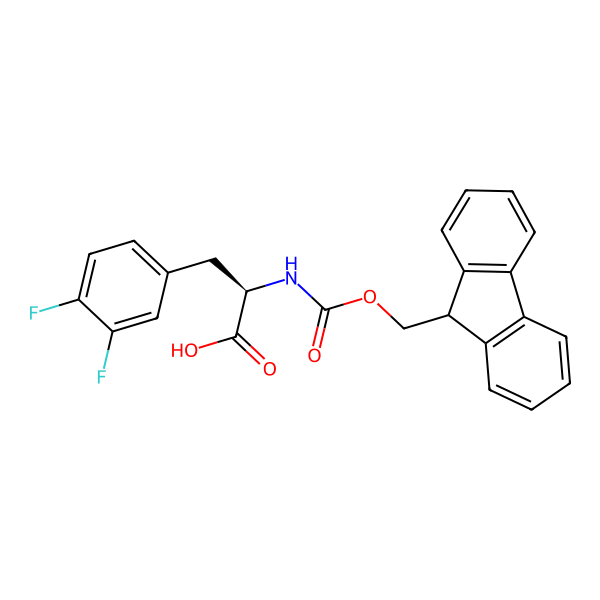
CAS: 198545-59-4; Fmoc-D-Phe(3,4-Dif)-Oh
该化合物是氨酸苯丙烯的衍生物,在苯环的3和4个位置用9-氟氧基碳基(FMOC)保护组和2个氟原子进行修改,该化合物通常用于浸泡合成和研究,因为其有能力在合成过程中增强peptipe的稳定性和溶性.氟原子的存在也可以影响分子的电子特性和再活性,使其在药用化学和药物设计中具有价值. FMOC-D-3-4-二氟苯丙烯在室内温度上一般以其固态为特征,并且可溶于二甲基硫氧化物和二氯甲烷等有机溶剂中,其独特的结构特征允许生物系统中的特定相互作用,使其成为研究蛋白质结构和功能的有用工具.应参考安全数据表处理和储存准则,如所有化学物质.
- 英文名称Fmoc-D-Phe(3,4-Dif)-Oh
- 中文名称FMOC-D-3,4-二氟苯丙氨酸
- IUPAC名称(R)-2-((((9H-fluoren-9-yl)methoxy)carbonyl)amino)-3-(3,4-difluorophenyl)propanoic acid
- 其它别名9-芴甲氧羰基-D-3,4-二氟苯丙氨酸; N-[(9H-Fluoren-9-Ylmethoxy)Carbonyl]-3,4-Difluoro-D-Phenylalanine
- CAS编号198545-59-4
- MFCD编号:MFCD00672551
- EINECS号:894-838-1
- 分子式:C24H19F2NO4
- 分子量:423.41
- 产品CID: 1010132
- 产品分类有机原料→分子砌块→手性化合物→手性砌块
相似化合物
198474-90-7 198560-43-9 205445-51-8物理性质
MSDS等安全信息
上下游产品
2-amino-3-(3,4-difluorophenyl)propanoic acid N-(9H-fluoren-2-ylmethoxycarbonyloxy)succinimide合成工艺路线路线简述
海关参考信息
- 2902600000-乙苯
2905121000-正丙醇
2912110000-甲醛
2912120000-乙醛 - 💡 提示:海关信息按照顺序优先匹配,如需确认的海关信息,请参考相关资料。
- 详情请参考:📖 海关编码查询和海关进出口税则
专利信息
专利号:US-11279734-B2
优先权日:2017-12-01
标 题:Solution-phase affinity selection of inhibitors from combinatorial peptide libraries
发明人:PENTELUTE BRADLEY L; TOUTI FAYCAL
权利人:MASSACHUSETTS INST TECHNOLOGY
摘要:The present invention provides novel peptides (e.g., peptides, macrocyclic peptides, mini-proteins) that modulate protein-protein interactions or salts thereof, and methods of making and using the inventive peptides. In some embodiments, the peptides are high affinity inhibitors (e.g., K D of at most 100 nM, at most 10 nM, at most 1 nM) of a protein-protein interaction. In certain embodiments, these peptides interfere with p53-MDM2 binding interactions (e.g., by binding to MDM2 (GenBank® Gene ID: 4193)). In some embodiments, the peptides interfere with the dimerization of the C-terminal domain of the human immunodeficiency virus (HIV) capsid protein (C-CA), comprising residues 146-231 of the HIV capsid protein (e.g., by binding to the C-terminal domain of the HIV capsid protein (C-CA), thereby inhibiting the dimeric interface of HIV capsid protein, thereby inhibiting viral assembly). These inventive peptides were rapidly generated and identified using novel methods described herein comprising combinatorial peptide synthesis and/or solution affinity selection.
专利号:US-8338565-B2
优先权日:2008-08-20
标 题 :Macrocyclic compounds for inhibition of tumor necrosis factor alpha
发明人:LEE JINBO; BOND JULIAN F; TERRETT NICHOLAS; FAVALORO JR FRANK G; WANG DANIEL; BRIGGS TIMOTHY F; SEIGAL BENJAMIN ADAM; SUN WEI-CHUAN; HALE STEPHEN P
权利人:LEE JINBO; BOND JULIAN F; TERRETT NICHOLAS; FAVALORO JR FRANK G; WANG DANIEL; BRIGGS TIMOTHY F; SEIGAL BENJAMIN ADAM; SUN WEI-CHUAN; HALE STEPHEN P; ENSEMBLE THERAPEUTICS CORP
摘要:Disclosed herein are macrocyclic compounds and methods for their synthesis and use. In particular, macrocyclic compounds are disclosed that modulate the activity of tumor necrosis factor alpha and/or are useful in the treatment of medical conditions, such as, rheumatoid arthritis, psoriasis, and asthma.
网址: http://www.gdbiochem.com.cn
电话: 021-50800786👤
销售电话:021-50800786
邮箱:sales@gdbiochem.com.cn
电话: 021-50800786👤
📞上海庭园生化科技有限公司 ⚠️参考联系方式
销售电话:021-50800786
邮箱:sales@gdbiochem.com.cn
🆔 联系时候可告知是从"百琢研"平台获取的信息.
⚠️ 声明: 该企业未认证、未认领,请自行辨别信息的真实性和可靠性。咨询或交易时请注意风险评估与信息核实,百琢研不参与任何交易。企业认领注册入口→
⚠️ 未注册 · 未认证企业
 备注: 📌 数据来源说明:本展台内容基于各搜索引擎等公开数据整理,仅作展示用途。请用户自行辨别 ✉️ 若企业需抹除展台内容或有异议, 请通过页面底部联系方式告知我们,我们会尽快处理。
第 1 / 1 页
供应商参考报价(招募中)
品牌试剂参考报价(招募中)
📌 第三方产品分析报告
合成参考文献
合成方法参考DOI号:10.1021/ja0348391


📝 需求与反馈
尽可能描述清楚需求与问题信息