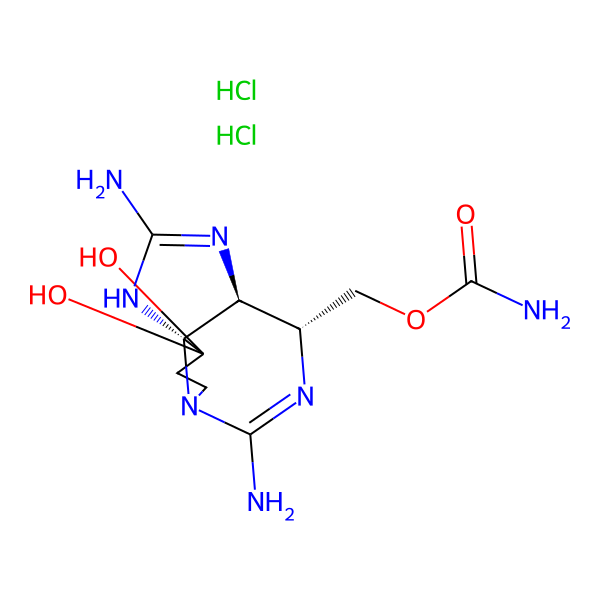
CAS: 35554-08-6; 1H,10H-Pyrrolo[1,2-C]Purine-10,10-Diol,2,6-Diamino-4-[[(Aminocarbonyl)Oxy]Methyl]-3A,4,8,9-Tetrahydro-, Hydrochloride(1:2), (3As,4R,10As)-
该化合物是某些二氧化旗菌种,特别是五氯硝基苯甲醚中的二氢氯化物,是一种强大的...
- 英文名称1H,10H-Pyrrolo[1,2-C]Purine-10,10-Diol,2,6-Diamino-4-[[(Aminocarbonyl)Oxy]Methyl]-3A,4,8,9-Tetrahydro-, Hydrochloride(1:2), (3As,4R,10As)-
- 中文名称1H,10H-B[1,2-C]嘌呤-10,10-二醇,2,6-二氨基-4-[[(氨基羰基)氧基]甲基]-3A,4,8,9-四氢-,胺盐酸盐(1:2),(3AS,4R,10AS)-
- IUPAC名称[(3aS,4R,10aS)-2,6-diamino-10,10-dihydroxy-3a,4,8,9-tetrahydro-1H-pyrrolo[1,2-c]purin-4-yl]methyl carbamate;dihydrochloride
- CAS编号35554-08-6
- EINECS号:808-963-6
- FDA UNII编号:VKS19V6FQN
- 分子式:C10H19Cl2N7O4分子量:371.087555
- 产品CID: 2252780
- 产品分类Biological Agents → Seafood Toxins

物理性质
MSDS等安全信息
- GHS象形图

- GHS符号GHS06;
注释: Skull and crossbones - 危险类别急性毒性 类别1(经口)
- 警示词Danger(危险)
- 危险描述H300 |吞咽致命.
- 防范说明P264, P270, P301+P316, P321, P330, P405, and P501
- 安全声明IDENTIFICATION AND USE: Saxitoxin dihydrochloride (STX) is a white solid. Saxitoxin and its derivatives, collectively referred to as paralytic shellfish toxins (PSTs), are unique among neurotoxins in that they are found in both marine and freshwater environments. Prokaryotic cyanobacteria are responsible for PST production in freshwater systems, while eukaryotic dinoflagellates are the main producers in marine waters. Bioaccumulation by filter-feeding bivalves and fish and subsequent transfer through the food web results in the potentially fatal human illnesses, paralytic shellfish poisoning and saxitoxin pufferfish poisoning. It is used as a tool in neurochemical research. STX is listed in schedule 1 of the Chemical Weapons Convention. HUMAN STUDIES: Exposure to saxitoxin most commonly occurs following ingestion of certain fish that contain it in their tissues. Ingestion of saxitoxin can cause numbness of the oral mucosa as quickly as 30 minutes after exposure. In severe poisoning, illness typically progresses rapidly and may include gastrointestinal (nausea, vomiting) and neurological (cranial nerve dysfunction, a floating sensation, headache, muscle weakness, paresthesias and vertigo) signs and symptoms. Respiratory failure and death can occur from paralysis. Much is known about the toxin sources, primarily certain dinoflagellate species, and there is extensive information on toxin transfer to traditional vectors - filter-feeding molluscan bivalves. Non-traditional vectors, such as puffer fish and lobster, may also pose a risk. ANIMAL STUDIES: In rats sublethal dose of STX administered intraperitoneally results in an acute alteration of dopamine (DA) production and its metabolite 3,4-dihydroxyphenylacetic acid (DOPAC). In rats after systemic administration of the STX, it reaches the brain producing alterations in neurotransmission increasing the levels of serotonin. ECOTOXICITY STUDIES: STX produced by toxic dinoflagellates enter the cytoplasm and induce apoptosis of oyster immune cells through a caspase-dependent pathway. STX disturbed the normal growth of medaka embryos probably by affecting the metabolic rate in the exposed medaka embryos. Fish detect extremely low levels of STX via the specialized gustatory receptor(s). Physiological and pharmacological studies show that receptor(s) for STX are distinct from those which detect feeding stimulant amino acids and bile acids.
- 危险类别码Highly toxic by ingestion; Stable at normal cooking temperatures; Causes paralytic shellfish poisoning; [HSDB] Onset of action is within 30 minutes after ingestion. [Olson, p. 247] Oral LD50 (mouse) = 263 ug/kg; [RTECS] Humans are poisoned after eating shellfish that have eaten saxitoxin-producing algae. Initial symptoms are nausea/vomiting, paresthesias, and sometimes diarrhea. In severe cases symptoms may include difficulty breathing, swallowing, and talking as well as incoordination, weakness, paralysis, respiratory failure, heart failure, shock, and rhabdomyolysis. [Weinstein, p. 94] The disease is associated with eating scallops, mussels, clams, and cockles. Patient may need respiratory support. The duration of illness is in days. [MMWR. Vol. 53/RR-4]
欧盟法规
C&L通报合成工艺路线路线简述
海关参考信息
- 2905122000-异丙醇
2912110000-甲醛
2915110000-甲酸
2921211000-乙二胺 - 💡 提示:海关信息按照顺序优先匹配,如需确认的海关信息,请参考相关资料。
- 详情请参考:📖 海关编码查询和海关进出口税则
供应商参考报价(招募中)
品牌试剂参考报价(招募中)
📌 第三方产品分析报告
合成参考文献
摘要:Archivos de la Facultad de Medicina de Madrid., 8(151), 1965
摘要:Venomous and Poisonous Animals and Noxious Plants of the Pacific Region, Keegan, H.L., and W.V. Macfarlane, eds., New York, Pergamon Press Inc., 1963, -(75), 1963
摘要:
摘要:
摘要:



📝 需求与反馈
尽可能描述清楚需求与问题信息