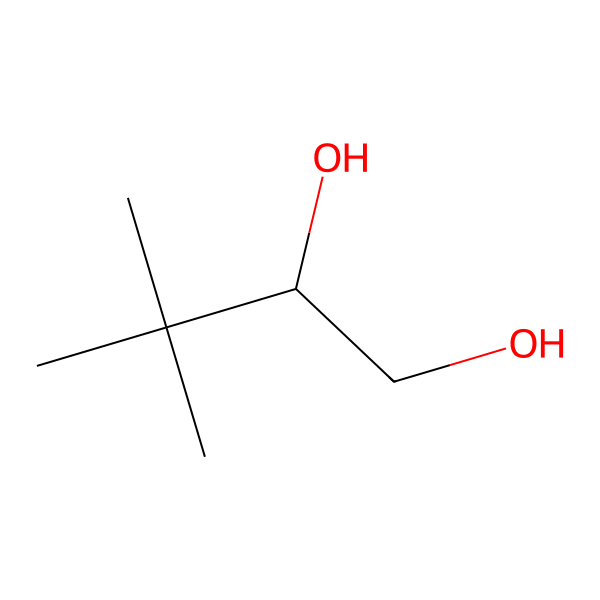
CAS: 59562-82-2; 3,3-Dimethyl-1,2-Butanediol
该化合物其结构特征为该化合物其结构特征为:丁烷主干骨上的两个羟基(-OH)组,在第三碳时又用两个甲基组替代;该化合物在室温上是一种无色的粘性液体,可溶于水中,因为存在可形成氢结质的羟基组;该化合物具有二醇的典型特性,包括作为溶剂和有机合成的潜在中间体的能力;多种甲基组的存在助长了其疏水性,影响其物理特性,如沸点和粘度. 3,3-二甲基-1,2-丁二醇被用于各种用途,包括作为化学中间体,用于其他化合物的生产以及需要特定粘度和溶性特性的配方;在处理和接触准则方面,应当参考安全数据,如任何化学物质一样.
- 英文名称3,3-Dimethyl-1,2-Butanediol
- 中文名称3,3-二甲基-1,2-丁二醇
- IUPAC名称3,3-dimethylbutane-1,2-diol
- 其它别名1-Tert-Butyl-1,2-Ethanediol; 3,3-Dimethyl-1,2-Butanediol,88%; 3,3-Dimethylbutane-1,2-Diol; 3,3-Dimethyl-1,2-Butanediol, Tech., 85+%; 3,3-Dimethyl-1,2-Butanediol, Gc 85%; 3,3-Dimethyl-1,2-Butanediol: Tech., ; 3,3-Dimethyl-1,2-Butanediol 88%; 3,3-Dimethyl-1,2-Butanediol
- CAS编号59562-82-2
- MFCD编号:MFCD00010735
- EINECS号:261-805-2
- 分子式:C6H14O2分子量:118.18
- 产品CID: 1572410
- 产品分类化学试剂 → 有机试剂 → 脂肪醇
物理性质
上下游产品
CAS号558-37-2 3,3-二甲基-1-丁烯 | CAS号2245-30-9 3,3-二甲基-1,2-环氧丁烷 | CAS号42282-48-4 (+/-)-ethyl 2-h... | CAS号916669-86-8 1,3,2-Benzodiox... | CAS号18511-56-3 (3,3-Dimethylox... | CAS号75-24-1 三甲基铝 | CAS号2855-08-5 3,3-二甲基-1-氯丁烷 | CAS号27490-33-1 (三丁基锡)甲醇 | CAS号630-19-3 三甲基乙醛 | CAS号18503-48-5 2-tert-butylqui... | CAS号630-19-3 三甲基乙醛 | CAS号75-98-9 三甲基乙酸 | CAS号128495-75-0 3,3-dimethyl-2-... | CAS号4026-20-4 2-羟基-3,3-二甲基丁酸 | CAS号52685-34-4 ethyl 2-cyano-4...合成工艺路线路线简述
📜3,3-二甲基-1-丁烯置于四氧化锇,N-甲基吗啉氧化物体系中,化学反应生成 3,3-二甲基-1,2-丁二醇
参考文献:铂催化末端烯烃与 B2(Pin)2 的对映选择性二硼化
标题:铂催化末端烯烃与 B2(Pin)2 的对映选择性二硼化
摘要:描述了 Pt 催化的双(频哪醇)二硼对简单单取代烯烃的对映选择性加成.该反应在容易获得的手性亚膦酸酯配体存在下发生,并且对多种末端烯烃底物有效.重要的是,该反应可以在催化剂负载仅为 1 Mol% Pt 的情况下进行.虽然中间体 1,2-双(硼酸酯)酯的氧化提供手性 1,2-二醇作为反应产物,但中间体也可进行同系化/氧化以提供手性 1,4-二醇作为反应产物.
DOI:10.1021/ja9047762
海关参考信息
- 2905122000-异丙醇
2905310000-1,2-乙二醇
2905320000-1,2-丙二醇
2905141000-异丁醇 - 💡 提示:海关信息按照顺序优先匹配,如需确认的海关信息,请参考相关资料。
- 详情请参考:📖 海关编码查询和海关进出口税则
专利信息
专利号:US-2020237918-A1
优先权日:2012-06-15
标 题 :Linear Polyester and Semi-Linear Glycidol Polymer Systems: Formulation and Synthesis of Novel Monomers and Macromolecular Structures
专利号:WO-9855085-A1
优先权日:1997-06-04
标题:Pharmaceutical compositions and methods
发明人:BROWN DAVID A; KHORLIN ALEXANDER A; LESIAK KRYSTYNA; REN WU YUN
权利人:CODON PHARMACEUTICALS INC; BROWN DAVID A; KHORLIN ALEXANDER A; LESIAK KRYSTYNA; REN WU YUN
摘要:Disclosed are methods and compositions for regulating the melanin content of mammalian melanocytes; regulating pigmentation in mammalian skin, hair, wool or fur; treating or preventing various skin and proliferative disorders; increasing the differentiation of mammalian neuronal cells for purposes of treating neurodegenerative diseases or nerve damage; and stimulating cellular nitric oxide (NO) synthesis, cyclic guanosine monophosphate levels (cGMP), and protein kinase G (PKG) activity for purposes of treating diseases mediated by deficiencies in the NO/cGMP/PKG signal transduction pathway; by administration of various compounds, including alcohols, diols and/or triols and their analogues.
供应商参考报价(招募中)
品牌试剂参考报价(招募中)
📌 第三方产品分析报告
合成参考文献
摘要:Shcherbakova, I., Science of Synthesis, (2007) 31, 802.



📝 需求与反馈
尽可能描述清楚需求与问题信息