CAS: 2467-25-6; 4,4'-Methylenebis(2-Methylphenol)
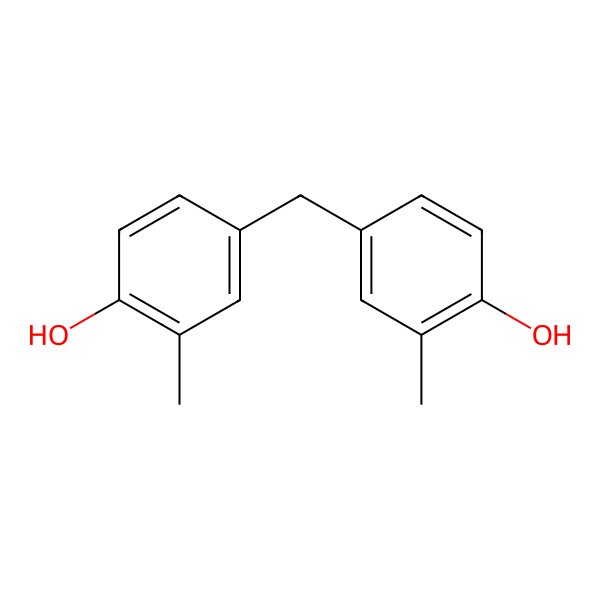
该化合物其结构特征为2-甲基苯酚组,由甲苯桥连接,该化合物一般在室温时是固体,在有机溶剂中可溶解,具有苯基特性,有助于其在各个领域的潜在应用,包括在塑料和聚合物中作为抗氧化剂或稳定剂的用途;芳香环上存在甲基组,加强了其疏水特性,并可能影响其再活性和与其他物质的相互作用;此外,该化合物可能具有中度毒性,需要小心处理和使用期间采取适当的安全措施;其化学行为可能受到温度和pH等因素的影响,因此有必要将这些因素纳入实际应用中加以考虑.
- 英文名称4,4'-Methylenebis(2-Methylphenol)
- 中文名称4,4'-亚甲基双(2-甲基苯酚)
- IUPAC名称4,4'-methylenebis(2-methylphenol)
- 其它别名4,4'-亚甲基双(2-甲基苯酚); Phenol, 4,4'-Methylenebis[2-Methyl-
- CAS编号2467-25-6
- MFCD编号:MFCD08276400
- EINECS号:607-415-1
- 分子式:C15H16O2分子量:228.29
- 产品CID: 1195862
- 产品分类有机原料→分子砌块→芳环类化合物→苯类化合物
物理性质
MSDS等安全信息

欧盟法规
ECHA物质C&L通报上下游产品
CAS号50-00-0 甲醛 | CAS号95-48-7 邻甲酚 | CAS号87-64-9 2-氯-6-甲酚 | CAS号58077-66-0 4,4'-methyleneb... | CAS号95-53-4 邻甲苯胺 | CAS号838-88-0 3.3'-二甲基-4.4'二氨基二苯甲烷 | CAS号636-21-5 邻甲苯胺盐酸盐 | CAS号7647-01-0 盐酸 | CAS号64-17-5 乙醇 | CAS号527-60-6 2,4,6-三甲酚 | CAS号95-48-7 邻甲酚 | CAS号247172-40-3 5-[(3-formyl-4-... | CAS号6641-13-0 4-[[4-hydroxy-3... | CAS号50-00-0 甲醛 | CAS号621-66-9 Phenol,2-methyl...合成工艺路线路线简述
📜双(2-甲基苯基氨基)甲烷 反应生成4,4'-亚甲基双(2-甲基苯酚)
参考文献:The Political Role Of The Internet In Societies In Transition: Russia And Ukraine Compared
标题:The Political Role Of The Internet In Societies In Transition: Russia And Ukraine Compared
摘要:Our Research Investigates The Opportunities Provided By The Internet For Political Parties To Communicate To The Electorate,And The Extent To Which Party Websites Are Used Versus Other Information Sources On The Web. We Find That Parties In Parliament,Major Parties And Newly Created Parties Are More Prominent Online Than Others,And,Based On Standard Quality Indicators,That Parliamentary Parties And New Parties Have Better Quality Websites. This Confirms Some Of The Findings Concerning Parties Online In Established Democracies. On Comparing Party With News Websites,However,We Find That Sites Of Online-Only Newspapers Are The Most Popular; That Online Versions Of Offline News Outlets Are Of Secondary Importance,In Contrast To What Has Been Found In Established Democracies; And That Party And Politician Websites Are Of Least Importance To Users,Based On The Number Of Hits To These Websites. The Political Role Of The Internet In Russia And Ukraine Is Discussed In Conclusion.
Doi:10.1177/1354068803009001720
海关参考信息
- 2902300000-甲苯
2907121100-间甲酚
2908199090-其他酚的卤化衍生物
2908999090-其他酚的硝化衍生物 - 💡 提示:海关信息按照顺序优先匹配,如需确认的海关信息,请参考相关资料。
- 详情请参考:📖 海关编码查询和海关进出口税则
专利信息
专利号:EP-0821042-A3
优先权日:1996-07-26
标 题:Elastic auto-crosslinking binder for coating of cans and sheets, its production and use
发明人:NEUMANN UWE DR; OBERRESSL PAUL
权利人:HOECHST AG
摘要:(1) Synthese eines Polyesters (A1) mit freien Säuregruppen aus mehrbasigen Carbonsäurenn(A11) ausgewählt aus aliphatischen Polycarbonsäuren (A111) und aromatischen Polycarbonsäurenn(A112) und Polyolen (A12), und (2) Umsetzen des Polyesters (A1) mit einem Epoxidharz (A2), nwobei die Stoffmenge der Epoxidgruppen in (A2) größer ist als die Stoffmenge der Carboxylgruppennin (A1), und der Polyester (B) wie der Polyester (A1) aus mehrbasigen Carbonsäurenn(A11) ausgewählt aus aliphatischen Polycarbonsäuren (A111) und aromatischen Polycarbonsäurenn(A112) und aliphatischen Polyolen (A12) durch Polykondensation hergestellt wird.Elastic, self-crosslinking binder, obtainable by mixing a polyester-modified epoxy resin (A) and an acid group-containing polyester (B), the epoxy resin (A) being produced in two steps (1) Synthesis of a polyester (A1) with free acid groups from polybasic carboxylic acids (A11) selected from aliphatic polycarboxylic acids (A111) and aromatic polycarboxylic acids (A112) and polyols (A12), and (2) reacting the polyester (A1) with an epoxy resin (A2), wherein the amount of the epoxy groups in (A2) is greater than the amount of the carboxyl groups in (A1), and the polyester (B) and the polyester (A1) from polybasic carboxylic acids (A11) selected from aliphatic polycarboxylic acids (A111) and aromatic polycarboxylic acids ( A112) and aliphatic polyols (A12) is produced by polycondensation.
专利号:US-8309655-B2
优先权日:2009-12-22
标题 :Methods for the preparation of a poly(arylene ether) polysiloxane multiblock copolymer, multiblock copolymers produced thereby, and associated compositions and articles
发明人:KAMALAKARAN RADHA; SRINIVASAN VEERARAGHAVAN; CHOWDHURY RAJESH; KARAMBELKAR VIVEK VASANT
权利人:KAMALAKARAN RADHA; SRINIVASAN VEERARAGHAVAN; CHOWDHURY RAJESH; KARAMBELKAR VIVEK VASANT; SABIC INNOVATIVE PLASTICS IP
摘要:A poly(arylene ether)-polysiloxane multiblock copolymer is prepared by the reaction of a hydroxy-diterminated poly(arylene ether), a hydroxyaryl-diterminated polysiloxane, and an aromatic diacid chloride. This synthesis overcomes disadvantages of known syntheses of poly(arylene ether)-polysiloxane block copolymers. The poly(arylene ether)-polysiloxane multiblock copolymer is useful for improving the melt processability of poly(arylene ether) compositions.
供应商参考报价(招募中)
品牌试剂参考报价(招募中)
📌 第三方产品分析报告
合成参考文献
参考文献:10.1055/s-0041-1737752
摘要:Oxidation of Alcohols and Aerobic Oxidative Synthesis of Benzoxazoles on TEMPO-Functionalized FDU-15. Synfacts. 2022 Jan 18;18(02):0187. doi: 10.1055/s-0041-1737752.



📝 需求与反馈
尽可能描述清楚需求与问题信息