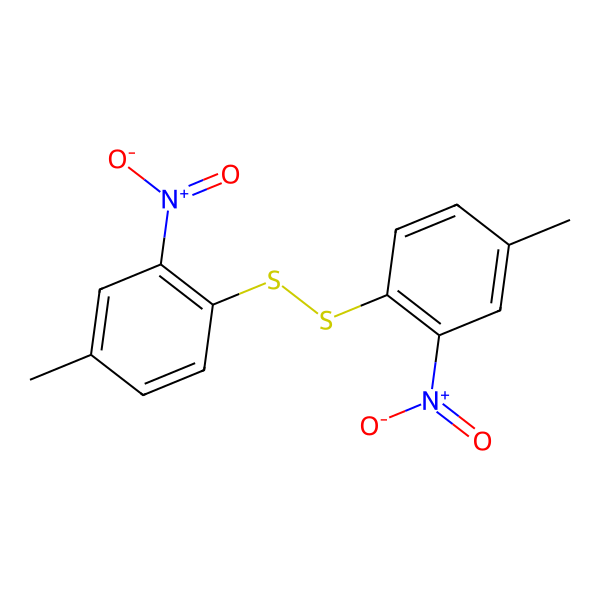
CAS: 35350-31-3; 4-Methyl-1-[(4-Methyl-2-Nitrophenyl)Disulfanyl]-2-Nitrobenzene
该化合物其结构特征为将两个硝基苯集团连接在一起的脱硫桥,具有独特的回活动性和潜在效用,用于有机合成和材料科学应用;电排硝基联组的存在,增强了其作为电益替代反应的中间体或功能化芳香系统的前体的适合性;甲基亚基苯有助于消毒和电子调节,影响溶性与稳定性;该化合物还可作为脱硫联结反应或再氧化工艺研究的示范子体;由于硝基芳烃系统的潜在敏感性,建议谨慎处理.
- 英文名称4-Methyl-1-[(4-Methyl-2-Nitrophenyl)Disulfanyl]-2-Nitrobenzene
- 中文名称4-甲基-1-[(4-甲基-2-硝基苯基)二硫烷基]-2-硝基苯
- IUPAC名称4-methyl-1-[(4-methyl-2-nitrophenyl)disulfanyl]-2-nitrobenzene
- 其它别名2-硝基对甲苯基二硫化物; Disulfide, Bis(4-Methyl-2-Nitrophenyl)
- CAS编号35350-31-3
- MFCD编号:MFCD00087053
- EINECS号:627-611-0
- FDA UNII编号:1S4PDJ3TV9
- 分子式:C14H12N2O4S2分子量:336.39
- 产品CID: 1360890
- 产品分类有机原料→分子砌块→芳环类化合物→苯类化合物
物理性质
MSDS等安全信息

欧盟法规
ECHA物质C&L通报上下游产品
methanol 2-nitro-4-toluenylsulfenyl chloride 4-methyl-2-nitrobenzenethiol 3-nitro-4-thi°Cyanatotoluene 4-methyl-2-nitrobenzenethiol 5-methylbenzo[d]thiazole 2,5-dimethylbenzothiazole 5-methyl-1,2,3-benzothiadiazole合成工艺路线路线简述
- 合成目标产物 2-Nitro-P-Tolyl Disulfide 主要起始原料 4-Chloro-3-Nitrotoluene
- (文献来源)合成步骤主要原料 4-Chloro-3-Nitrotoluene
📜硫氰酸4-甲基-2-硝基苯基酯置于alkaline Solution体系中,化学反应生成2-硝基对甲苯基二硫化物
参考文献:Bogert; Allen,Journal Of The American Chemical Society,1927,Vol. 49,P. 1320
标题:Bogert; Allen,Journal Of The American Chemical Society,1927,Vol. 49,P. 1320
海关参考信息
- 2902300000-甲苯
- 💡 提示:海关信息按照顺序优先匹配,如需确认的海关信息,请参考相关资料。
- 详情请参考:📖 海关编码查询和海关进出口税则
专利信息
专利号:US-3759935-A
优先权日:1969-11-03
标题 :Azoles method for the preparation of 2-alkyl substituted thiazoles and selen
发明人:DE CAT A; MANSSENS L
权利人:AGFA GEVAERT NV
摘要:WHEREIN: Alk stands for C1-C5 alkyl for example methyl and ethyl, X stands for sulphur or selenium, Y stands for nitro or amino, Z1 stands for the atoms necessary to complete a benzene or naphthalene ring including a substituted benzene or naphthalene ring for instance substituted by alkyl including substituted alkyl for example methyl, ethyl, trifluoromethyl, acyloxymethyl, and hydroxymethyl, alkenyl for example allyl, aryl including substituted aryl, halogen such as chlorine, alkyloxy, alkylthio, alkylsulphonyl, haloalkyloxy, haloalkylthio, haloalkylsulphonyl, carboxy, sulpho, amino, (di)alkylamino, acylamino, nitro, alkoxycarbonyl, etc., and Z2 stands for the atoms necessary to complete a benzene or naphthalene ring optIonally carrying substituents, which are either identical to the substituents present in Z1 or are derived forms thereof converted under the reaction conditions of the invention such as amino where Z1 carries nitro, acetyloxymethyl where Z1 carries hydroxymethyl, propyl where Z1 carries allyl, etc. Under the reaction conditions of the invention it would be possible to prepare the benzothiozoles starting from 2nitrothiophenols instead of using bis(2nitrophenyl)disulphides; however, 2-nitrothiophenols as compared with bis(2-nitrophenyl)-disulphides disulphides are difficult to prepare. The method of the present invention comprises more especially the steps of admixing an aromatic disulphide or diselenide carrying in the 2-positions relative to the disulphide or diselenide group nitro groups or amino groups with an aliphatic carboxylic anhydride and a catalytic amount of a rhenium sulphide, charging the reaction vessel with a sufficient hydrogen pressure, heating the reaction mixture to a temperature at which hydrogen is readily absorbed until absorption of hydrogen ceases, cooling the reaction mixture to a temperature below the boiling temperature of the aliphatic carboxylic acid formed, filtering off the rhenium sulphide catalyst and isolating the 2-alkyl heterocyclic base formed from the filtrate by any suitable means e.g., by concentrating the filtrate by evaporation if necessary under rpduced pressure and filtering off the precipitate formed or distilling the residue. The rhenium sulphide catalyst is generally used in amounts comprised between 0.25 g and 10 g, preferably from 1 g to 5 g per mole of disulphide or diselenide compound. The amount of aliphatic carboxylic anhydride used may vary between wide limits. The most effective amount can easily be determined by some simple tests. The required minimum theoretical amount depends on whether there is stated from a 2,2''-dinitro aromatic disulphide or diselenide or from a 2,2''-diaminoaromatic disulphide or diselenide and from the optional presence of further nitro and amino groups. The minimum amount of aliphatic carboxylic anhydride is 3 moles of anhydride per nitro group present and 2 moles of anhydride per amino group present. Solubility considerations may necessitate the use of larger amounts and also supplemental amounts may be required to convert other groups present in the starting material. Indeed, the 2,2''-dinitro (or 2,2''-diamino)phenyl (or naphthyl) disulphide or diselenide might comprise in addition to the 2,2''dinitro (or diamino) groups, groups known to those skilled in the art of preparative organic chemistry to undergo alteration under the reaction conditions of the method of the invention either by reaction with the carboxylic anhydride used or by being itself hydrogenated so that the resulting thiazole or selenazole compounds comprise in the fused-on aromatic ring substituents of a nature different from those of the starting materials. For instance when the 2,2''-dinitro (or 2,2''-diamino)phenyl (or naphthyl) disulphide or diselenide comprises further nitro or amino groups, the heterocyclic base formed will carry an acyl amino group, by reaction of the amino or reduced nitro group with the aliphatic acarboxylic anhydride; as known by those skilled in the art of preparative organic chemistry the acyl amino group can be converted into amino by boiling with hydrochloric acid. In the same way, substituents in the starting products carrying hydroxyl groups such as hydroxymethyl, will also react with the carboxylic anhydride to form ester groups; as is illustrated hereinafter it is possible to hydrolyse the ester group formed by treating the reaction mixture afterwards with hydrochloric acid so that the hydroxyl group is formed again. The exact working conditions of the method oF the invention are of course dependent on the nature of the starting material used and the optimum combination of temperature, pressure, amount of catalyst used and the reaction time. A hydrogen pressure of 1,000 to 1,500 psi generally suffices to obtain fast hydrogenation rates at temperatures comprised between 100 and 175* C. In many cases the hydrogen is readily absorbed at temperatures of 130140* C. Once the absorption of hydrogen ceases, the reaction mixture is cooled below the boiling temperature of the lower aliphatic carboxylic acid formed. The rhenium sulphide of use according to the present invention can be prepared by methods well known to those skilled in the art and described in literature. For instance rhenium(VII) sulphide can be prepared as described in J1.Am.Chem.Soc. 76, 151923(1954). The following preparations illustrate the method of the present invention. A method of preparing 2-alkylthiazoles or 2-alkylselenazoles is described wherein an aromatic disulphide or diselenide having amino groups or nitro groups in the 2-positions relative to the disulphide or diselenide group is catalytically hydrogenated using a rhenium sulphide as catalyst in the presence of an aliphatic carboxylic anhydride. The method is a one-step synthesis and high yields of 2-alkyl thiazoles or selenazoles are obtained having a high degree of purity. The present invention relates to a new method for the preparation of a 2-alkyl substituted thiazoles or selenazoles with fused-on aromatic group. As is known 2-alkyl-benzothiazoles, 2-alkyl-naphthothiazoles, 2alkyl-benzoselenazoles and 2-alkylnaphthoselenazoles are important heterocyclic bases for use in the preparation of methine dyes (see e.g., F.M. Hamer ''''The Cyanine Dyes and related compounds'''' Interscience Publishers 1964, New-York/London, and P.Glafkides, Photographic Chemistry, Vol. II, Chapter XXXVI, Fountain press, London), which are used amongst others as spectrally sensitizing agents for photosensitive systems such as photographic silver halide material and electrophotographic material. It has now been that 2-alkyl substituted thiazoles or selenazoles having a fused-on 6-carbon mononuclear or 10-carbon dinuclear aromatic ring can be prepared by catalytic hydrogenation under pressure of an aromatic disulphide or diselenide comprising in the 2-positions relative to the disulphide or diselenide group, amino groups or nitro groups, said hydrogenation taking place in the presence of an aliphatic carboxylic anhydride using as catalyst a rhenium sulphide, more particularly rhenium(VII)sulphide. The said aliphatic carboxylic anhydride may serve also as the reaction medium. The general one step synthesis of 2-alkyl substituted thiazoles or selenazoles having a fused-on 6-carbon mononulcear or 10carbon dinuclear aromatic ring according to the present invention is time-saving and gives high yields with a high degree of purity. Moreover, the method of the invention can be carried out very easily, even on an industrial scale without giving rise to technological difficulties. The rhenium sulphide used according to the present invention is not poisoned by the sulphur-containing starting products used in the method of the invention and cause no fission of the carbonsulphur bond, while being resistant to carboxylic anhydrides. The method of the invention can be represented by the following reaction scheme:
供应商参考报价(招募中)
品牌试剂参考报价(招募中)
📌 第三方产品分析报告
主要参考文献
参考标题:One-Pot Synthesis Of Functionalized β-Amino Sulfides/β-Amino Selenides Via Ring Opening Of Cyclic Sulfamidates作者:Cheerladinne Venkateswarlu,Bandita Datta,Srinivasan Chandrasekaran
摘要:A Number Of Functionalized β-Amino And γ-Amino Sulfides And Selenides Have Been Synthesized Involving A One-Pot Process Of Ring Opening Of Cyclic Sulfamidates With 'In Situ' Generated Thiolate And Selenoate Species From Diaryl Disulfides And Diphenyl Diselenide Using Rongalite. A Mild And Efficient Method Has Been Developed For The Synthesis Of Cysteines From Serine.
合成参考文献
参考文献:10.1021/jm960375o
摘要:Rice WG, Turpin JA, Schaeffer CA, Graham L, Clanton D, Buckheit RW, Zaharevitz D, Summers MF, Wallqvist A, Covell DG. Evaluation of selected chemotypes in coupled cellular and molecular target-based screens identifies novel HIV-1 zinc finger inhibitors. J Med Chem. 1996 Sep 13;39(19):3606–16. doi: 10.1021/jm960375o.



📝 需求与反馈
尽可能描述清楚需求与问题信息