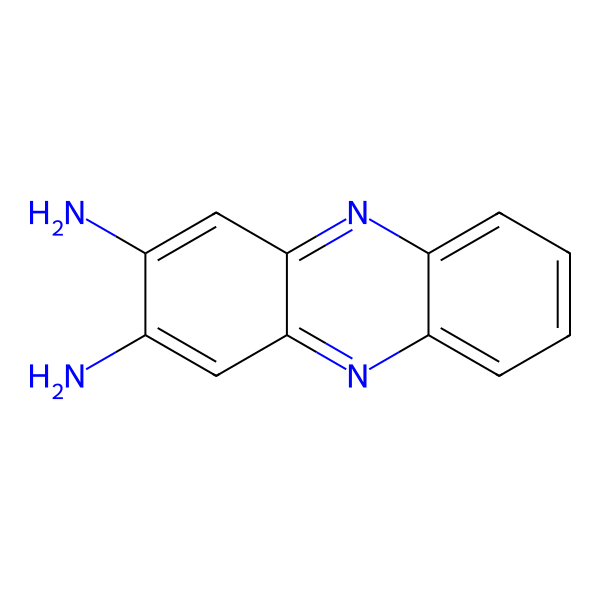
CAS: 655-86-7; Phenazine-2,3-Diamine
该化合物是一种环环芳化合物,其特点是2和3个位置的麻黄碱核心,并配有氨基替代成分,这种二胺衍生物因其作为有机合成的多用途中间体的作用而受到重视,特别是在制备染料,颜料和协合综合体方面,其电子富集结构和双功能再活动使其适合于建造同系系统和相带金属离子.该化合物在受控条件下表现出稳定性,并经常用于涉及红氧化活性材料或荧光探测器的研究应用中.建议谨慎处理,因为有可能对光和氧化具有敏感性.其纯度和一贯性能对于合成工作流程的再生结果至关重要.
- 英文名称Phenazine-2,3-Diamine
- 中文名称2,3-二氨基吩嗪
- IUPAC名称phenazine-2,3-diamine
- 其它别名Phenazine,2,3-diamino- (6CI,7CI,8CI); 2,3-Diaminophenazine
- CAS编号655-86-7
- MFCD编号:MFCD00160693
- EINECS号:211-512-0
- FDA UNII编号:0B20H27U1Y
- 分子式:C12H10N4
- 分子量:210.23
- 产品CID: 1637722
- 产品分类有机原料 → 氨基化合物

物理性质
MSDS等安全信息
- GHS象形图

- GHS符号GHS07;
注释: Exclamation mark - 危险类别急性毒性 类别4(经口)
特定目标器官毒性 - 单次接触 类别3
皮肤腐蚀/刺激 类别2
严重眼刺激 类别2
急性毒性 类别4(吸入)
急性毒性 类别4(经皮) - 警示词Warning(警告)
- 危险描述H302 |吞咽有害.
H335 |可能引起呼吸道刺激.
H315 |造成皮肤刺激.
H319 |造成严重眼刺激.
H332 |吸入有害.
H312 |皮肤接触有害. - 防范说明P261-P264-P270-P301+P312-P302+P352-P305+P351+P338
- 危险等级IRRITANT
- UN编号NONH for all modes of transport
- 危险品标志Xn,Xi
- 安全声明26-36/37
- 危险类别码22-36/37/38
- WGK Germany3
欧盟法规
ECHA物质C&L通报REACH预注册上下游产品
CAS号95-54-5 邻苯二胺(OPD) | CAS号619-05-6 3,4-二氨基苯甲酸 | CAS号4153-06-4 (4-chloro-2-nit... | CAS号603-81-6 2,3-二氨基苯甲酸 | CAS号89-41-8 4-甲氧基-3-硝基苯甲酸 | CAS号1588-83-6 4-氨基-3-硝基苯甲酸 | CAS号480-96-6 苯并氧化呋咱 | CAS号1516-58-1 1-叠氮基-2-硝基苯 | CAS号39145-59-0 benzene-o-diami... | CAS号60-09-3 4-阿基苯甲酯 | CAS号258-00-4 pyrazino[2,3-b]... | CAS号92-82-0 吩嗪 | CAS号2876-23-5 2-Phenazinamine | CAS号531-47-5 5,12-二氢-5,7,12,... | CAS号43193-60-8 吡嗪四羧酸合成工艺路线路线简述
- 合成目标产物 2,3-Diaminophenazine 主要起始原料 O-Phenylenediamine
- (文献来源)合成步骤主要原料 O-Phenylenediamine
O-Phenylenediamine Dihydrochloride置于双氧水,4-羟乙基哌嗪乙磺酸体系中,用 水 作为反应溶剂,化学反应生成 2,3-二氨基吩嗪
参考文献:使用具有氧化催化活性的铜掺杂沸石咪唑框架-8纳米晶体进行癌细胞成像
标题:使用具有氧化催化活性的铜掺杂沸石咪唑框架-8纳米晶体进行癌细胞成像
摘要:制备了铜掺杂的咪唑骨架-8(cu / Zif-8),并检查了其过氧化物酶样的氧化催化活性,并证明了其在癌细胞成像中的适用性.通过在室温下简单的溶液化学反应,制得了cu / Zif-8纳米晶体,该晶体在H2O 2存在下催化氧化邻苯二胺的有机底物.与过氧化物酶类似,Cu / Zif-8纳米晶体通过乒乓机制氧化了底物,活化能为59.2 Kj Mol-1.掺杂的铜原子充当了活性位点,预计在催化过程中会反应生成活性铜中间体,而未掺杂的zif-8则没有任何氧化活性.cu / Zif-8纳米晶体具有低细胞毒性,并通过与癌细胞中各种活性氧之间的H2O 2相互作用而显示出催化活性.这种体外的氧化活性通过利用邻苯二胺的氧化产物发出的光致发光而使癌细胞成像,而在没有cu / Zif-8纳米晶体的情况下这是微不足道的.这项研究的结果表明,Cu / Zif-8纳米晶体是用于分析微生物系统的有前途的催化剂.
DOI:10.1002/asia.201800749
专利信息
专利号:WO-2023199355-A1
优先权日:2022-04-12
标题 :A method for synthesis of nano plant nutrients
发明人:URVI RAJESH DEDHIA; PANDHARINATH BANSODE UMESH; MAHADEO GOLE ANAND
权利人:COROMANDEL INTERNATIONAL LTD
摘要:The present invention relates to a method for synthesis of nano plant nutrients and compositions thereof. More particularly, the present invention relates to method for synthesis of nano- plant nutrient composition comprising plant nutrient and natural polymers like chitosan for improving the bioavailability of macro and micronutrients to plants.
专利号:WO-2024236596-A1
优先权日:2023-05-15
标 题 :A process of synthesis of nano dap plant nutrient
发明人:DOSHI SIDDHARTH; DR MANKAD MOUNIL
权利人:A RAY NANO SCIENCE AND RESERCH CENTRE LLP
摘要:The present invention relates to the novel manufacturing process of nanostructured diammonium phosphate (DAP) composite plant nutrients and/or biomolecules using natural and/or synthetic polymers as an encapsulating agent More particularly, said invention provides novel production of nano DAP and its formulation through the utilization of natural as well as synthetic materials that multifunctionally act as reducing and stabilizing agents for the solubilization of commercially available DAP. Moreover, the present invention facilitates significant improvement of commercially available DAP through novel nano-structured DAP formulations for the growth and stability of plants under normal conditions.
专利号:US-2023407357-A1
优先权日:2022-05-20
标 题 :Biomanufacturing of oligosaccharides and derivatives from simple sugar
发明人:HOEPKER ALEXANDER CHRIS; CORGIE STEPHANE CEDRIC; SAVINO KEITH
权利人:ZYMTRONIX CATALYTIC SYSTEMS INC
摘要:The invention provides methods for glycosylation and preparation of compounds. The compounds include galactosylated, sialylated, fucosylated, and N-acetylglucosaminylated compounds from simple animal-derived, plant-derived, or microbe-derived oligosaccharides and sugars. In certain embodiments, the invention provides trinucleotide-free enzymatic production of oligosaccharides starting from simple sugars that include plant-based sugars. The invention also provides the enzymatic production of fucosylated oligosaccharides and fucosylated antibody-glycan conjugates from common sugars. The production may be a cell-free, one-pot synthesis using enzymes, and in some embodiments, immobilized enzymes. The synthesis is a highly customizable and highly efficient cell-free manufacturing process. In some embodiments, lactose derivatives and human milk oligosaccharides (HMOs) are produced.
专利号:US-2022340949-A1
优先权日:2021-04-16
标 题 :Methods of Isoprenoid Synthesis Using a Genetically Engineered Hydrocarbonoclastic Organism in a Biofilm Bioreactor
发明人:MAGYAR ANDREW P; ONDERKO ELIZABETH
权利人:CAPRA BIOSCIENCES INC
摘要:Described herein are genetically-engineered organisms comprising synthetic operons for the production of isoprenoids, carotenoids, and retinoids, optimized for use in a hydrocarbonoclastic organism, and methods for the synthesis and extraction of isoprenoids in a biofilm bioreactor comprising the genetically-engineered organisms.
专利号:US-2024132927-A1
优先权日:2020-12-02
标 题 :Modular glycan production with immobilized bionanocatalysts
发明人:CORGIE STEPHANE CEDRIC; HOEPKER ALEXANDER CHRIS
权利人:ZYMTRONIX CATALYTIC SYSTEMS INC
摘要:The invention provides modular cell-free de-novo synthesis of glycans with immobilized bionanocatalysts. The invention provides materials, and in particular, magnetic materials, for producing glycans of defined length and sequences using one or more enzymes that are immobilized within bionanocatalysts (BNCs) which in turn are embedded within scaffolds to control the synthesis in batch or continuous processes manufacturing. In some embodiments, the scaffolds are high magnetism and high porosity composite blends of thermoplastics or thermosets comprising magnetic particles that form powders. In some embodiments, Selective Laser Sintering (SLS) is used to design and produce objects via 3D printing by sintering composite magnetic powders. The modular flow cells may be mixed and matched for a highly customizable and highly efficient cell-free manufacturing process. In some embodiments the elementary and system modules provided by the invention are employed. In preferred embodiments, human milk oligosaccharides (HMOs) are produced.
专利号:US-2025243525-A1
优先权日:2022-06-24
标 题 :Biocatalytic manufacture of sugar nucleotides
发明人:HOEPKER ALEXANDER CHRIS; CILA MEGHA; GISKA FABIAN
权利人:ZYMTRONIX CATALYTIC SYSTEMS INC
摘要:The invention provides the production of sugar-nucleotides and the isolation of sugar-nucleotides. In some embodiments the production or isolation are accomplished under acidic conditions. The production is a cell-free synthesis using enzymes, including immobilized enzymes. They may be accomplished using a one-pot reaction protocol. The synthesis may be used as a highly customizable and highly efficient cell-free manufacturing process. In some embodiments, the sugar-nucleotides are used to prepare UDP-Gal, lactose derivatives, and human milk oligosaccharides (HMOs).
网址: http://www.scipharmacn.com
企业联系电话:022-60116533👤
地址:天津市华苑产业园区(环外)海泰发展六道6号海泰绿色产业基地
企业联系电话:022-60116533👤
📞天津科创医药中间体技术生产力促进有限公司 ⚠️参考联系方式
联系人:王经理
电话:022-60116533
手机:13207668525
传真:022-60979672
邮箱:saleskc@scipharmacn.com
通信地址: 天津市华苑产业园区(环外)海泰发展六道6号海泰绿色产业基地
邮编: 300118
电话:022-60116533
手机:13207668525
传真:022-60979672
邮箱:saleskc@scipharmacn.com
通信地址: 天津市华苑产业园区(环外)海泰发展六道6号海泰绿色产业基地
邮编: 300118
🆔 联系时候可告知是从"百琢研"平台获取的信息.
⚠️ 声明: 该企业未认证、未认领,请自行辨别信息的真实性和可靠性。咨询或交易时请注意风险评估与信息核实,百琢研不参与任何交易。企业认领注册入口→
地址:天津市华苑产业园区(环外)海泰发展六道6号海泰绿色产业基地
⚠️ 未注册 · 未认证企业
 备注: 📌 数据来源说明:本展台内容基于各搜索引擎等公开数据整理,仅作展示用途。请用户自行辨别
✉️ 若企业需抹除展台内容或有异议, 请通过页面底部联系方式告知我们,我们会尽快处理。
第 1 / 1 页
供应商参考报价(招募中)
品牌试剂参考报价(招募中)
📌 第三方产品分析报告
合成参考文献
参考文献:10.1021/ac2008465
摘要:Yang X, Wang E. A Nanoparticle Autocatalytic Sensor for Ag+ and Cu2+ Ions in Aqueous Solution with High Sensitivity and Selectivity and Its Application in Test Paper. Anal. Chem. 2011 May 27;83(12):5005–11. doi: 10.1021/ac2008465.
参考文献:10.1038/nchembio.2285
摘要:Elshahawi SI, Cao H, Shaaban KA, Ponomareva LV, Subramanian T, Farman ML, Spielmann HP, Phillips GN, Thorson JS, Singh S. Structure and specificity of a permissive bacterial C-prenyltransferase. Nature Chemical Biology. 2017 Feb 06;13(4):366–8. doi: 10.1038/nchembio.2285.
参考文献:10.2116/analsci.21p267
摘要:Yue J, Wang W, Lv Q, Wang Z, Liu Y, Zhang Q. Bicomponent colorimetric probe based on carbon quantum dots and o-phenylenediamine for sensitive and selective Cu2+ sensing. Anal Sci. 2022 Feb;38(2):323–30. doi: 10.2116/analsci.21p267.
参考文献:10.1016/0165-1218(94)90119-8
摘要:Sarrif AM, Arce GT, Krahn DF, O'Neil RM, Reynolds VL. Evaluation of carbendazim for gene mutations in the Salmonella/Ames plate-incorporation assay: the role of aminophenazine impurities. Mutation Research/Genetic Toxicology. 1994 Apr;321(1-2):43–56. doi: 10.1016/0165-1218(94)90119-8.



📝 需求与反馈
尽可能描述清楚需求与问题信息