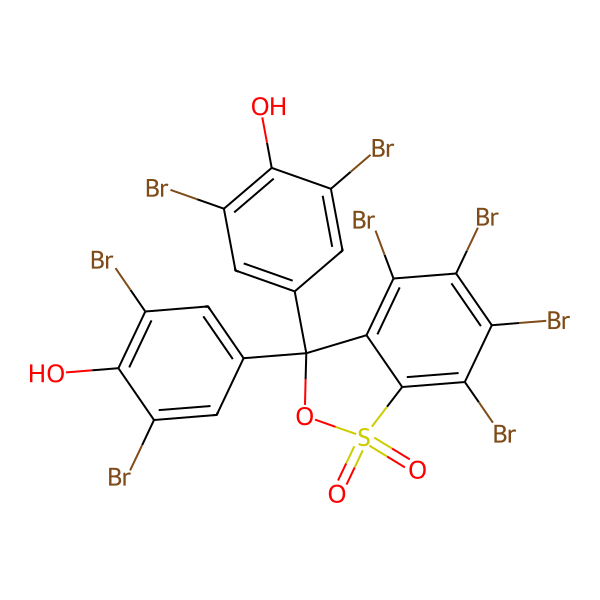
CAS: 4430-25-5; 4,5,6,7-Tetrabromo-3,3-Bis(3,5-Dibromo-4-Hydroxyphenyl)-3H-Benzo[c][1,2]Oxathiole 1,1-Dioxide
该化合物是一种合成染料和pH指标,在各种生化和分析应用中常用,其特点是其充满活力的蓝色颜色,随着pH变异而变化,使pH改变的溶液具有可视化作用;该化合物在水中溶解,显示出一种独特的颜色转变,通常从酸性条件下的黄色到中性环境中的蓝色,到中性环境中的蓝色,到碱性环境中的蓝色;四溴酚蓝色经常用于实验室环境,特别是在电光和凝胶电子磷中的跟踪染料,因为它能够与核糖酸和蛋白迁移;其分子结构包括多个溴原子,有助于其稳定性和颜色特性;此外,必须小心处理这一化合物,因为如果不妥善管理,它可能会对环境和健康造成风险.总的来说,四溴酚蓝色是科学研究和教育中的宝贵工具,有助于对依赖pH的过程进行研究.
- 英文名称4,5,6,7-Tetrabromo-3,3-Bis(3,5-Dibromo-4-Hydroxyphenyl)-3H-Benzo[c][1,2]Oxathiole 1,1-Dioxide
- 中文名称四溴酚蓝
- IUPAC名称4,5,6,7-tetrabromo-3,3-bis(3,5-dibromo-4-hydroxyphenyl)-3H-benzo[c][1,2]oxathiole 1,1-dioxide
- 其它别名四溴苯酚兰; 四溴苯酚四溴磺酞; Tbpb, Ind
- CAS编号4430-25-5
- MFCD编号:MFCD00005876
- EINECS号:224-622-9
- FDA UNII编号:S6FO6931N7
- 分子式:C19H6Br8O5S
- 分子量:985.54
- 产品CID: 1451274
- 产品分类有机原料→通用试剂→有机通用试剂
相似化合物
77172-72-6 115-39-9 76-60-8物理性质
MSDS等安全信息

欧盟法规
欧盟化妆品法规附录三-限用物质清单ECHA物质ECHA物质C&L通报REACH预注册上下游产品
4,5,6,7-Tetrabromo-3,3-Bis-(4-Hydroxy-Phenyl)-3H-Benz[c][1,2]Oxathiol-1,1-Dioxide 77172-72-6合成工艺路线路线简述
3,4,5,6-Tetrabromophenolsulfonephthalein Lithium Salt置于双氧水,溴,溶剂黄146体系中,用 水 作为反应溶剂,以85.3 %的收率获得产物四溴酚蓝
参考文献:Cn116375681
标题:Cn116375681
海关参考信息
- 2902300000-甲苯
2905110000-甲醇
2906210000-苄醇
2904100000-仅含磺基的衍生物及其盐和乙酯 - 💡 提示:海关信息按照顺序优先匹配,如需确认的海关信息,请参考相关资料。
- 详情请参考:📖 海关编码查询和海关进出口税则
专利信息
专利号:US-7301049-B2
优先权日:2001-06-21
标 题:Photolabile esters and their uses
发明人:SERAFINOWSKI PAWEL JERZY; GARLAND PETER BRYAN
权利人:CANCER RES INST
摘要:Compounds which are capable of generating acid on photolysis are disclosed, and the uses of these compounds, especially for deprotecting the termini of nucleic acid molecules or peptides during synthesis of arrays. The compounds described herein may be employed in the detritylation of 5′-O-dimethoxytrityl (DMT) protected nucleotides by photolysing the compounds to generate an acid capable of removing the DMT group allowing oligonucleotide arrays to be synthesised using readily available 5′-O-DMT-nucleoside-3′-O-phosphoramidite monomers conventionally used in solid phase nucleic acid synthesis. A method of avoiding the effects of stray light in projection lithography techniques is also disclosed.
专利号:US-4256727-A
优先权日:1978-09-18
标 题:Synthesis and use of diagnostic radio-pharmaceuticals comprising radioactive isotopes of bromine with dyes
发明人:TRIPLETT JOHN W; SMITH RANDALL B
权利人:UNIV KENTUCKY RES FOUND
摘要:A process for preparing bromine-containing dyes labelled with gamma-emitting isotopes of bromine, and the product thereof which is useful as an imaging agent for the hepato-biliary system, particularly in dynamic imaging methods. The dyes prepared are from the class of triarylmethane dyes, and also from the phthalein subclass of the class of xanthene dyes, and the labelling thereof is effected with 76Br, 77Br or 82Br. The process for preparing these dyes involves reacting the non-brominated dye precursor with either 76Br2, 77Br2 or 82Br2. This is a substitution type of reaction in which a ring hydrogen is substituted by either 76Br, 77Br or 82Br.
专利号:CN-116375681-B
优先权日:2023-04-06
标题 :Aqueous phase synthesis method of tetrabromophenol tetrahalosulfonphthalein
网址: http://www.dingyanchem.com
企业联系电话:18267553885👤
地址:杭州市江干区下沙19号大街571号下沙电子商务园4A601-602室
企业联系电话:18267553885👤
📞杭州鼎燕化工有限公司 ⚠️参考联系方式
联系人:林女士
电话:18267553885
手机:18267553885
传真:0571-87156470
邮箱:sales@dingyanchem.com
通信地址: 杭州市江干区下沙19号大街571号下沙电子商务园4A601-602室
邮编: 310018
电话:18267553885
手机:18267553885
传真:0571-87156470
邮箱:sales@dingyanchem.com
通信地址: 杭州市江干区下沙19号大街571号下沙电子商务园4A601-602室
邮编: 310018
🆔 联系时候可告知是从"百琢研"平台获取的信息.
⚠️ 声明: 该企业未认证、未认领,请自行辨别信息的真实性和可靠性。咨询或交易时请注意风险评估与信息核实,百琢研不参与任何交易。企业认领注册入口→
地址:杭州市江干区下沙19号大街571号下沙电子商务园4A601-602室
⚠️ 未注册 · 未认证企业
 备注: 📌 数据来源说明:本展台内容基于各搜索引擎等公开数据整理,仅作展示用途。请用户自行辨别
✉️ 若企业需抹除展台内容或有异议, 请通过页面底部联系方式告知我们,我们会尽快处理。
网址: http://www.ekarbio.com
企业联系电话:024-66599021 13998815952👤
地址:沈阳市浑南区金紫街188-31号2门
企业联系电话:024-66599021 13998815952👤
📞沈阳益佳生物医药科技有限公司 ⚠️参考联系方式
联系人:任经理
电话:024-66599021 13998815952
手机:13998815952
邮箱:sale_ekar@163.com
通信地址: 沈阳市浑南区金紫街188-31号2门
邮编: 110179
电话:024-66599021 13998815952
手机:13998815952
邮箱:sale_ekar@163.com
通信地址: 沈阳市浑南区金紫街188-31号2门
邮编: 110179
🆔 联系时候可告知是从"百琢研"平台获取的信息.
⚠️ 声明: 该企业未认证、未认领,请自行辨别信息的真实性和可靠性。咨询或交易时请注意风险评估与信息核实,百琢研不参与任何交易。企业认领注册入口→
地址:沈阳市浑南区金紫街188-31号2门
⚠️ 未注册 · 未认证企业
备注: 📌 数据来源说明:本展台内容基于各搜索引擎等公开数据整理,仅作展示用途。请用户自行辨别✉️ 若企业需抹除展台内容或有异议, 请通过页面底部联系方式告知我们,我们会尽快处理。
网址: http://www.fine-chemtech.com
企业联系电话:17714198479👤
地址:安徽省滁州市定远盐化工业园义和路
企业联系电话:17714198479👤
📞安徽华邦药业有限公司 ⚠️参考联系方式
联系人:销售部
电话:17714198479
传真:QQ 2254784343
邮箱:sales@fine-chemtech.com
通信地址: 安徽省滁州市定远盐化工业园义和路
邮编: 210046
电话:17714198479
传真:QQ 2254784343
邮箱:sales@fine-chemtech.com
通信地址: 安徽省滁州市定远盐化工业园义和路
邮编: 210046
🆔 联系时候可告知是从"百琢研"平台获取的信息.
⚠️ 声明: 该企业未认证、未认领,请自行辨别信息的真实性和可靠性。咨询或交易时请注意风险评估与信息核实,百琢研不参与任何交易。企业认领注册入口→
地址:安徽省滁州市定远盐化工业园义和路
⚠️ 未注册 · 未认证企业
备注: 📌 数据来源说明:本展台内容基于各搜索引擎等公开数据整理,仅作展示用途。请用户自行辨别✉️ 若企业需抹除展台内容或有异议, 请通过页面底部联系方式告知我们,我们会尽快处理。
网址: http://xuanmingchem.com
企业联系电话:0519-85525329👤
地址:江苏省常州市新北区汉江路120号
企业联系电话:0519-85525329👤
📞常州市宣明医药科技有限公司 ⚠️参考联系方式
联系人:刘明;许雯
电话:0519-85525329
手机:15951231113;13646117943
传真:0519-85190960
邮箱:sales@xuanmingchem.com
通信地址: 江苏省常州市新北区汉江路120号
邮编: 213000
电话:0519-85525329
手机:15951231113;13646117943
传真:0519-85190960
邮箱:sales@xuanmingchem.com
通信地址: 江苏省常州市新北区汉江路120号
邮编: 213000
🆔 联系时候可告知是从"百琢研"平台获取的信息.
⚠️ 声明: 该企业未认证、未认领,请自行辨别信息的真实性和可靠性。咨询或交易时请注意风险评估与信息核实,百琢研不参与任何交易。企业认领注册入口→
地址:江苏省常州市新北区汉江路120号
⚠️ 未注册 · 未认证企业
备注: 📌 数据来源说明:本展台内容基于各搜索引擎等公开数据整理,仅作展示用途。请用户自行辨别✉️ 若企业需抹除展台内容或有异议, 请通过页面底部联系方式告知我们,我们会尽快处理。
第 1 / 1 页
供应商参考报价(招募中)
品牌试剂参考报价(招募中)
📌 第三方产品分析报告
主要参考文献
[参考文献]: Chen-Meng Kuan, Et Al. Lignocellulose-Based Analytical Devices: Bamboo As An Analytical Platform For Chemical Detection. Sci Rep. 2015 Dec 21:5:18570.合成参考文献
摘要:S109 | PARCEDC | List of 7074 potential endocrine disrupting compounds (EDCs) by PARC T4.2 | DOI:10.5281/zenodo.10944198



📝 需求与反馈
尽可能描述清楚需求与问题信息