CAS: 1097733-23-7; Bromo(2-Pyridyl)Carbene
MSDS等安全信息
合成工艺路线路线简述
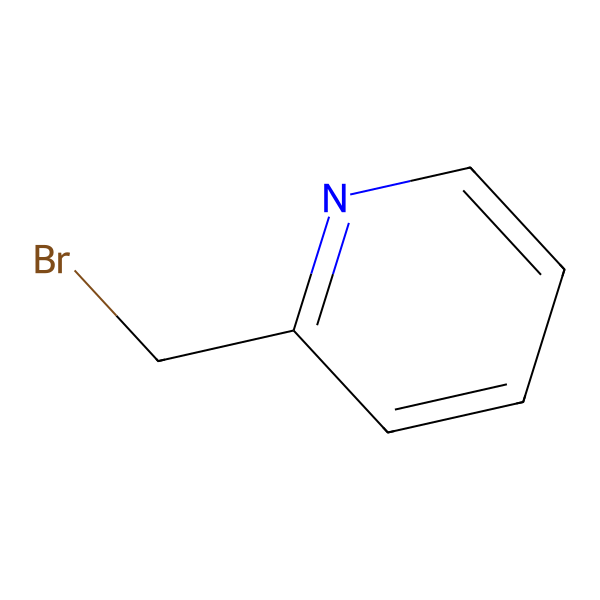
📜3-Bromo-3-(2-Pyridyl)Diazirine 以 异辛烷 用作溶剂,化学反应生成2-溴甲基吡啶
参考文献:Absolute Reactivity Of Halo(Pyridyl)Carbenes
标题:Absolute Reactivity Of Halo(Pyridyl)Carbenes
摘要:A Comprehensive Series Of Halo(Pyridyl)Carbenes Was Generated By Laser Flash Photolysis Of The Appropriate Diazirines. Only The Chloro-And Bromo(2-Pyridyl)Carbenes And The Chloro-And Bromo(3-Pyridyl)Carbenes Could Be Directly Observed,But The Reactivity Of All Nine Halo(Pyridyl)Carbenes Could Be Directly Studied Using The Standard And A Modified Pyridine-Ylide Approach. The Carbenes Were All Ambiphilic,Being Highly Reactive Toward Both Electron-Rich And Election-Deficient Alkenes. Second-Order Rate Constants For These Reactions Ranged From 2.9 X 10(6) To 3.5 X 10(9) M-1 S(-1) And Depended On Both The Position Of The Nitrogen Atom Within The Pyridine Ring And The Nature Of The Halogen Group,As Well As The Electrophilicity Or Nucleophilicity Of The Alkene. A Reactivity Trend With Respect To The Location Of The Nitrogen Within The Pyridine Ring Was Observed,With The 4-Pyridyl Carbenes Being The Most Reactive Followed By The 2-Pyridylcarbenes And Then The 3-Pyridylcarbenes Being The Least Reactive. This Observed Reactivity Trend Is Consistent With The Pyridyl Ring Acting As An Overall Electron-Withdrawing Group. The Results Also Show That Resonance Delocalization Of Electron Density Into The Nitrogen Atom Of The 4-Pyridyl-And 2-Pyridylcarbenes In The Transition State Significantly Reduces The Effect Of The Adjacent Halogen (F,Cl,Or Br) On The Reactivity Of The Pyridyl Carbenes With A Series Of Alkenes.
Doi:10.1021/jo802132Z
海关参考信息
- 2933310010-吡啶
2903399020-溴甲烷
2939800000-其他生物碱 - 💡 提示:海关信息按照顺序优先匹配,如需确认的海关信息,请参考相关资料。
- 详情请参考:📖 海关编码查询和海关进出口税则
供应商参考报价(招募中)
品牌试剂参考报价(招募中)
📌 第三方产品分析报告
合成参考文献
参考DOI号:10.1021/jo802132z


📝 需求与反馈
尽可能描述清楚需求与问题信息