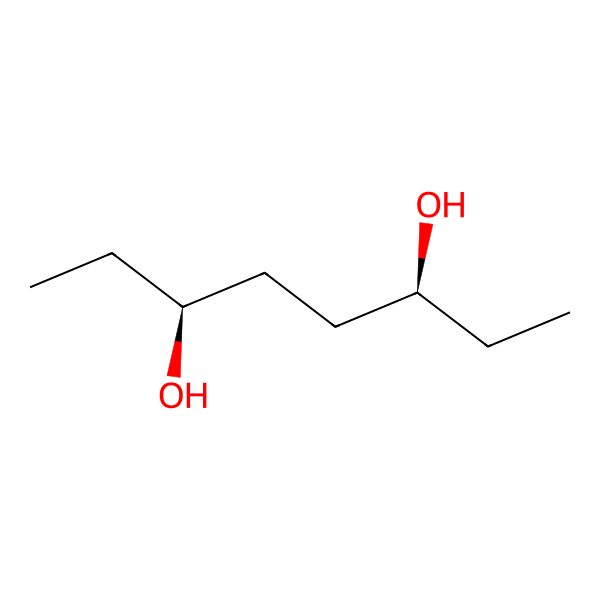
CAS: 136705-66-3; (3S,6S)-Octane-3,6-Diol
该化合物是一种具有明确立体化学特性的手性二醇,使其成为有机合成和制药应用中有价值的中间体. 它的僵硬结构和三,六位置的氢氧基组得以有选择地功能化,便于合成具有高度对应纯度的复杂分子. 化合物的立体特性有利于不对称催化和生物活性化合物的制备,而精确的空间取向至关重要. 此外,它在普通有机溶剂中的稳定性和溶解性增强了其在多步合成途径中的效用. 这二醇对于需要受控立体化学学的手电,聚合物和精细化学物的开发特别有用.
- 英文名称(3S,6S)-Octane-3,6-Diol
- 中文名称(3S,6S)-3,6-辛二醇
- IUPAC名称(3S,6S)-octane-3,6-diol
- 其它别名(3S,6S)-Octane-3,6-Diol; (3S,6S)-3,6-Octanediol; Bckoqwwrtrbsgr-Yumqzzprsa-N; 3,6-Octanediol,(3S,6S)-; (3S,6S)-(+)-3,6-Octanediol; 3,6-Octan
- CAS编号136705-66-3
- MFCD编号:MFCD01631088
- 分子式:C8H18O2
- 分子量:146.23
- 产品CID: 570448
- 产品分类有机原料 → 醇,酚,酚醇类化合物及衍生物
- 相似结构搜索
- 产品信息参考
 ;;;;
;;;; - InChIKey: BCKOQWWRTRBSGR-YUMQZZPRSA-N
- InChI=1S/C8H18O2/c1-3-7(9)5-6-8(10)4-2/h7-10H,3-6H2,1-2H3/t7-,8-/m0/s1…
- 计算化学: 氢键受体数2.0氢键供体数2.0可旋转键数5.0
物理性质
上下游产品
CAS号10504-06-0 2,5-diethylfuran | CAS号79516-59-9 β-hydroxyvaleri... | CAS号24434-07-9 4-°Ctyne-3,6-diol | CAS号30414-53-0 丙酰乙酸甲酯 | CAS号42558-50-9 (S)-羟基戊酸甲酯 | CAS号136705-64-1 1,2-双((2R,5R)-2...合成工艺路线路线简述
4-辛炔-3,6-二醇置于platinum On Activated Charcoal,(S)-B-Methyl-4,5,5-Triphenyl-1,3,2-Oxazaborolidine Jones Reagent,Dimethyl Sulfide Borane,氢气体系中,用 四氢呋喃,甲醇 用作溶剂,化学反应生成(3S,6S)-3,6-辛二醇
参考文献:立体选择性还原不饱和的1,4-二酮.制备手性1,4-二醇的实用方法
标题:立体选择性还原不饱和的1,4-二酮.制备手性1,4-二醇的实用方法
摘要:基于硼烷介导的恶唑硼烷催化的2-烯-1,4-二酮(2),2-炔-1,4-二酮(2)还原反应的合成c 2对称手性1,4-二醇的新合成路线描述3)和/或共络二酮4.对二酮3和4的还原分别获得了非常好或优异的对映异构和非对映异构选择性,分别由恶唑硼烷6和5催化.
Doi:10.1016/s0040-4039(96)02476-8
海关参考信息
- 2905122000-异丙醇
2905399002-1,4-丁二醇
2905142000-仲丁醇
2901100000-饱和无环烃 - 💡 提示:海关信息按照顺序优先匹配,如需确认的海关信息,请参考相关资料。
- 详情请参考:📖 海关编码查询和海关进出口税则
专利信息
专利号:US-7407910-B2
优先权日:2001-10-05
标 题:Ligands for asymmetric reactions
发明人:BERENS ULRICH
权利人:SOLVIAS AG
摘要:The invention relates to a process for the manufacture of bidentate ligands of the formula IA and IIA, characterized in that N,N-(optionally substituted) dialkylamino phosphines bound to an aromatic carbon are lithiated in ortho-position and the lithiated compounds are further converted to said bidentate ligands: n nwherein X 1 is NR, O or S; X 2 is CHR 1 or CR 1 ; X 3 is CHR 2 or NR 2 or, if X 2 is CR 1 , X 3 is CR 2 or N; and R, R 1 and R 2 are radicals such as alkyl groups or R 1 and R 2 together form an annealed ring; Y 1 *, Y 2 * and Y 1 ′* are, independently of each other, an element of the fifth group of the periodic table of elements as such or in thioxo or oxo form; Z 1 *, Z 2 *, Z 3 *, Z 4 *, Z 1 ′*, Z 2 ′* are, independently of each other, for example halogen, hydrogen, or an unsubstituted or substituted moiety selected from radicals such as alkyl groups; the substituents have otherwise the meanings given in the specification; and the ligands are capable of forming metal complexes, which can be used as catalysts in stereoselective synthesis, especially hydrogenation, of various organic molecules.
网址: http://www.coachchem.com
企业联系电话:021-67290723,67299971👤
地址:上海市金山区漕泾镇蒋庄村2088号6幢4楼
企业联系电话:021-67290723,67299971👤
📞上海克琴科技有限公司 ⚠️参考联系方式
联系人:翁小姐
电话:021-67290723,67299971
手机:18117322963
传真:021-67299972
邮箱:marketing@coachchem.com,sales@coachchem.com, johnnywu@coachchem.com
通信地址: 上海市金山区漕泾镇蒋庄村2088号6幢4楼
邮编: 201508
电话:021-67290723,67299971
手机:18117322963
传真:021-67299972
邮箱:marketing@coachchem.com,sales@coachchem.com, johnnywu@coachchem.com
通信地址: 上海市金山区漕泾镇蒋庄村2088号6幢4楼
邮编: 201508
🆔 联系时候可告知是从"百琢研"平台获取的信息.
⚠️ 声明: 该企业未认证、未认领,请自行辨别信息的真实性和可靠性。咨询或交易时请注意风险评估与信息核实,百琢研不参与任何交易。企业认领注册入口→
地址:上海市金山区漕泾镇蒋庄村2088号6幢4楼
⚠️ 未注册 · 未认证企业
 备注: 📌 数据来源说明:本展台内容基于各搜索引擎等公开数据整理,仅作展示用途。请用户自行辨别
✉️ 若企业需抹除展台内容或有异议, 请通过页面底部联系方式告知我们,我们会尽快处理。
第 1 / 1 页
供应商参考报价(招募中)
品牌试剂参考报价(招募中)
📌 第三方产品分析报告
合成参考文献
参考DOI号:10.1016/S0040-4039(96)02476-8


📝 需求与反馈
尽可能描述清楚需求与问题信息