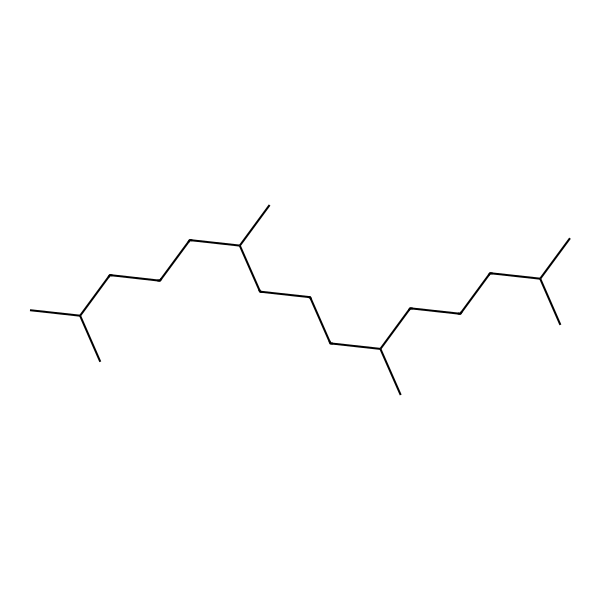
CAS: 1921-70-6; 2,6,10,14-Tetramethylpentadecane
该化合物是一个以长碳链和多甲基组为特征的分支链烷,碳氢化合物由15个碳原子组成,饱和,这意味着碳原子中只有单一的链条,其结构有助于其相对较高的分子量和与较短链碳氢化合物相比的低挥发性.多种甲基组的存在增强了其分支,通常导致其沸点较低,与直链对等相比更加稳定.这种化合物一般没有色素,无味无味,在水中无法溶解,但在有机溶剂中可溶解.由于其疏水性,它经常用于润滑油,燃料等应用,并在各种化学分析中用作参考化合物.此外,其独特的结构使其对与燃烧和环境化学有关的研究感兴趣,特别是了解各种条件下复杂的碳氢化合物的行为.

物理性质
MSDS等安全信息

欧盟法规
ECHA物质ECHA物质C&L通报REACH预注册上下游产品
CAS号502-67-0 (2E,6E)-3,7,11-... | CAS号253686-88-3 3,7,11,15-tetra... | CAS号21980-66-5 2,6,10,14-tetra... | CAS号502-69-2 植酮 | CAS号645-72-7 3,7,11,15-四甲基十六烷-1-醇 | CAS号2140-82-1 2,6,10,14-tetra... | CAS号90304-31-7 2-fluoro-2,6,10... | CAS号90304-32-8 6-fluoro-2,6,10...合成工艺路线路线简述
- 合成目标产物 Pristane 主要起始原料 Isophytol
- (文献来源)合成步骤主要原料 Isophytol
📜异植物醇置于sodium Periodate,Lithium Aluminium Tetrahydride,溶剂黄146,三乙胺,Potassium Iodide体系中,用 四氢呋喃,二氯甲烷,丙酮 用作溶剂,化学反应 43.0H,反应生成姥鲛烷
参考文献:一种姥鲛烷的合成方法
标题:一种姥鲛烷的合成方法
摘要:本发明公开了基于异植物醇为起始原料的化学合成姥鲛烷的新方法.将异植物醇经过氧化,甲基格氏化,磺酰化,卤代,还原得到姥鲛烷.本发明方法同传统的合成方法相比,原料便宜,避免了高压氢化反应,解决了传统合成方法中脱水反应导致的甲基迁移或者环化导致的异构化问题.本发明的方法适合于工业化生产姥鲛烷.
专利信息
专利号:US-10260154-B2
优先权日:2015-08-01
标 题:Method for the synthesis of layered luminescent transition metal dichalcogenide quantum dots
发明人:MANIKOTH SHAIJUMON MANCHERI; DAMIEN DIJO; Gopalakrishnan Deepesh
权利人:INDIAN INSTITUTE OF SCIENCE EDUCATION AND RES THIRUVANANTHAPURAM IISER TVM
摘要:The invention discloses a method for the synthesis of monodispersed luminescent quantum dots of transition metal dichalcogenides (TMDC), single- or few-layered, using a single-step electrochemical exfoliation that involves dilute ionic liquid and water. The method disclosed helps to obtain nanoclusters of TMDC of desired size including small sizes ranging up to 6 nm, by varying the concentration of the electrolyte and the applied DC voltage. The invention further discloses a method by which mono- or few-layered luminescent transition metal dichalcogenides can be directly deposited onto conducting substrates in a uniform manner. The monodispersed single- or few-layered luminescent TMDC and electro-deposited substrates exhibit improved electronic conductivity and new active sites, making them suitable as high-performance electrocatalysts in hydrogen evolution reactions in solar water-splitting applications and also as electrodes for solar cell applications.
专利号:US-9763452-B2
优先权日:2012-06-11
标 题 :Synthesis of MOFs
发明人:MORRIS RUSSELL EDWARD; WHEATLEY PAUL STEWART; WARRENDER STEWART; DUNCAN MORVEN
权利人:UNIV COURT UNIV ST ANDREWS; UNIVERISTY COURT OF THE UNIV OF ST ANDREWS
摘要:The present invention relates to the synthesis of a variety of metal organic frameworks (MOFs) using low temperature and solvents which are considered to be not particularly harmful to the environment. There is also provided novel MOFs which may be made by the desired processes.
专利号:US-11078073-B2
优先权日:2015-02-23
标 题:Self-processing synthesis of hybrid nanostructures
发明人:YERUSHALMI ROIE; PALTIEL YOSSEF; PINCHAS-HAZUT ORI; WAICHMAN SHARON; ZIV AMIR; YOCHELIS SHIRA
权利人:YISSUM RES DEV CO OF HEBREW UNIV JERUSALEM LTD
摘要:Provided is a self-processing synthesis of hybrid nanostructures, novel nanostructures and uses thereof in the construction of electronic and optoelectronic devices.
专利号:US-2025023061-A1
优先权日:2021-11-17
标题 :Method for the synthesis of a metal catalyst surrounded with a carbon matrix
发明人:CHATENET MARIAN; DOAN HUONG; SGARBI RICARDO
权利人:INST POLYTECHNIQUE GRENOBLE; UNIV GRENOBLE ALPES; CENTRE NAT RECH SCIENT; UNIV SAVOIE MONT BLANC
摘要:A method for a synthesis of a metal catalyst, including providing at least one metal complex including a metal ion and a non-chelating complexing agent having carbon, the complex having a decomposition temperature, and performing a pyrolysis of the complex at a temperature greater than or equal to a decomposition temperature of the complex, whereby inducing a formation of nanoparticles surrounded by a carbon matrix to form the catalyst. Thanks to the carbon matrix, the catalysts provided herein can be corrosion resistant, self-healing, more cost-effective, and can have higher catalytic activity. The synthesis of the catalyst and its properties can furthermore be improved compared to catalysts formed from a complex including a chelating.
专利号:US-2010087658-A1
优先权日:1996-08-06
标 题 :Methods and intermediates for synthesis of selective dpp-iv inhibitors
发明人:CAMPBELL DAVID ALAN; LEITAO EMILIA P T; WU ZHEN-PING; WANG PENG
权利人:PHENOMIX CORP
摘要:Methods and intermediates for the synthesis of selective inhibitors of dipeptidyl peptidase IV (DPP-IV) are provided. Coupling of a carboxylate salt with a boro-proline derivative provides a protected form of a DPP-IV inhibitor, which may be deblocked to yield the medicinal compound. The carboxylate salt can be a crystalline form of a sodium salt or a dicyclohexylammonium salt. The inhibitor can be used in the treatment of diabetes.
专利号:US-10930473-B2
优先权日:2015-12-15
标 题:Apparatus and method for plasma synthesis of carbon nanotubes
发明人:PAUKNER CATHARINA; KURZEPA LUKASZ; KOZIOL KRZYSZTOF KAZIMIERZ
权利人:FGV CAMBRIDGE NANOSYSTEMS LTD
摘要:Apparatus and method for plasma synthesis of carbon nanotubes couple a plasma nozzle to a reaction tube/chamber. A process gas comprising a carbon-containing species is supplied to the plasma nozzle. Radio frequency radiation is supplied to the process gas within the plasma nozzle, so as to sustain a plasma within the nozzle in use, and thereby cause cracking of the carbon-containing species. The plasma nozzle is arranged such that an afterglow of the plasma extends into the reaction tube/chamber. The cracked carbon-containing species also pass into the reaction tube/chamber. The cracked carbon-containing species recombine within the afterglow, so as to form carbon nanotubes in the presence of a catalyst.
供应商参考报价(招募中)
品牌试剂参考报价(招募中)
📌 第三方产品分析报告
主要参考文献
1: Freitas EC, de Oliveira MS, Monticielo OA. Pristane-induced lupus: considerations on this experimental model. Clin Rheumatol. 2017 Nov;36(11):2403-2414. doi: 10.1007/s10067-017-3811-6. Epub 2017 Sep 6.
163:187-195. doi: 10.1016/bs.mcb.2020.10.016. Epub 2020 Nov 25.
12:683249. doi: 10.3389/fimmu.2021.683249.
合成参考文献
参考文献:10.1007/s00792-010-0301-z
摘要:Tapilatu YH, Grossi V, Acquaviva M, Militon C, Bertrand JC, Cuny P. Isolation of hydrocarbon-degrading extremely halophilic archaea from an uncontaminated hypersaline pond (Camargue, France). Extremophiles. 2010 Mar;14(2):225–31. doi: 10.1007/s00792-010-0301-z.



📝 需求与反馈
尽可能描述清楚需求与问题信息