CAS: 72963-72-5; Imiprothrin
- 英文名称Imiprothrin
- 中文名称炔咪菊酯
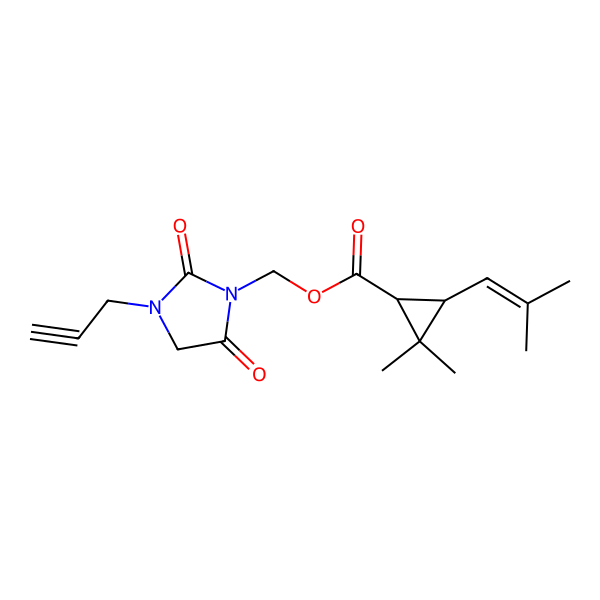
- IUPAC名称(2,5-dioxo-3-(prop-2-yn-1-yl)imidazolidin-1-yl)methyl 2,2-dimethyl-3-(2-methylprop-1-en-1-yl)cyclopropane-1-carboxylate
- 其它别名2,5-Dioxo-3-prop-2-ynylimidazolidin-1-ylmethyl (1R,3R)-2,2-dimethyl-3-(2-methylprop-1-enyl)cyclopropanecarboxylate
- CAS编号72963-72-5
- MFCD编号:MFCD03703407
- EINECS号:615-873-9
- 分子式:C17H22N2O4
- 分子量:318.37
- 产品CID: 1715784
- 产品分类化学农药原药 → 杀虫剂 → 拟除虫菊脂杀虫剂
物理性质
- 熔点<25 °C
- 沸点375.6±52.0 °C at 760 mmHg
- 闪点181.0±30.7 °C
- 密度1.2±0.1 g/cm3
- pKa:-2.34±0.20(预测)
- PSA:66.92
- LogP:2.02
- 折射率1.562
- 蒸汽压0.0±0.8 mmHg at 25°C
- 溶解性Chloroform (Slightly), Methanol (Slightly)
- 外观形态白色至类白色蜡状
- 储存条件2-8°C
- 产品应用该品主要用于防治蟑螂;蚂蚁;蠹虫;蟋蟀;蜘蛛等害虫,对蟑螂有特效.
- 性质描述工业品为金黄色粘稠液体,蒸汽压1.8×10⁻⁶Pa(25°C),比密度d0.979,粘度60CP,闪点110°C.不溶于水,不溶于水,可溶于甲醇;丙酮;二甲苯等有机溶剂.常温下贮存两年无变化.
MSDS等安全信息
- GHS象形图


- GHS符号GHS08 & GHS07 & GHS09;
注释: Health hazard & Exclamation mark & Environment - 危险类别致癌性 类别2
急性毒性 类别4(吸入)
急性毒性 类别4(经口)
STOT SE 2
水生急性毒性 类别1
水生慢性毒性 类别1 - 警示词Warning(警告)
- 危险描述H351 |怀疑致癌.
H332 |吸入有害.
H302 |吞咽有害.
H371 |可能损害器官.
H400 |对水生生物毒性极大.
H410 |对水生生物毒性极大并具有长期持续影响. - 防范说明P202-P260-P273-P301+P312-P304+P340+P312-P308+P311
- UN编号UN3082 9/PG 3
- 危险品标志Xn,N
- 安全声明61
- 危险类别码22-50
- WGK Germany2
欧盟法规
ECHA物质C&L通报REACH预注册合成工艺路线路线简述
海关参考信息
- 2901210000-乙烯
2901220000-丙烯
2901292000-乙炔
2905121000-正丙醇 - 💡 提示:海关信息按照顺序优先匹配,如需确认的海关信息,请参考相关资料。
- 详情请参考:📖 海关编码查询和海关进出口税则
专利信息
专利号:US-9468207-B2
优先权日:2012-04-12
标 题 :Insecticide and acaricide paints that inhibit chitin synthesis, regulate insect juvenile hormone and repel arthropods, for controlling endemic diseases, pests and allergens
发明人:MATEO HERRERO MARIA PILAR
权利人:MATEO HERRERO MARIA PILAR
摘要:The present invention relates to insecticide and acaricide paints that inhibit chitin synthesis, regulate insect juvenile hormone and repel arthropods, for controlling endemic diseases, pests and allergens. The paints comprise at least the following compounds (in any combination): 1%-100% water, 0.0001%-20% insecticides, 0.0001%-20% chitin inhibitor, 0.0001%-20% juvenile hormone regulator, 1%-50% polymers, 0%-40% pigments, 0%-60% fillers, 0%-60% natural repellents, and 0.01%-20% stabilizers. The composition of the paints allows the active ingredients to be encapsulated in an aqueous polymer with or without the incorporation of fillers and pigments, and therefore the range of use thereof is increased.
专利号:WO-2021074309-A1
优先权日:2019-10-16
标 题:1-(3-quinolyl)-3,4-dihydroisoquinoline derivatives as fungicides for combating specific phytopathogens
发明人:WEISS MATTHIAS; QUARANTA LAURA; BOU HAMDAN FARHAN; MAHAJAN ATUL; WILLIAMS SIMON; KILARU JAGADEESH; SEN INDIRA; BIERI STEPHANE; DIGGELMANN MARTIN
权利人:SYNGENTA CROP PROTECTION AG
摘要:1-(3-quinolyl)-3,4-dihydroisoquinoline derivatives of formula (I) as well as a method of combating, preventing or controlling the phytopathogens Mycosphaerella graminicola (Septoria tritici), Fusarium culmorum, Gibberella zeae (Fusarium graminearum) and Monographella nivalis (Microdochium nivale), which comprises applying to the phytopathogen, to the locus of the phytopathogen, or to a plant susceptible to attack by the phytopathogen, or to propagation material thereof, a fungicidally effective amount of a 1-(3-quinolyl)-3,4-dihydroisoquinoline derivative of formula (I). The present description discloses the synthesis of exemplary compounds, formulation examples, relevant biological data (antifungal activity against Mycosphaerella graminicola (Septoria tritici), Fusarium culmorum, Gibberella zeae (Fusarium graminearum) and Monographella nivalis (Microdochium nivale) when spayed on plants), as well as comparative data against three prior art compounds (e.g. pages 52 to 85; formulation examples; examples A1 to A3; table E; compounds E.01 to E.187; biological examples). Exemplary compounds are e.g.: 5-bromo-1-(8-fluoro-3-quinolyl)spiro[4H-isoquinoline-3,1'- cyclopropane] (example A1) 5-bromo-1-(8-fluoro-3-quinolyl)-3,3-dimethyl-4H-isoquinoline (example A2) 1-(8-fluoro-3-quinolyl)-3,3-dimethyl-4H-isoquinoline-5-carbonitrile (example A3)
专利号:WO-2021074311-A1
优先权日:2019-10-16
标题:1-(3-quinolyl)-1,2,3,4-tetrahydroisoquinoline derivatives as fungicides for combating specific phytopathogens
发明人:WEISS MATTHIAS; QUARANTA LAURA; BOU HAMDAN FARHAN; MAHAJAN ATUL; WILLIAMS SIMON; KILARU JAGADEESH; BIERI STEPHANE; DIGGELMANN MARTIN
权利人:SYNGENTA CROP PROTECTION AG
摘要:1-(3-quinolyl)-1,2,3,4-tetrahydroisoquinoline derivatives of formula (I) as well as a method of combating, preventing or controlling the phytopathogens Mycosphaerella graminicola (Septoria tritici), Fusarium culmorum, Gibberella zeae (Fusarium graminearum) and Monographella nivalis (Microdochium nivale), which comprises applying to the phytopathogen, to the locus of the phytopathogen, or to a plant susceptible to attack by the phytopathogen, or to propagation material thereof, a fungicidally effective amount of a 1-(3-quinolyl)-1,2,3,4-tetrahydroisoquinoline derivatives of formula (I). The present description discloses the synthesis of exemplary compounds, formulation examples, relevant biological data (antifungal activity against Mycosphaerella graminicola, Monographella nivalis, Fusarium culmorum and/or Gibberella zeae when spayed on plants) (e.g. pages 47 to 55; examples A1 and A2; compounds E.01 to E.17; table E). An exemplary compounds is e.g.: 3-(5-bromo-3,3-dimethyl-2,4-dihydro-1 H-isoquinolin-1-yl)-8-fluoro- quinoline (example A1)
专利号:US-2011230343-A1
优先权日:2008-10-24
标题 :Method for the Manufacture of Microparticles Comprising an Effect Substance
发明人:SCHROERS MICHAEL; DYLLICK-BRENZINGER RAINER; MERK MICHAEL; BARG HEIKO
权利人:BASF SE
摘要:A subject matter of the present invention is a process for the preparation of effect compound-comprising microparticles M comprising A) the formation of a crude suspension of microparticles A by means of enzymatic polyester synthesis in an inverse miniemulsion comprising enzyme, effect compound and polyester monomers; and B) the polymerization of wall monomers from the group consisting of ethylenically unsaturated monomers, polyisocyanates and polyepoxides in the crude suspension of microparticles A. Furthermore, the present invention relates to microparticles M which can be obtained by means of the process according to the invention and also to an agrochemical formulation comprising microparticles M. In addition, the present invention relates to the use of microparticles M prepared according to the invention as component in colorants, cosmetics, drugs, biocides, plant protection agents, fertilizers, additives for food or animal fodder, or auxiliaries for polymers, paper, textiles, leather, detergents or cleaners. Finally, the invention also relates to a method for combating undesirable plant growth, to a method for combating undesirable insect or acarid infestation on plants and/or for combating phytopathogenic fungi, and to seeds treated with the agrochemical formulation.
专利号:US-11213031-B2
优先权日:2017-11-13
标 题:Tetrazolylpropyl derivatives and their use as fungicides
发明人:SUDAU ALEXANDER; HOFFMANN SEBASTIAN; DAHMEN PETER; WEBSTER ROBERT ALAN; MEISSNER RUTH; GOERTZ ANDREAS; MILLER RICARDA; COQUERON PIERRE-YVES; BERNIER DAVID; NICOLAS LIONEL; BRUNET STEPHANE; KENNEL PHILIPPE; TOQUIN VALERIE; GOURGUES MATHIEU; LOQUE DOMINIQUE; THOMAS VINCENT
权利人:BAYER AG; BAYER CROPSCIENCE AG
摘要:The present invention relates to tetrazolylpropyl derivatives of formula (I) n nwherein one of V 1 and V 2 represents CR 3 and the other one of V 1 and V 2 represents N, Q represents a 6-membered aromatic cycle as defined in the specification, and R 1 , R 2 , R 3 , R 4 , and R 5 are defined as disclosed in the specification, to compositions comprising such compounds, to the use of said compounds as fungicides, as well as to particular intermediates useful in the synthesis of said tetrazolylpropyl derivatives.
专利号:WO-2020226482-A1
优先权日:2019-05-09
标题:Synergistic compositions for controlling plant pathogens with chitinolytic microorganisms / organic acid combinations and method of use thereof
发明人:LAI HONG HENG
权利人:LAI HONG HENG
摘要:The present invention relates to pesticidal compositions and methods for controlling plant pathogens, particularly basal stem rot in the oil palm primarily caused by Ganoderma species. The pesticidal compositions comprising, as active components: (A) Bioactive compound derived from a whole broth culture of an chitinolyic microorganisms, wherein the bioactive compound comprises any or any combination of: chitinolyic microorganism, whole cell broths, liquid cultures, spores, pure cultures, cell fraction, substances, suspensions, supernatants, filtrates, extract or a cell-free extract thereof or metabolite thereof or isolated compounds, wherein the bioactive compound is derived from at least one chitinolyic microorganisms that degrade chitinous substrates. The said chitinolytic microorganism is bacteria belonging to genus Bacillus, Streptomyces and/or fungal genus Trichoderma; (B) at least one organic acid; and (C) at least one pesticide selected from chemical pesticides, microbial pesticides, plant defense activators, cuticle degrading enzymes, cell wall synthesis inhibitors, bacteriocins, antifungal peptides, antimicrobial preservatives, plant oil or plant extract. More specifically, this invention envisions the use of bioactive compounds and/or metabolites from chitinolyic microorganisms in combination essentially of organic acid and the compositions comprising them, in the use form as fungicides and/or insecticides, also be present as 'booster' to other pesticides results in many cases in an expension of pesticidal spectrum of activity or in a prevention of pesticide resistance development. Furthermore, in many cases, synergistic effects are obtained. In various embodiments, the organic acid consists essentially of acetic acid, preferably acetic acid from a fermentation. The formulation is typically applied to agricultural soil or plant material. In a particular, the present invention can be used in combination with a carrier selected from the plant growth nutrient, organic fertilizer or inorganic/organic mixture fertilizer. Although the following description relates almost exclusively to managing basal stem rot (BSR) disease in oil palm primarily caused by Gonoderma species. It will be appreciated by those skill in the art that the invention could be used to treat other diseases and pests of other plants, includes but is not limited to a fungus, bacteria, actinomycete, virus, insects, Acari and/or nematodes.
网址: http://www.skybluechem.com
电话: 86-21-58356513 58356613👤
销售电话:86-21-58356513 58356613
邮箱:info@skybluechem.com
电话: 86-21-58356513 58356613👤
📞上海凯贝化工有限公司 ⚠️参考联系方式
销售电话:86-21-58356513 58356613
邮箱:info@skybluechem.com
🆔 联系时候可告知是从"百琢研"平台获取的信息.
⚠️ 声明: 该企业未认证、未认领,请自行辨别信息的真实性和可靠性。咨询或交易时请注意风险评估与信息核实,百琢研不参与任何交易。企业认领注册入口→
⚠️ 未注册 · 未认证企业
 备注: 📌 数据来源说明:本展台内容基于各搜索引擎等公开数据整理,仅作展示用途。请用户自行辨别 ✉️ 若企业需抹除展台内容或有异议, 请通过页面底部联系方式告知我们,我们会尽快处理。
第 1 / 1 页
供应商参考报价(招募中)
品牌试剂参考报价(招募中)
📌 第三方产品分析报告
主要参考文献
1: Germant OM, Shashina NI. [EFFECT OF PYRETHROIDS ON TAIGA TICKS (IXODES PERSULCATUS IXODIDAE)]. Med Parazitol (Mosk). 2016 Jan-Mar;(1):60-2. Russian. doi: 10.1186/s13071-015-1027-7.
4: Mir-Tutusaus JA, Masís-Mora M, Corcellas C, Eljarrat E, Barceló D, Sarrà M, Caminal G, Vicent T, Rodríguez-Rodríguez CE. Degradation of selected agrochemicals by the white rot fungus Trametes versicolor. Sci Total Environ. 2014 Dec 1;500-501:235-42. doi: 10.1016/j.scitotenv.2014.08.116. Epub 2014 Sep 15. doi: 10.1016/j.jpba.2009.09.048. Epub 2009 Oct 7. doi: 10.1016/j.talanta.2014.07.098. Epub 2014 Aug 8. doi: 10.1016/j.chroma.2009.04.087. Epub 2009 May 3. doi: 10.1186/1476-069X-10-19.
11: Adedeji AA, Ahmed IA, Akinwunmi M, Aina SA, Tikare O, Adeboye AF, Badmos SO, Adedeji KA, Fehintola FA, Amoo AO. Use and effectiveness of commercial flit-spray insecticides in control of mosquito population in Sagamu, Southwest Nigeria. Afr J Med Med Sci. 2012 Jun;41(2):197-203. doi: 10.1371/journal.pone.0169480. eCollection 2017.
合成参考文献
摘要:Tomlin, C.D.S. (ed.). The Pesticide Manual - World Compendium, 11 th ed., British Crop Protection Council, Surrey, England 1997, p. 712



📝 需求与反馈
尽可能描述清楚需求与问题信息