CAS: 14642-79-6; (Benzyloxy)Trimethylsilane
该化合物是一种多用途有机硅化合物,配有分子式C10H16OSi.它通常用作有机合成特别是酒精中的保护性集体试剂,因为它能够在温和条件下形成稳定的苯氧基(BnO)醚;三甲基硅酸酯(TMS)组可增强反应性,便于选择性地降低防护.这种试剂因其稳定性,处理方便性以及与多种反应条件的兼容性而具有价值.它对于制造硅醚和作为制药及精细化学合成的中间体也是有益的.它具有低挥发性和湿度,需要在惰性条件下谨慎储存.
- 英文名称(Benzyloxy)Trimethylsilane
- 中文名称苄氧基三甲基硅烷
- IUPAC名称(benzyloxy)trimethylsilane
- 其它别名Silane,(benzyloxy)trimethyl- (6CI,7CI,8CI); Silane, trimethyl(phenylmethoxy)- (9CI); (Benzyloxy)trimethylsilane; Benzyl alcohol trimethylsilyl ether; Benzyltrimethylsilyl ether; Phenyl(trimethylsiloxy)methane; Trimethyl(benzyloxy)silane; Trimethyl(phenylmethoxy)silane
- CAS编号14642-79-6
- MFCD编号:MFCD00134529
- EINECS号:801-592-0
- 分子式:C10H16OSi分子量:180.32
- 产品CID: 697638
- 产品分类化学试剂 → 硅烷试剂
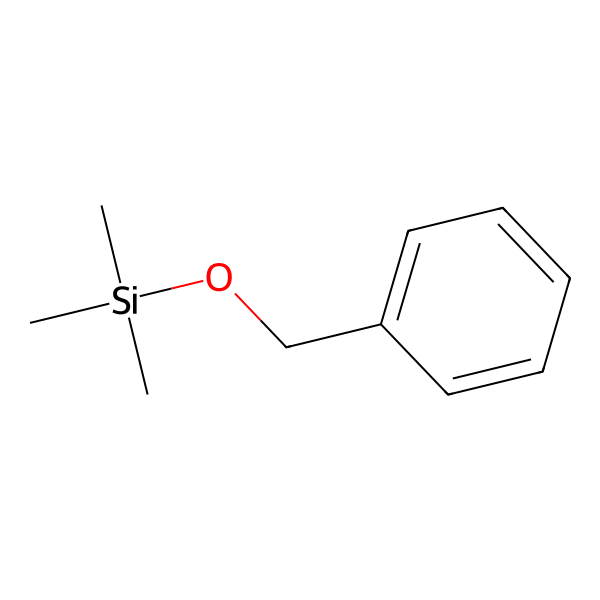
- 相似结构搜索
- 产品信息参考
 ;;;
;;; - InChIKey: AOKMFXQCRBQJOP-UHFFFAOYSA-N
- InChI=1S/C10H16OSi/c1-12(2,3)11-9-10-7-5-4-6-8-10/h4-8H,9H2,1-3H3
- 计算化学: 氢键受体数1.0氢键供体数*可旋转键数3.0
物理性质
MSDS等安全信息

欧盟法规
C&L通报上下游产品
chloro-trimethyl-silane benzyl alcohol 1,1,1,3,3,3-hexamethyl-disilazane Hexamethyldisiloxanebenzenesulfinic acid benzyl ester α-trimethylsilyl-α-trimethylsiloxytoluene α-Triaethylsiloxy-α-trimethylsilyltoluol Benzyl-methansulfinat合成工艺路线路线简述
📜苯甲醇置于1-Butyl-3-Methylimidazolium Tetrachloroindate体系中,化学反应 0.1H,反应生成苄氧基三甲基硅烷
参考文献:[c4Mim][incl4]: An Efficient Catalyst-Medium For Alkoxymethylation Of Alcohols And Their Interconversion To Acetates And Tms-Ethers
标题:[c4Mim][incl4]: An Efficient Catalyst-Medium For Alkoxymethylation Of Alcohols And Their Interconversion To Acetates And Tms-Ethers
摘要:摘要 提出了一种简单,绿色且选择性强的方法,利用lewis酸性室温离子液体[c4Mim][incl4]作为催化剂和反应介质,在常温,微波和超声辐射下,对一级和二级醇进行甲氧基甲基化和乙氧基甲基化.在该催化系统中,相应的mom和eom醚以非常好的收率和短时间的反应获得.此外,该催化系统还用于在热条件及微波和超声辐射下,将这些保护醇温和高效地转化为相应的醋酸酯和三甲基硅醚.
Doi:10.1016/j.Crci.2010.08.006
海关参考信息
- 2902300000-甲苯
2905110000-甲醇
2906210000-苄醇 - 💡 提示:海关信息按照顺序优先匹配,如需确认的海关信息,请参考相关资料。
- 详情请参考:📖 海关编码查询和海关进出口税则
专利信息
专利号:US-4076758-A
优先权日:1976-12-09
标题 :Synthesis of vicinal glycols
发明人:OWSLEY DENNIS C; BLOOMFIELD JORDAN J
权利人:MONSANTO CO
摘要:Relatively low molecular weight primary alcohols are coupled to form relatively higher molecular weight vicinal glycols in which a trialkylsilyl protecting group is employed on the hydroxyl position of said low molecular weight primary alcohol during said coupling reaction. n BACKGROUND OF THE INVENTION n This invention relates to the production of vicinal glycols from starting molecules having fewer carbon atoms such as, for example, the preparation of ethylene glycol and glycerol from methanol. More particularly, this invention is concerned with the coupling of relatively low molecular weight or short chain primary alcohols to form relatively higher molecular weight or vicinal glycols by employing a trialkylsilyl protecting group on the hydroxyl position of said low molecular weight primary alcohol. n In view of the fuel and mineral shortages facing the world, particularly petroleum feedstocks, there is a scarcity of vital building blocks such as ethylene and propylene used to synthesize many modern chemical entities. Consequently, alternate carbon sources for the chemical industry's basic organic chemicals must be developed for future needs from either coal or single carbon molecules such as carbon monoxide, carbon dioxide or methanol. n Two major products produced from petroleum-derived feedstocks such as ethylene and propylene are, respectively, ethylene glycol and glycerol. Ethylene glycol is widely used for antifreeze and in numerous nonantifreeze outlets, including cellophane, polyester fibers and films, and polyglycols. Glycerol finds wide use in cosmetics, dentifrices, drugs and pharmaceuticals, alkyd resins, cellophane and in tobacco as a humectant and in the manufacture of plasticizers for cellulose cigarette filters. n In the production of ethylene glycol, ethylene oxide is usually first prepared by direct oxidation of ethylene or by the chlorohydrin synthesis and the ethylene oxide is then reacted with water to make ethylene glycol. n Although glycerol is a natural by-product of soap manufacture, a significant quantity of synthetic glycerin also is prepared from propylene. One such process involves the chlorination of propylene to allyl chloride, conversion into epichlorohydrin, and thence into glycerin. Another process involves oxidation of propylene to acrolein, conversion into allyl alcohol, then reaction with hydrogen peroxide to yield glycerin. In a third process, propylene oxide is catalytically converted into allyl alcohol, which is treated with peracetic acid to yield glycidol. Glycidol then combines with water to make glycerin. n An improved method of producing vicinal glycols such as, for example, ethylene glycol and glycerol, from shorter chain molecules such as, for example, methanol, instead of employing petroleum-derived feedstocks such as ethylene and propylene, would provide significant advantages over prior methods of production. n BRIEF DESCRIPTION OF THE INVENTION n In accordance with the present invention, vicinal glycols are produced from starting molecules having fewer carbon atoms. In particular, relatively low molecular weight or short chain primary alcohols are coupled to form relatively higher molecular weight vicinal glycols by employing a trialkylsilyl protecting group on the hydroxyl position of said low molecular weight primary alcohol. n As used herein, the term 'trialkylsilyl' means a group containing a silicon atom bonded to three alkyl radicals, any of which can be the same as, or different than, any other. n The process of this invention involves the oxidative or dehydrogenative coupling of the shorter chain primary alcohol without over-oxidation to undesirable by-products, for example, aldehydes. The initial dehydrogenation of the shorter chain primary alcohol is thus made to take place on the carbon rather than the hydroxyl group by using the trialkylsilyl blocking group on the hydroxyl. Alcoholysis of the coupled reaction product then readily yields the desired vicinal glycol. n The coupling reaction of this invention is briefly illustrated by the preparation of ethylene glycol and glycerol from methanol. In order to produce ethylene glycol, two trialkylsilyl blocked methanol molecules are reacted to form 1,2-bis(trialkylsiloxy)ethane which, upon methanolysis, yields ethylene glycol. In order to produce glycerol, three trialkylsilyl blocked methanol molecules are reacted to form 1,2,3-tris(trialkylsiloxy)propane which, upon methanolysis, yields glycerol. n The above process has definite advantages over the direct coupling of methanol to ethylene glycol and glycerol. This process has a higher selectivity for ethylene glycol and glycerol and less by-product is produced. That the direct coupling of methanol undesirably leads to a substantial amount of formaldehyde is seen from the work of Schwetlich et al, Angew. Chem. 72, 779 (1960); and Ladygin and Saraeva, Kinetics and Catalysis 6, 189-95 (1965) and 7, 832-39 (1966).
专利号:US-11827660-B2
优先权日:2019-02-01
标题 :Synthesis strategy for gap protecting group
发明人:SEIFERT COLE
权利人:SEDERMA SA
摘要:The present invention relates to a novel synthesis method to form particular molecules. These molecules have multiple uses, most notably in the field of protecting groups used throughout organic and synthetic chemistry. The disclosed method is safer, more cost- and time-effective, and more amenable to large scale production than those currently known in the art. The protecting groups synthesized are useful in GAP peptide synthesis.
专利号:US-11840537-B2
优先权日:2020-11-03
标 题:Preparation and application of a 5-bromoquinazoline derivative
发明人:LUO MEI
权利人:LUO MEI; UNIV HEFEI TECHNOLOGY
摘要:A 5-bromoquinazoline derivative (I), structural formula thereof is as follows:the synthesis method thereof comprises weighing 1.18 g of 5-bromoisatin, 2.5503 g of ammonium formate and 100 ml of absolute methanol in a 250 mL round-bottom flask, heating, stirring and refluxing for 48 h, stopping reaction, rotating to obtain 1.6033 g of filter residue crude product, carrying out column chromatography separation by using dichloromethane and absolute methanol according to a volume ratio of 1:1, and obtaining a target crystal compound I; the application of the 5-bromoquinazoline derivative compound crystal (I), as a catalyst has a good catalytic effect in nitrile silicification reaction of benzaldehyde and auto-polymerization reaction of benzophenone hydrazone, the conversion rates thereof respectively reach 39% and 76%, and the crystal (I) can be used as an anti-cancer reagent which has certain anti-cancer activity of breast cancer, liver cancer and lung cancer.
专利号:CA-1076606-A
优先权日:1976-12-09
标 题 :Synthesis of vicinal glycols
供应商参考报价(招募中)
品牌试剂参考报价(招募中)
📌 第三方产品分析报告
合成参考文献
摘要:Okamoto, K.; Ohe, K., Science of Synthesis Knowledge Updates, (2020) 1, 100.
摘要:Singh, F. V.; Wirth, T., Science of Synthesis Knowledge Updates, (2015) 2, 428.
摘要:Wan, J.-P., Science of Synthesis: Multicomponent Reactions, (2013) 2, 402.



📝 需求与反馈
尽可能描述清楚需求与问题信息