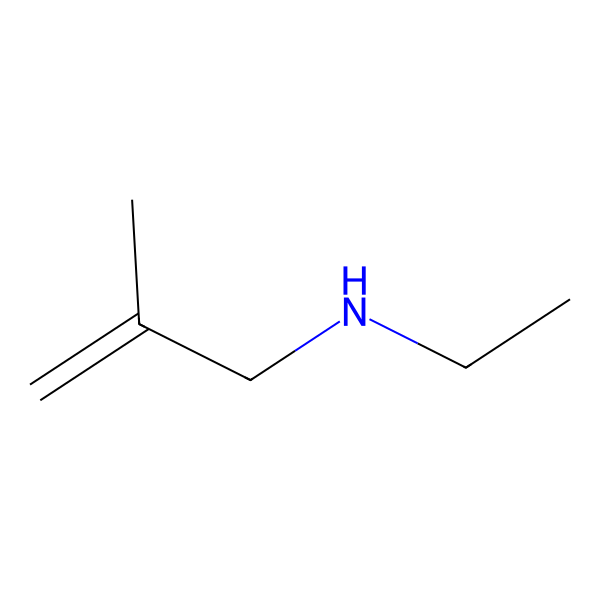
CAS: 18328-90-0; N-Ethyl-2-Methylprop-2-En-1-Amine
该化合物是一种有机化合物,其特征是其有矿功能组,有助于其基本性和再活性;其特征是分支烷基链,具体而言,是附属于2-甲基异丙醇结构的乙基组,使其成为次要的矿物质;该化合物一般没有颜色,可粉色黄色,具有独特的矿物质味;该化合物在有机溶剂中可溶解,并由于有矿物质组的存在而在水中表现出中等溶解性.N-Ethyl-2-甲基异丙胺在各种化学中间体合成中的潜在用途,包括制药和农用化学品,其潜在用途使其能够参与核分裂替代反应,并可参与聚合过程.安全考虑包括在通风良好的地区处理该物质,并使用适当的个人防护设备,因为它可能会对皮肤和呼吸系统产生刺激.
- 英文名称N-Ethyl-2-Methylprop-2-En-1-Amine
- 中文名称N-乙基甲基丙烯胺
- IUPAC名称N-ethyl-2-methylprop-2-en-1-amine
- 其它别名N-Ethyl-2-methyl-2-propen-1-amine; N-Ethyl-2-methylallylamine
- CAS编号18328-90-0
- MFCD编号:MFCD00010757
- EINECS号:242-217-5
- FDA UNII编号:DQF79T13KF
- 分子式:C6H13N分子量:99.1736
- 产品CID: 942538
- 产品分类有机原料 → 烃类化合物及其衍生物 → 无环烃
物理性质
MSDS等安全信息
- GHS象形图


- GHS符号GHS02 & GHS06 & GHS08 & GHS05;
注释: Flame & Skull and crossbones & Health hazard & Corrosion - 危险类别易燃液体 类别2
急性毒性 类别3(吸入)
急性毒性 类别3(经皮)
急性毒性 类别2(经口)
STOT SE 2
皮肤腐蚀 类别1C
急性毒性 类别4(吸入)
急性毒性 类别4(经皮)
急性毒性 类别4(经口)
皮肤腐蚀 类别1B
特定目标器官毒性 - 单次接触 类别3 - 警示词Danger(危险)
- 危险描述H225 |高度易燃液体和蒸气.
H331 |吸入会中毒.
H311 |皮肤接触会中毒.
H300 |吞咽致命.
H371 |可能损害器官.
H314 |造成严重皮肤灼伤和眼损伤.
H332 |吸入有害.
H312 |皮肤接触有害.
H302 |吞咽有害.
H335 |可能引起呼吸道刺激. - 防范说明P261-P271-P304+P340-P311-P321-P403+P233-P405-P501-P260-P264-P280-P301+P330+P331-P303+P361+P353-P363-P304+P340-P310-P321-P305+P351+P338-P405-P501-P280-P302+P352-P312-P322-P361-P363-P405-P501-P280-P305+P351+P338-P310-P264-P270-P301+P310-P321-P330-P405-P501-P210-P233-P240-P241-P242-P243-P280-P303+P361+P353-P370+P378-P403+P235-P501-P260-P264-P270-P309+P311-P405-P501
- 危险等级3.1
- UN编号UN 2733 3/PG 2
- 危险品标志F,C
- 包装等级II
- 安全声明16-26-27-33-36/37/39-45
- 危险类别码11-20/21/22-34
- WGK Germany2
欧盟法规
REACH注册ECHA物质C&L通报REACH预注册上下游产品
CAS号75-04-7 乙胺 | CAS号563-47-3 3-氯-2-甲基-1-丙烯(MAC) | CAS号321860-21-3 Piperazine, 1-e... | CAS号62371-19-1 ethyl N-ethyl-N... | CAS号62721-79-3 N-ethyl-N-(2-me...合成工艺路线路线简述
- 合成目标产物 N-Ethylmethallylamine 主要起始原料 Ethylamine And 3-Chloro-2-Methylpropene
- (文献来源)合成步骤主要原料 Ethylamine 和 3-Chloro-2-Methylpropene
📜乙胺,3-氯-2-甲基丙烯置于sodium Hydroxide体系中,化学反应生成N-乙基甲基丙烯胺
参考文献:Thiolcarbamates. Preparation And Molar Refractions1
标题:Thiolcarbamates. Preparation And Molar Refractions1
摘要:
Doi:10.1021/ja01512A052
海关参考信息
- 2901210000-乙烯
2901220000-丙烯
2921199090-其他无环单胺 - 💡 提示:海关信息按照顺序优先匹配,如需确认的海关信息,请参考相关资料。
- 详情请参考:📖 海关编码查询和海关进出口税则
专利信息
专利号:US-5486634-A
优先权日:1993-12-23
标 题 :Method for the preparation of organopolysiloxanes with secondary aminoalkyl groups linked through a carbon atom to a silicon atom
发明人:HAHN GUENTER; KLEIN KLAUS-DIETER; SCHAEFER DIETMAR
权利人:GOLDSCHMIDT AG TH
摘要:A method for the synthesis of organopolysiloxanes having ##STR1## group, wherein R 1 is an alkyl group with 1 to 4 carbon atoms, is described. The products are obtained by the hydrosilylation of compounds of the formula ##STR2## with hydrogensiloxanes, the addition taking place exclusively in the form of a γ addition.
专利号:US-2005053642-A1
优先权日:2000-08-23
标题:Biocompatible materials
发明人:ULBRICHT MATHIAS; THOM VOLKMAR; JANKOVA KATJA; ALTANKOV GEORGE; JONSSON GUNNAR
摘要:The present invention teaches a novel approach of creating biocmpatible surfaces, said surfaces being capable of functionally interact with biological material. SAid biocompatible surfaces comrise at least two comonents, such as a hydrophobic substratum and a macromolecule of hydrophilic nature, which, in a cooperativity, form together the novel biocoompatible surfaces. The novel approach is ased on contacting said hydrophobic substratum with a laterally patterned monomolecular layer of said hydrophilic and flexible macromolecules, exhibiting a pronounced excluded volume. The htus formed two component surface is, in respect to polarity and morphology, a molecularly heterogeneous surface. Structural features of said macromolecular monolayer (as e.g. the layer thickness or its lateral density) are determined by: i) the structural features of the layer forming macromolecules (as e.g. their MW or their molecular architecture) and ii) the method of creating said monomolecular layer (as e.g. by physi- or chemisorbing, or by chemically binding said macromolecules). The structural features of the layer forming macromolecules(s) is in turn determined by synthesis. AMount and conformation and thus also biological activity of biological material (as e.g. polypeptides) which contact the novel biocompatible surface, is determined and maintained by the cooperative action of the underlying hydrophobic substratum and the macromolecular layer. In this way it becomes possible to maintain and control biological interactions between said contacted polypeptides and other biological compounds as e.g. cells, antibodies and the like. Consequently, the present invention aims to reduce and/or eliminate the deactivation and/or denaturation associated with the contacting of polypeptides and/or other biological material to a hydrophobic substratum surface.
供应商参考报价(招募中)
品牌试剂参考报价(招募中)
📌 第三方产品分析报告
合成参考文献
摘要:Clark, R. W.; Wiskur, S. L., Science of Synthesis Knowledge Updates, (2015) 1, 16.
摘要:Braverman, S.; Cherkinsky, M., Science of Synthesis Knowledge Updates, (2014) 3, 221.



📝 需求与反馈
尽可能描述清楚需求与问题信息