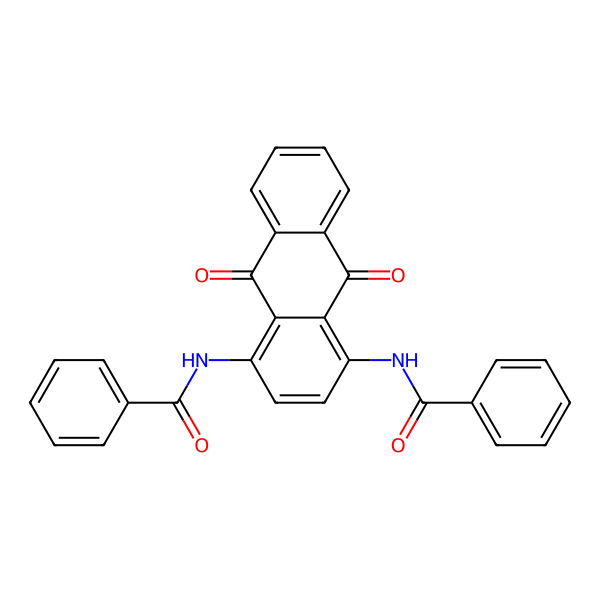
CAS: 2987-68-0; N,N'-(9,10-Dioxo-9,10-Dihydroanthracene-1,4-Diyl)Dibenzamide
- 英文名称N,N'-(9,10-Dioxo-9,10-Dihydroanthracene-1,4-Diyl)Dibenzamide
- 中文名称N,N'-(9,10-二氧代-9,10-二氢蒽-1,4-二基)二苯甲酰胺
- IUPAC名称N,N'-(9,10-dioxo-9,10-dihydroanthracene-1,4-diyl)dibenzamide
- 其它别名还原红42; N,N'-(9,10-Dihydro-9,10-Dioxoanthracene-1,4-Diyl)Bisbenzamide
- CAS编号2987-68-0
- MFCD编号:MFCD00328563
- EINECS号:221-058-5
- FDA UNII编号:WNN6WV4DK4
- 分子式:C28H18N2O4分子量:446.46
- 产品CID: 1280898
- 产品分类有机原料→分子砌块→芳环类化合物→苯类化合物

相似化合物
2475-44-7 14233-37-5 117-06-6物理性质
欧盟法规
ECHA物质C&L通报REACH预注册上下游产品
1,4-dichloroanthraquinone benzamide 1,4-diamino-9,10-anthraquinone disperse blue 141-amino-4-benzamidoanthraquinone N,N'-(9,10-dihydroxy-anthracene-1,4-diyl)-bis-benzamideN,N'-(9,10-dihydroxy-anthracene-1,4-diyl)-bis-benzamide 1,4-bis-benzoylamino-2-nitro-anthraquinone 1,4-diamino-2-nitro-anthraquinone合成工艺路线路线简述
📜分散蓝 14,苯甲酰胺置于盐酸,硝基苯体系中,化学反应生成还原红42
参考文献:Nitrogenous Condensation Products And Process Of Producing Same
标题:Nitrogenous Condensation Products And Process Of Producing Same
海关参考信息
- 2912110000-甲醛
2912210000-苯甲醛
2914610000-蒽醌
2924199090-其他无环酰胺 - 💡 提示:海关信息按照顺序优先匹配,如需确认的海关信息,请参考相关资料。
- 详情请参考:📖 海关编码查询和海关进出口税则
专利信息
专利号:US-2005009924-A1
优先权日:2003-07-08
标 题 :Synthesis and pharmaceuticals of novel bis-substituted anthraquinone derivatives
发明人:HUANG HSU-SHAN
摘要:This invention relates to novel anthraquinone compounds useful in the treatment of allergic, inflammatory conditions, antioxidant, tumor condition, stem cell application, tissue engineering, applied in treating age-associate tissue degeneration, reverse organ failure in chronic high-turnover disease and therapeutic compositions containing such compounds. The compounds of the present invention are 1,4-, 1,5- and 1,8-difunctionalized anthraquinones or analogs thereof. According to the practice of the invention, there are provided bis-symmetrical substituted anthraquinone compounds according to formula I: n n nwherein R1, R2, R3 and R4 present a straight, aminoalkylamino side chains or branched chain alkyl group having 1 to 6 carbons which may be substituted with one or more groups of R5, or R1, R2, R3 and R4 present phenyl or benzyl which may be substituted with one or two groups of R6; wherein R5 is selected from the group consisting of halogen, —RNH 2 , —RNH 2 R, —ROH, —NO 2 , —OCH 3 , —OCH 2 CH 3 , and —OCH 2 CH 2 CH 3 ; and wherein R6 is selected from the group consisting of a straight or branched chain alkyl group having 1 to 4 carbons, halogen, —RNH 2 , —RNH 2 R, —ROH, —NO 2 , —OCH 3 , —OCH 2 CH 3 , —OCH 2 CH 2 CH 3 , —CH 2 Br, —CH 2 Cl, —CH 2 OH, —C(CH 3 ) 3 , —(CH 2 ) 2 0H, —(CH 2 ) 3 OH, —(CH 2 ) 4 OH, —CH 2 NH 2 , —(CH 2 ) 2 NH 2 , —(CH 2 ) 3 NH 2 , —(CH 2 ) 4 NH 2 , —(CH 2 ) 5 NH 2 , —CH 2 N(CH 3 ) 2 , —(CH 2 ) 2 N(CH 3 ) 2 , —(CH 2 ) 2 NH(CH 2 ) 2 OH, —(CH 2 ) 3 NH(CH 2 ) 2 OH, —(CH 2 ) 2 NHCH 2 OH, —(CH 2 ) 3 NHCH 2 OH, —CH 2 CH(CH 3 ) 2 , —CHCl 2 , —CH(CH 3 )Cl, —(CH 2 ) 2 Cl, —(CH 2 ) 3 Cl, —(CH 2 ) 3 Br, —(CH 2 ) 4 Br, and —(CH 2 ) 4 Cl. n n Chart 1. Activation of hTERT promoter-driven SEAP expression by c-Myc. About 1×10 7 hTERT-BJ1 cells were transfected with 13.5 μg each of plasmid pSEAP or pPhTERT-SEAP and of plasmid pMT2T or pMT2T-cMyc by electroporation. After 24 h, viable cells were harvested, and reinoculated at a density of 3×10 5 /mL, and the SEAP activity after 24 h at 37 â–¡. The transfection efficiency of each experiment was determined by cotransfection with 1.5 μg of plasmid pCMVβ. The values were determined from three experiments. P<0.05 is presented by an asterisk.
供应商参考报价(招募中)
品牌试剂参考报价(招募中)
📌 第三方产品分析报告
合成参考文献
摘要:S109 | PARCEDC | List of 7074 potential endocrine disrupting compounds (EDCs) by PARC T4.2 | DOI:10.5281/zenodo.10944198



📝 需求与反馈
尽可能描述清楚需求与问题信息