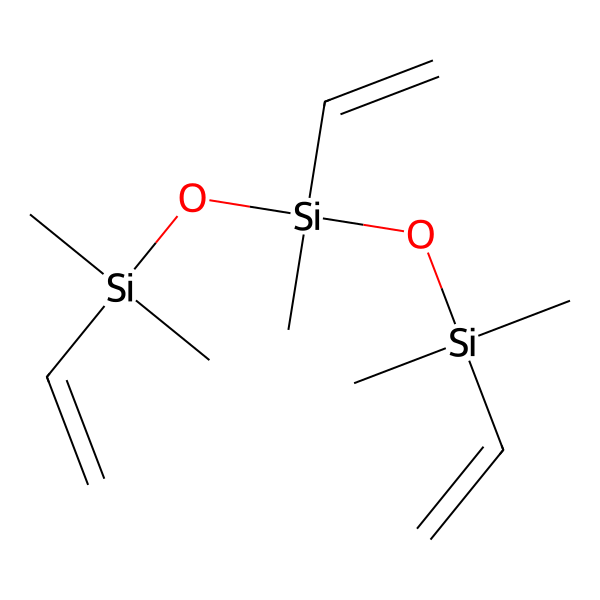
CAS: 1529-65-3; 1,3,5-Trivinyl-1,1,3,5,5-Pentamethyltrisiloxane
该化合物是一种硅烷化合物,其独特结构包括三硅氧烷脊椎和多种乙烯组,其特点是硅和氧原子链,其甲基组附于硅原子,造成其疏水性能;三个乙烯组的存在导致不饱和,这可以促进多种化学反应,如聚合;该化合物通常用于硅酮聚合物,密封剂和涂层的用途,因为其热稳定性和耐降解性;此外,该化合物的独特结构允许在特殊应用中潜在使用,包括用作联结剂或高级材料的配制;该化合物一般被认为毒性较低,但处理仍应遵循标准安全议定书,以尽量减少接触.
- 英文名称1,3,5-Trivinyl-1,1,3,5,5-Pentamethyltrisiloxane
- 中文名称1,3,5-三乙烯基-1,1,3,5,5-五甲基三硅氧烷
- 其它别名Trisiloxane,1,1,3,5,5-pentamethyl-1,3,5-trivinyl- (7CI,8CI); 1,1,3,5,5-Pentamethyl-1,3,5-trivinyltrisiloxane
- CAS编号1529-65-3
- MFCD编号:MFCD00053691
- EINECS号:216-220-7
- 分子式:C11H24O2Si3分子量:272.56
- 产品CID: 750900
- 产品分类有机原料→分子砌块→脂肪链类化合物
相似化合物
2627-95-4 5356-84-3 1873-88-7物理性质
MSDS等安全信息
合成工艺路线路线简述
海关参考信息
- 2901210000-乙烯
- 💡 提示:海关信息按照顺序优先匹配,如需确认的海关信息,请参考相关资料。
- 详情请参考:📖 海关编码查询和海关进出口税则
专利信息
专利号:US-11767388-B1
优先权日:2019-09-18
标 题 :Silicon-functionalized rubber
发明人:ENSIGN SETH CODY; VIELHABER MARGARET FLOOK; JOHNGRASS JENA LYNN; MA LIQING
权利人:GOODYEAR TIRE & RUBBER
摘要:The compatibility between silica fillers and synthetic rubbers which are synthesized utilizing lanthanide-based catalyst systems, such as neodymium catalyst systems can be improved by terminating the polymerization with a vinyl silane terminating agent. In doing so the vinyl silane is allowed to react with the polymer chain ends of the neodymium rubber to functionalize the chain ends of the polymer chains with silicon containing groups. This results in the rubber having better characteristics for utilization in tire rubber formulations, such a tire tread formulations, that exhibit improved wear characteristics and lower rolling resistance. The process for the synthesis of such functionalized polydiene rubber comprises (1) polymerizing a diene monomer in the presence of a lanthanide-based catalyst system, and (2) terminating the polymerization with a vinyl silane terminator. The functionalized polydiene rubber composition made by this method is comprised of a polydiene rubber which is functionalized at its chain ends with a silicon containing group.
专利号:US-6384172-B1
优先权日:2001-01-02
标题:Hyperbranched polycarbosilanes, polycarbosiloxanes, polycarbosilazenes and copolymers thereof
发明人:DVORNIC PETAR R; HU JIN; MEIER DALE J; NOWAK ROBERT M
权利人:MICHIGAN MOLECULAR INST
摘要:Hyperbranched polycarbosilanes, polycarbosiloxanes, polycarbosilazenes and copolymers thereof are prepared by reacting a difunctional or polyfunctional monomer having functional groups of one type (A) without any other functional groups capable of reacting significantly during polymerization, and a difunctional or polyfunctional monomer having functional groups of another type (B) without any other functional groups capable of reacting significantly during polymerization, wherein each A-functional group is reacted with a B-functional group, and wherein at least one of the monomers has a functionality of at least three. The process enables hyperbranched polycarbosilanes, polycarbosiloxanes, polycarbosilazenes and copolymers thereof to be prepared at a lower cost than with conventional synthesis processes, and provides greater flexibility in the preparation of a larger variety of different types of hyperbranched polycarbosilanes, polycarbosiloxanes, polycarbosilazenes and copolymers thereof.
供应商参考报价(招募中)
品牌试剂参考报价(招募中)
📌 第三方产品分析报告
合成参考文献
摘要:Compound: Poly[oxy(ethenylmethylsilylene)], α-(ethenyldimethylsilyl)-ω-[(ethenyldimethylsilyl)oxy]-



📝 需求与反馈
尽可能描述清楚需求与问题信息