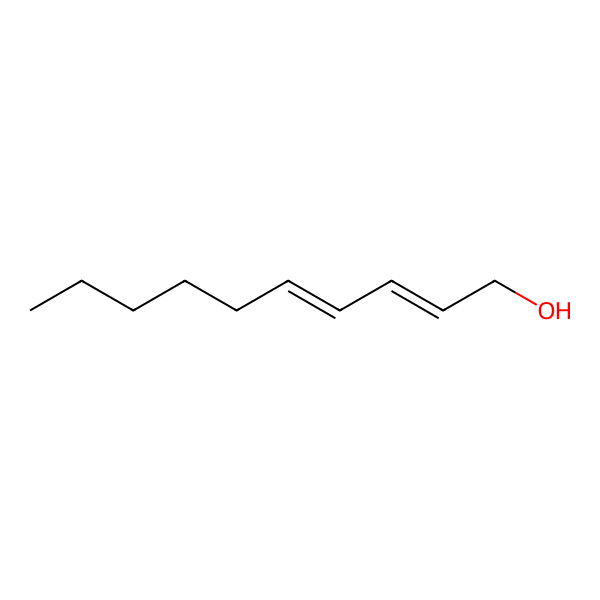
CAS: 18409-21-7; (E,E)-2,4-Decadien-1-Ol
该化合物是一种不饱和的脂肪酒精,其特点是在10碳链的2和4个位置上具有相交双键,该化合物由于其结构特征,对有机合成和芳香应用感兴趣,因为它有助于其再活性和作为更复杂分子的前体的潜力.同源迪恩系统增强了其在迪尔斯-阿尔德尔反应中的效用,而终端氢氧基组则允许进一步功能化.其独特的化学特性使其在研究和工业环境中,特别是在香味和香味化合物的开发中具有价值.该化合物定义的立体化学确保了合成途径和产品结果的一致性.
相似化合物
25152-84-5 14507-02-9 3025-30-7物理性质
MSDS等安全信息

欧盟法规
ECHA物质C&L通报REACH预注册上下游产品
CAS号25152-84-5 反,反-2,4-癸二烯醛 | CAS号7328-33-8 methyl (2E,4E)-... | CAS号7328-34-9 ethyl (2E,4E)-2... | CAS号77663-37-7 (E)-dec-4-en-2-... | CAS号4762-26-9 |n|-己基三苯基溴化鏻 | CAS号2548-87-0 E-2-辛烯醛 | CAS号16387-56-7 1,1-diethoxy°Ct... | CAS号30361-33-2 (2E,4E)-2,4-癸二烯酸 | CAS号16387-55-6 2-辛炔醛二乙基缩醛 | CAS号65405-70-1 反式-4-癸烯醛 | CAS号25152-84-5 反,反-2,4-癸二烯醛 | CAS号73151-59-4 (7E,9E,11E)-Aur... | CAS号63072-56-0 methyl 3-oxotet...合成工艺路线路线简述
(2E,4E)-2,4-癸二烯酸置于lithium Aluminium Tetrahydride,乙醚体系中,化学反应生成(2E,4E)-2,4-癸二烯醇
参考文献:Crombie Et Al.,Journal Of The Chemical Society,1955,P. 1025
标题:Crombie Et Al.,Journal Of The Chemical Society,1955,P. 1025
海关参考信息
- 2901210000-乙烯
2901220000-丙烯
2901241000-1,3-丁二烯 - 💡 提示:海关信息按照顺序优先匹配,如需确认的海关信息,请参考相关资料。
- 详情请参考:📖 海关编码查询和海关进出口税则
专利信息
专利号:US-8865624-B2
优先权日:2010-09-01
标题 :Inhibitor for tobacco axillary bud growth and method for inhibiting tobacco axillary bud growth
发明人:TANAKA MOTOKI; TANAKA KEIJITSU; SHIBUYA TAKESHI; IKUTA EIJI; YOSHINAGA KOTARO; YAMAGUCHI YUKI
权利人:TANAKA MOTOKI; TANAKA KEIJITSU; SHIBUYA TAKESHI; IKUTA EIJI; YOSHINAGA KOTARO; YAMAGUCHI YUKI; SDS BIOTECH CORP
摘要:The present invention relates to an inhibitor for tobacco axillary bud growth, the inhibitor comprising, as an active ingredient, one or more kinds of very-long chain fatty acid synthesis inhibitors such as a chloroacetamide-based herbicide, fentrazamide, cafenstrole or indanofan; an inhibitor for tobacco axillary bud growth, the inhibitor comprising the aforesaid very-long chain fatty acid synthesis inhibitor together with clorthal-dimethyl or an aliphatic alcohol having 6 to 20 carbon atoms; and a method for inhibiting tobacco axillary bud growth which comprises applying the inhibitor for tobacco axillary bud growth. The inhibitor for tobacco axillary bud growth of the present invention shows sustained drug efficacy at a low concentration, induces neither chemical injury nor disease, and can contribute to the improvement in labor productivity.
网址: http://www.xinhechem.cn
企业联系电话:15318402391👤
地址:济宁市任城区中德广场A座1305
企业联系电话:15318402391👤
📞济宁心和化工有限公司 ⚠️参考联系方式
联系人:李丽
电话:15318402391
手机:15264160071
传真:QQ: 1615850970
邮箱:1615850970@qq.com
通信地址: 济宁市任城区中德广场A座1305
邮编: 250101
电话:15318402391
手机:15264160071
传真:QQ: 1615850970
邮箱:1615850970@qq.com
通信地址: 济宁市任城区中德广场A座1305
邮编: 250101
🆔 联系时候可告知是从"百琢研"平台获取的信息.
⚠️ 声明: 该企业未认证、未认领,请自行辨别信息的真实性和可靠性。咨询或交易时请注意风险评估与信息核实,百琢研不参与任何交易。企业认领注册入口→
地址:济宁市任城区中德广场A座1305
⚠️ 未注册 · 未认证企业
 备注: 📌 数据来源说明:本展台内容基于各搜索引擎等公开数据整理,仅作展示用途。请用户自行辨别
✉️ 若企业需抹除展台内容或有异议, 请通过页面底部联系方式告知我们,我们会尽快处理。
第 1 / 1 页
供应商参考报价(招募中)
品牌试剂参考报价(招募中)
📌 第三方产品分析报告
合成参考文献
参考文献:10.1007/978-3-642-73739-8_37
摘要:Tang W, Eisenbrand G. Centipeda minima (L.) A. Braun et Aschers. 1992. In: Chinese Drugs of Plant Origin. : Springer Berlin Heidelberg; 1992.



📝 需求与反馈
尽可能描述清楚需求与问题信息