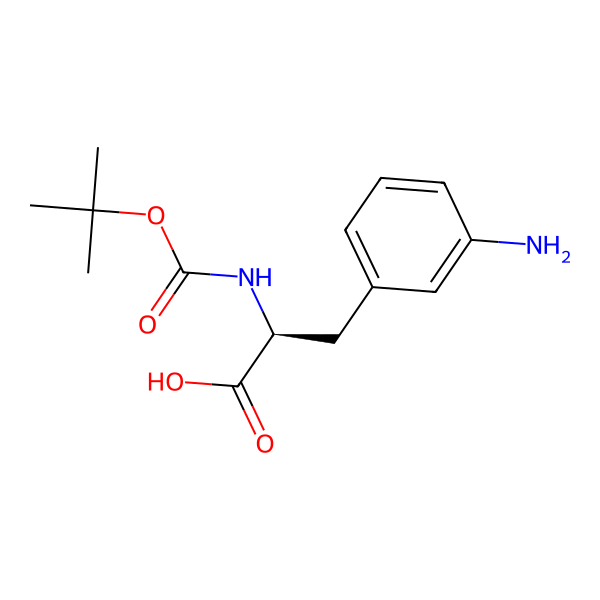
CAS: 170157-55-8; (S)-3-(3-Aminophenyl)-2-((Tert-Butoxycarbonyl)Amino)Propanoic Acid
该化合物是广泛用于制药合成和浸泡化学的手性中间体,其主要结构特征包括一个受保护的氨基氨基酸和一种免费的碳酸,允许对多步反应进行选择性修改.(S)配置确保立体化学精度,这对于生物活性化合物开发至关重要.在酸性条件下,三丁基碳基(Boc)组具有稳定性,同时允许在温和条件下进行非保护.芳香矿团为进一步功能化提供了多功能处理.这一化合物在合成高纯度和控制性强的成性性强性成性小分子活性活性反应中特别宝贵.其定义明确的再活动特征使其成为复杂的有机转化的可靠构件.
相似化合物
908571-75-5 223581-75-7 160560-73-6物理性质
MSDS等安全信息
上下游产品
(2S)-2-[(tert-butoxycarbonyl)amino]-3-(3-nitrophenyl)propanoic acid DL-N-acetyl-3-nitrophenylalanine ethyl 2-(acetylamino)-3-(3-nitrophenyl)propanoate diethyl 2-(acetylamino)-2-(3-nitrobenzyl)malonatem-valpromidoyl-B°C-phenylalanine合成工艺路线路线简述
- 合成目标产物 3-Amino-N-[(1,1-Dimethylethoxy)Carbonyl]- L-Phenylalanine 主要起始原料 Boc-L-3-Nitrophenylalanine
- (文献来源)合成步骤主要原料 Boc-L-3-Nitrophenylalanine
📜间硝基氯化苄置于palladium On Activated Charcoal 盐酸,Sodium Hydroxide,氯化亚砜,氢气,Sodium Ethanolate,溶剂黄146体系中,用 乙醇,水,乙腈,叔丁醇 用作溶剂,-20.0~42.0 °C,289.58 Kpa 条件下,反应 54.5H,反应生成Boc-3-氨基苯丙氨酸
参考文献:Gonadotropin-Releasing Hormone Antagonists: Novel Members Of The Azaline B Family
标题:Gonadotropin-Releasing Hormone Antagonists: Novel Members Of The Azaline B Family
摘要:A Series Of Antagonists Of Gonadotropin-Releasing Hormone (Gnrh) Homologous To Azaline B ([ac-Dnal(1),Dcpa(2),Dpal(3),Aph(5)(Atz),Daph(6)(Atz),Ilys(8),Dala(10)]Gnrh) Was Synthesized,Characterized,And Tested In A Rat Antiovulatory Assay (Aoa). Selected Analogues Were Also Tested In Both An In Vitro Dispersed Rat Pituitary Cell Culture Assay For Inhibition Of Gnrh-Stimulated Luteinizing Hormone Release And An In. Vitro Histamine Release Assay. The Duration Of Action Of Some Of The Most Potent And Safest Analogues In Those Assays Was Also Determined In The Castrated Male Rat In Order To Measure The Extent (Efficacy And Duration Of Action) Of Inhibition Of Luteinizing Hormone Release. Structurally,This Series Of Analogues Has Novel Substitutions (X And Y) In The Structure Of The Azaline B Precursor: [ac-Dnal(1),Dcpa(2),Dpal(3),-Aph(5)(X),Daph(6)(Y),Ilys(8),Dala(10)]Gnrh. These Substitutions Were Designed To Confer Increased Hydrophilicity As Compared To That Of Azaline B (Determined By Relative Retention Times On A C-18 Reverse Phase Column Using A Triethylammonium Phosphate Buffer At Ph 7.3) Or To Make Them More Easily Accessible Synthetically. Some Bulky Substituents Were Introduced In Order To Probe The Spatial Limitations Of The Receptor'S Cavity. These Substitutions Include Acylated 4-Aminophenylalanine At Positions 5 And/or 6 (29 Analogues),N-Alpha-Methylated Backbone Substitutions (Six Analogues),N-Omega-Isopropylaminophenylalanine At Position 8,And Hydrophilic Amino Acids At Position 1. Out Of 20 Novel Analogues Tested For Long Duration Position 8,And Hydrophilic Amino Acids At Position 1. Out Of 20 Novel Analogues Tested For Long Duration Of Action In This Series,Only Seven ([ac-Dnal(1),Dcpa(2),Dpal(3),Aph(5),Daph(6),Ilys(8),Dala(10)]Gnrh,[ac-Dnal(1),Dcpa(2),Dpal(3),Aph(5)(For),Daph(6)(For),Ilys(8),Dala(10)]Gnrh,[ac-Dnal(1),Dcpa(2),Dpal(3),Aph(5)(Ac),Daph(6)(Ac),-Ilys(8),Dala(10)]Gnrh (Acyline),[ac-Dnal(1),Dcpa(2),Dpal(3),Aph(5)(Pio),Daph(6)(Pio),Ilys(8,)Dala(10)]Gnrh,[ac-Dnal(1),Dcpa(2),Dpal(3),Aph(5)(Atz),Daph(6)(Ac),Ilys(8),Dala(10)]Gnrh,[ac-Dnaldcpa(2),Dpal(3),Aph(5)(Atz-Beta Ala),Daph(6)(Atz-Beta Ala),Ilys(8),Dala(10)]Gnrh,[ac-Dnal(1),Dcpa2,Dpal(3),Aph(5)(Atz-Gab),Daph(6)(Atz-Gab),Ilys(8),Dala(10)]Gnrh) Had Relative Potencies And/or Duration Of Action Comparable To Those Of Azaline B. The Others Were One-Half To One-Tenth As Effective As Azaline B. N-Alpha-Methylated Backbone Substitutions At Position 5 Yielded Analogues That Were Significantly More Hydrophilic Presumably Because Of The Breakage Of The Nh Alpha-Tyr(5) To Arg(8)-Co Hydrogen Bond Reported To Stabilize A Beta-Turn Encompassing Residues 5-8 And Which Favored Beta-Sheet Formation As Shown Earlier By Haviv Et Al.(2) This Substitution Resulted,However,In An Increased Potency In The Histamine Release Assay And In Significantly Shorter Duration Of Action.(3) Similarly,Attempts At Replacing Isopropyllysine In Position 8 By Either Isopropyl-4-Aminophenylalanine Or Isopropyl-4(Aminomethyl)Phenylalanine Resulted In Loss Of Potency In The Aoa.Changes In Chirality At Position 1 Or 10 Resulted In Analogues That Were One-Tenth And One-Half As Potent,Respectively,As Acyline. Introduction Of A Relatively Hydrophilic Acetylated Residue In Position 1 (Ac-4-Aminophenylalanine,Ac-2-Quinolylalanine,Ac-3-Quinolylalanine) Also Resulted In Potent Analogues In The Aoa In The Latter Two Cases (Yet Very Short Acting In The Case Of ([ac-D2Qal(1),Dcpa(2),Dpal(3),Aph(5)(Atz),Daph(6)(Atz),Ilys(8),Dala(10)]-Gnrh). Introduction Of Either Mesityl,(2-Chlorophenyl)Isourea,Or (3-Chlorophenyl)Isourea As A Substituent On The 4-Amino Function At Residues 5 And 6 Of The Azaline B Precursor Was Considerably Less Successful. In This Article,We Describe In Details,Improved Synthetic Protocols For All Novel Amino Acis,N Alpha-Methylation Of Amino Acids On The Resin,And Elimination Of The Undesired N Omega-Methylation Of Pyridylalanine At Position 3 As The Result Of Base Treatment (Piperidine Or Hydrazine) During The Deprotection Of The Fmoc Group Or Formation Of The Triazole Moiety In The Presence Of Ch2Cl2.
Doi:10.1021/jm00014A017
海关参考信息
- 2902600000-乙苯
2905122000-异丙醇
2905143000-叔丁醇
2912110000-甲醛 - 💡 提示:海关信息按照顺序优先匹配,如需确认的海关信息,请参考相关资料。
- 详情请参考:📖 海关编码查询和海关进出口税则
供应商参考报价(招募中)
品牌试剂参考报价(招募中)
📌 第三方产品分析报告
合成参考文献
合成方法参考DOI号:10.1021/mp2001878


📝 需求与反馈
尽可能描述清楚需求与问题信息