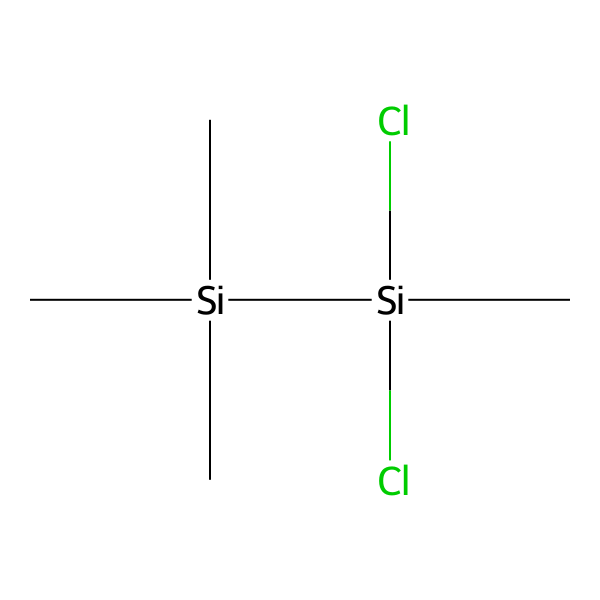
CAS: 39437-99-5; Dichloro-Methyl-Trimethylsilylsilane
- 英文名称Dichloro-Methyl-Trimethylsilylsilane
- 中文名称四甲基二氯二硅烷
- 其它别名dichlorotetramethyl-disilan; 1,2-dichlorotetramethyldisilane
- CAS编号39437-99-5
- MFCD编号:MFCD00078528
- EINECS号:254-449-4
- 分子式:C4H12Cl2Si2分子量:187.22
- 产品CID: 1406344
- 产品分类化学试剂 → 硅烷试剂
物理性质
合成工艺路线路线简述
专利信息
专利号:US-8207366-B2
优先权日:2008-02-26
标题:Method for producing alkyl chlorosilanes from the residues of the direct synthesis of alkyl chlorosilanes
发明人:BOECK MANFRED; FUCHS PAUL; MAUTNER KONRAD
权利人:BOECK MANFRED; FUCHS PAUL; MAUTNER KONRAD; WACKER CHEMIE AG
摘要:High boiling residue from the direct synthesis of alkylchlorosilanes are converted in large part to monosilanes by heating the residue by passage of alternating current in a pressurized reactor.
专利号:US-6939984-B2
优先权日:2003-11-20
标 题 :Process for preparing alkylchlorosilanes from the residues of direct synthesis of alkylchlorsilanes
发明人:STRAUSSBERGER HERBERT
权利人:WACKER CHEMIE GMBH
摘要:The invention provides a continuous process for preparing alkylchlorosilanes from the residues of direct synthesis of alkylchlorosilanes which comprise liquid constituents with a boiling point of at least 70° C. at 1013 hPa and may also contain solids, with hydrogen chloride, by passing the residues at a temperature not above 200° C. and hydrogen chloride at a temperature higher than the latter into a reactor so that the resultant reaction temperature is from 400° C. to 800° C.
专利号:US-8957237-B2
优先权日:2011-12-19
标 题 :Method for the direct synthesis of alkylhalogenosilanes
发明人:ROSIER CÉCILE
权利人:BLUESTAR SILICONES FRANCE; BLUESTAR SILICONES FRANCE
摘要:An improved industrial method for the direct synthesis of alkylhalogenosilanes is described. Specifically, a method is described for preparing alkylhalogenosilanes by reacting, in a fluidized bed reactor, and alkyl halogenide, preferably CH3Cl, with a solid body, which is referred to as a contact body and which includes powdered silicon and a catalytic system including at least one copper catalyst and β1 and β2 promoter activities.
专利号:US-5922893-A
优先权日:1997-02-28
标 题 :Method for preparing monosilanes from a high-boiling fraction formed as by-products in the direct synthesis of methylchlorosilanes
发明人:TSUKUNO AKIHITO; SATOH YUKINORI; MARUYAMA MASAO; HARADA KESAJI; TANAKA SHOICHI; FURUYA MASAAKI
权利人:SHINETSU CHEMICAL CO
摘要:The direct synthesis of methylchlorosilanes to react metallic silicon with methyl chloride in the presence of a copper catalyst yields a high-boiling fraction of methylchlorodisilanes as by-products. The invention provides a method for preparing monosilanes from the high-boiling fraction by reacting it with hydrogen chloride in the presence of an amine or amide catalyst. The reaction is effected under the condition that the amount of iron, aluminum, zinc, tin and compounds thereof present in the reaction system is less than the equimolar amount with respect to the catalyst. This increases the conversion of disilanes into monosilanes.
专利号:US-6344578-B1
优先权日:2000-08-10
标题 :Process for working up residues from the direct synthesis of organochlorosilanes
发明人:MAUTNER KONRAD; KOEHLER BERND; TAMME GUDRUN
权利人:WACKER CHEMIE GMBH
摘要:The invention relates to a process for preparing alkylchlorosilanes from the liquid constituents of the residues from the direct synthesis of alkylchlorosilanes which have a boiling point of above 70° C. at 1013 hPa and comprise disilanes, in which the residues are heated with hydrogen chloride and silicon at temperatures of at least 300° C., with at least 10% by weight of trichlorosilane and/or tetrachlorosilane, based on the weight of the alkylchlorosilanes formed, being formed at the same time.
专利号:US-5627297-A
优先权日:1995-04-10
标 题 :Process for cleaving the by-products of the direct synthesis of alkylchlorosilanes
发明人:GILBERT LAURENT; LAROZE GILLES
权利人:RHONE POULENC CHIMIE
摘要:The process for cleaving the heavy by-products derived from the synthesis of alkylchlorosilanes, in particular C1 to C6 alkylchlorosilanes, more particularly methylchlorosilanes, in particular for the cleavage of alkylchlorodisilanes, in particular methylchlorodisilanes having from one to five chlorine atoms, is carried out by treatment with hydrochloric acid in the presence of a catalytic system which comprises at least one metal phosphate, preferably associated with a basic impregnation compound. The metal phosphate may in particular correspond to the formula: M(XPO4)y in which M represents a metal chosen from: monovalent metals, in which case X is 2H and y=1 divalent metals, in which case X is H and y=1 trivalent metals, in which case X is absent and y=1 tetravalent metals, in which case X is: H and y=2 pentavalent metals, in which case X is 0 and y=1.
供应商参考报价(招募中)
品牌试剂参考报价(招募中)
📌 第三方产品分析报告
合成参考文献
参考文献:10.1038/ncomms13782
摘要:Lian Z, Nielsen DU, Lindhardt AT, Daasbjerg K, Skrydstrup T. Cooperative redox activation for carbon dioxide conversion. Nature Communications. 2016 Dec 16;7(1):13782. doi: 10.1038/ncomms13782.



📝 需求与反馈
尽可能描述清楚需求与问题信息