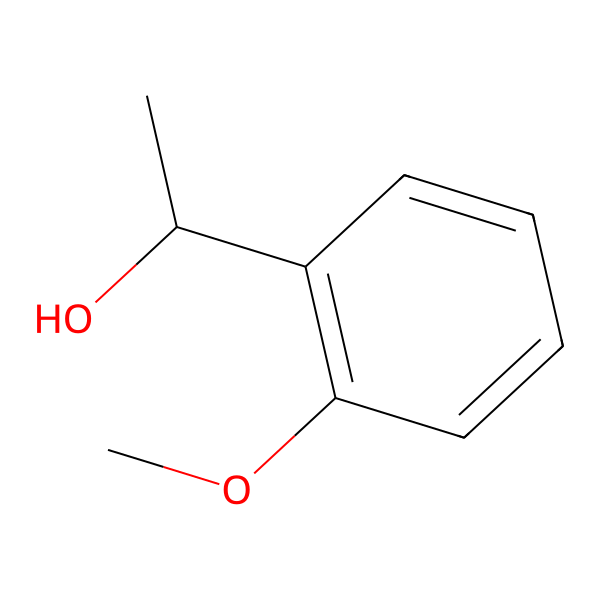
CAS: 13513-82-1; 1-(2-Methoxyphenyl)Ethanol
该化合物是一种有机化合物,其特点是芳香结构,并同时含有甲基和羟基功能组.该化合物的特点是附于苯环的甲氧基(-OCH3)组,该组又被一个甲基组所取代,其独特性更能有所增强.该化合物一般没有颜色,可粉色黄色液体,有香味.该化合物在有机溶剂中溶解,并且由于存在氢氧基组,在水中表现出中等溶解性.该化合物经常用于有机合成,并可作为生产各种药品和芳香的中间体.该化合物的化学行为受到甲氧基体组的电饱和特性的影响,该物质会影响其电药用替代反应的再活性.应参考安全数据处理和接触准则,如任何化学物质一样.
- 英文名称1-(2-Methoxyphenyl)Ethanol
- 中文名称1-(2-甲氧基苯基)乙醇
- IUPAC名称1-(2-methoxyphenyl)ethan-1-ol
- 其它别名Dl-2-甲氧基-Alpha-甲基苄醇; Dl-O-Methoxy-Alpha-Methylbenzyl Alcohol
- CAS编号13513-82-1
- MFCD编号:MFCD00004512
- EINECS号:236-850-6
- 分子式:C9H12O2分子量:152.19
- 产品CID: 535186
- 产品分类有机原料→分子砌块→芳环类化合物→苯类化合物
相似化合物
108100-06-7 579-74-8 113724-48-4物理性质
MSDS等安全信息
欧盟法规
ECHA物质C&L通报REACH预注册上下游产品
CAS号579-74-8 2'-甲氧基苯乙酮 | CAS号67-63-0 异丙醇 | CAS号614-45-9 过氧化苯甲酸叔丁酯 | CAS号14804-32-1 2-乙基苯甲醚 | CAS号75-24-1 三甲基铝 | CAS号135-02-4 邻甲氧基苯甲醛 | CAS号612-15-7 2-甲氧基苯乙烯 | CAS号917-54-4 甲基锂 | CAS号695-84-1 2-乙烯基苯酚 | CAS号41453-01-4 Methylniobtetra... | CAS号40023-74-3 1-(2-甲氧基苯基)乙胺 | CAS号321-28-8 2-氟苯甲醚 | CAS号90-00-6 2-乙基苯酚 | CAS号612-15-7 2-甲氧基苯乙烯 | CAS号14804-32-1 2-乙基苯甲醚 | CAS号223375-01-7 1-(1-溴乙基)-2-甲氧基苯 | CAS号22233-80-3 Hydrazinecarbox... | CAS号90-05-1 愈创木酚 | CAS号52193-85-8 (R)-(+)-1-(2-萘基)乙醇 | CAS号579-74-8 2'-甲氧基苯乙酮合成工艺路线路线简述
- 合成目标产物 1-(2-Methoxyphenyl)Ethanol 主要起始原料 2'-Methoxyacetophenone
- (文献来源)合成步骤主要原料 2'-Methoxyacetophenone
📜(R)-1-(2-Methoxyphenyl)Ethyl Acetate置于sodium Hydroxide体系中,用 甲醇 用作溶剂,化学反应 0.08H,反应生成(R)-1-(2-甲氧基苯基)乙醇
参考文献:Rapid,Room-Temperature Acylative Kinetic Resolution Of Sec-Alcohols Using Atropisomeric 4-Aminopyridine/triphenylphosphine Catalysis
标题:Rapid,Room-Temperature Acylative Kinetic Resolution Of Sec-Alcohols Using Atropisomeric 4-Aminopyridine/triphenylphosphine Catalysis
摘要:Two New Atropisomeric 4-Aminopyridine-Based Nucleophilic Catalysts Containing Terphenyl 'Blocking Groups' Have Been Prepared And Evaluated For Kinetic Resolution (Kr) Of Aryl Alkyl Sec-Alcohols. One Of These Biaryls Is Shown To Be The Most Selective Atropisomeric Catalyst Yet Prepared For Several Sec-Alcohols But Its Low Reactivity Makes It Non-Optimal For Use At Room Temperature (Rt). Optimisation Of The Conditions For Conducting Krs At Rt Using A Previously Described Catalyst (Containing A Phenyl Blocking Group) At The 1 Mol% Level Indicates That Pph3 (1 Equiv) Is Beneficial For Enantioselectivity And Allows Kr Of (+/-)-1-(Naphthyl)Ethanol In Less Than 30 Min With S > 15 (I.E. Similar To 40% Recovered Alcohol With > 95% Ee). These Conditions Constitute A Convenient And Practical Method For Rapid Kr Of Sec-Alcohols And Are Anticipated To Facilitate A Detailed Kinetic Study Of This Catalytic Manifold By Calorimetry. (C) 2005 Elsevier Ltd. All Rights Reserved.
Doi:10.1016/j.Tet.2005.08.124
海关参考信息
- 2902600000-乙苯
2906210000-苄醇
2907121100-间甲酚
2908199090-其他酚的卤化衍生物 - 💡 提示:海关信息按照顺序优先匹配,如需确认的海关信息,请参考相关资料。
- 详情请参考:📖 海关编码查询和海关进出口税则
专利信息
专利号:US-6080874-A
优先权日:1997-09-25
标题:Synthesis and isolation of N-(aryl or heteroaryl)-alkyl-N-hydroxyurea
发明人:HENGEVELD JOHN E; LEESE ELISE H; MOON BRIAN S; ABAD DENNIS M; ALLEN KIMBERLY A; BAUER PHILIP E; MURPHEY DAVID B; FOHEY BRIAN T; COPP JR RICHARD R; LANNOYE GREG S; MITTAG RODNEY M
权利人:ABBOTT LAB
摘要:The present invention provides a simple, 1-step process for preparing a N-(aryl or heteroaryl)-hydroxyurea comprising reacting the corresponding alcohol, ester or ether with hydroxyurea and acid. This reaction is particularly useful for preparing a benzo[b]thienyl substituted N-hydroxyurea of formula: from compound 1: by reacting compound 1 with hydroxyurea and acid. R1 is selected from the group consisting of hydrogen, 1-6 carbon alkyl, 1-6 carbon alkoxy, and halogen; R2 is an 1-4 carbon alkyl; and R3 is selected from the group consisting of hydrogen, acyl, methyl, ethyl and mixtures thereof. Additional steps to isolate the pure bulk product follow.
供应商参考报价(招募中)
品牌试剂参考报价(招募中)
📌 第三方产品分析报告
合成参考文献
摘要:Zaidlewicz, M.; Pakulski, M. M., Science of Synthesis: Stereoselective Synthesis, (2011) 2, 65.
摘要:Hollmann, F., Science of Synthesis Knowledge Updates, (2021) 3, 445.
摘要:Matsunami, A.; Kayaki, Y.; Ikariya, T., Science of Synthesis: Catalytic Reduction in Organic Synthesis, (2018) 2, 57.
摘要:Stoltz, B. M.; Wright, A. C.; Ebner, D. C.; Park, N., Science of Synthesis: Catalytic Oxidation in Organic Synthesis, (2017) 1, 580.
摘要:Tan, X.; Lv, H.; Zhang, X., Science of Synthesis: Catalytic Reduction in Organic Synthesis, (2017) 1, 41.



📝 需求与反馈
尽可能描述清楚需求与问题信息