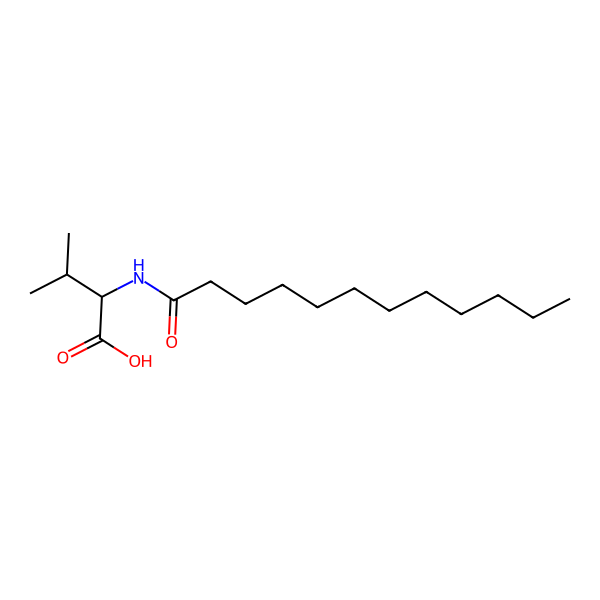
CAS: 14379-28-3; N-Dodecanoyl-Valine
- 英文名称N-Dodecanoyl-Valine
- 中文名称N-十二碳酰基-L-缬氨酸
- IUPAC名称dodecanoyl-L-valine
- 其它别名N-Dodecanoyl-Valine; N-Dodecanoyl-L-Valine; 3-Methyl-2-(1-Oxododecylamino)Butanoic Acid; L-Valine, N-(1-Oxododecyl)-; N-Dodecanoyl-L-Valine Usp/ep/bp; (2S)-2-(Dodecanoylamino)-3-Methylbutanoic Acid
- CAS编号14379-28-3
- 分子式:C17H33NO3分子量:299.45
- 产品CID: 666992
- 产品分类生物化工 → 氨基酸及其衍生物 → 缬氨酸类衍生物
物理性质
MSDS等安全信息
上下游产品
N-succinimidyl laurate L-valine lauric acid N-n-dodecanoyl methyl (L)-valinate合成工艺路线路线简述
📜L-缬氨酸置于sodium Hydroxide,氯化亚砜,Potassium Hydrogencarbonate,三乙胺体系中,用 四氢呋喃,甲醇,氯仿,水 用作溶剂,化学反应 13.0H,反应生成N-十二碳酰基-L-缬氨酸
参考文献:Molecular Mechanism Of Physical Gelation Of Hydrocarbons By Fatty Acid Amides Of Natural Amino Acids
标题:Molecular Mechanism Of Physical Gelation Of Hydrocarbons By Fatty Acid Amides Of Natural Amino Acids
摘要:A Variety Of Fatty Acid Amides Of Different Naturally occurring L-Amino Acids Have Been Synthesized And They Are Found To Form Gels With Various Hydrocarbons. The Gelation Properties Of These Compounds Were Studied By A Number Of Physical Methods Including Ftir Spectroscopy,X-Ray Diffraction,Scanning Electron Microscopy,Differential Scanning Calorimetry,Rheology,And It Was Found That Gelation Depended Critically On The Fatty Acid Chain Length And The Nature Of The Amino Acid. Among Them L-Alanine Based Gelators Were Found To Be The Most Efficient And Versatile Gelators As They Self-Assemble Into A Layered Structure To Form The Gel Network. Mechanisms For The Assembly And Formation Of Gels From These Molecules Are Discussed. (C) 2007 Elsevier Ltd. All Rights Reserved.
Doi:10.1016/j.Tet.2007.05.028
海关参考信息
- 2905121000-正丙醇
2905130000-正丁醇
2912110000-甲醛
2912120000-乙醛 - 💡 提示:海关信息按照顺序优先匹配,如需确认的海关信息,请参考相关资料。
- 详情请参考:📖 海关编码查询和海关进出口税则
专利信息
专利号:US-6090250-A
优先权日:1993-09-20
标题 :Chiral surfactants and methods for their use in chiral separations
发明人:MAZZEO JEFFREY R; GROVER EDWARD R; SWARTZ MICHAEL E; MERION MICHAEL; PETERSEN JOHN S
权利人:WATERS INVESTMENTS LTD
摘要:PCT No. PCT/US94/10655 Sec. 371 Date Mar. 20, 1996 Sec. 102(e) Date Mar. 20, 1996 PCT Filed Sep. 20, 1994 PCT Pub. No. WO95/08529 PCT Pub. Date Mar. 30, 1995Chiral surfactants, methods for their synthesis and use, and apparatus designed to facilitate chiral separations using nucellar capillary electrophoresis is disclosed. A chiral surfactant having the general formula: is described, R1 is the hydrophobic tail, Y-A-X is the linker, the brackets define a chiral center, and the hydrophilic head group is Z. All the various components may potentiate the enantioselectivity of the chiral surfactant. The capillary electrophoresis (CE) system includes a narrow diameter capillary, a high voltage power supply, an electrolyte reservoir at each end of the capillary, a means for injecting a sample, and a detector. Chiral surfactants are dissolved in the electrolyte above their critical micelle concentration (cmc), resulting in the formation of chiral micelles. The electrolyte reservoirs and capillary tube are filled with the electrolyte. A sample containing a mixture of enantiomers is then injected into the capillary, and a high voltage potential is applied across the capillary. The sample components migrate through the capillary due to the influence of the applied electric field. An example separation of the four sereoisomers of aspartame is shown.
供应商参考报价(招募中)
品牌试剂参考报价(招募中)
📌 第三方产品分析报告
合成参考文献
参考文献:10.1007/978-3-663-06727-6_3



📝 需求与反馈
尽可能描述清楚需求与问题信息