CAS: 16858-02-9; N1,N1,N2,N2-Tetrakis(Pyridin-2-Ylmethyl)Ethane-1,2-Diamine
该化合物是一种以能够形成稳定的金属离子复合体而闻名的铬化剂,该化合物具有四组双丙基甲基基体的中央乙基亚胺骨干特征,加强了其协调性.TEP的特点是极地溶解性很高,适合协调化学和催化的各种应用.多种氮捐献点的存在,使得它能够有效地与在生物机能化学和材料科学等领域很有价值的过渡金属结合.此外,TEP由于能够与生物系统中的金属离子进行互动,其结构复杂性和功能性多功能性使它成为关注侧重于金属离子探测和分离过程的研究的一个主题.
- 英文名称N1,N1,N2,N2-Tetrakis(Pyridin-2-Ylmethyl)Ethane-1,2-Diamine
- 中文名称N,N,N’,N’-四(2-吡啶甲基)乙二胺
- IUPAC名称N1,N1,N2,N2-tetrakis(pyridin-2-ylmethyl)ethane-1,2-diamine
- 其它别名Pyridine,2,2',2'',2'''-[ethylenebis(nitrilodimethylene)]tetra- (8CI); N,N,N',N'-Tetrakis(2-pyridylmethyl)-1,2-ethanediamine; N,N,N',N'-Tetrakis(2-pyridylmethyl)ethylenediamine; N,N,N',N'-Tetrakis(pyridin-2-yl-methyl)ethylenediamine; TPEDA; TPEN
- CAS编号16858-02-9
- MFCD编号:MFCD00036918
- EINECS号:605-520-7
- FDA UNII编号:R9PTU1U29I
- 分子式:C26H28N6分子量:424.54
- 产品CID: 851588
- 产品分类有机原料→生命科学→生化试剂→螯合剂
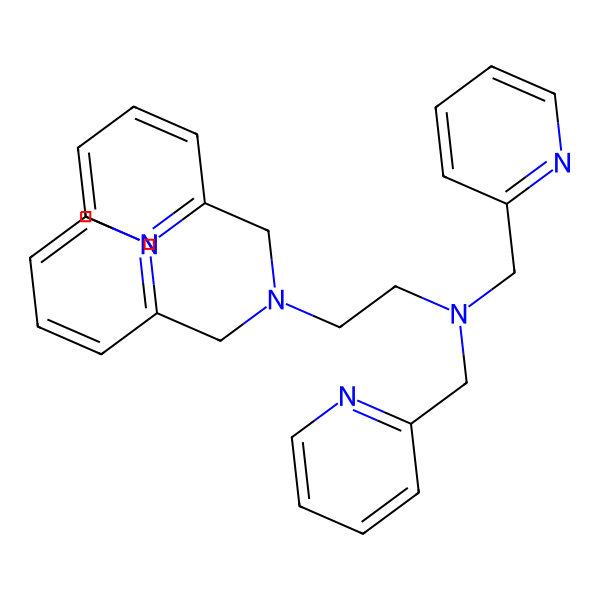
相似化合物
189440-33-3 80384-94-7 136768-57-5物理性质
- 熔点110-112 °C
- 沸点542.1 °C at 760 mmHg
- 闪点281.7 °C
- 密度1.3893 (粗估)
- pKa:5.19±0.12(预测)
- PSA:58.04
- LogP:3.9712
- 折射率1.4570 (估算)
- 溶解性Soluble In DMSO (Up To 10 mg/mL).
- 外观形态类白色或棕褐色棕褐色固体
- 储存条件密封干燥,2-8°C
- 产品应用该化合物用作通过对细胞内NO和ZN2+信号进行负面调节,在NB4细胞中诱发聚变;它作为急性红蛋白性白血病的治疗战略,具有潜力;它能减少镉,汞和甲基汞造成的重金属诱发的毛发-2型荧光变化;它通过铜红氧化循环处理,针对结肠癌细胞,降低细胞的剂量和时间性;它能够引起DNA损坏并激活ATM/ATR信号路径,导致细胞死亡.
MSDS等安全信息

欧盟法规
ECHA物质C&L通报REACH预注册上下游产品
N,N'-二-2-吡啶甲基乙二胺 N,N'-Bis(2-Pyridylmethyl)Ethylenediamine 4608-34-8合成工艺路线路线简述
- 合成目标产物 Tpen 主要起始原料 N,N'-Bis(2-Pyridylmethylene)Ethylenediamine
- (文献来源)合成步骤主要原料 N,N'-Bis(2-Pyridylmethylene)Ethylenediamine
📜N,N'-二(2-吡啶亚甲基)乙二胺置于sodium Hydroxide,Sodium Tetrahydroborate,四乙基溴化铵体系中,用 乙醇,二氯甲烷,水 用作溶剂,化学反应 243.0H,反应生成N,N,N,N-四-(2-吡啶基甲基)乙二胺
参考文献:Chromium(III) Complexes Of The Hexadentate Ligand N,N,N',N'-Tetrakis(2-Pyridylmethyl)Ethane-1,2-Diamine. Synthesis,Structure And Reactivity.
标题:Chromium(III) Complexes Of The Hexadentate Ligand N,N,N',N'-Tetrakis(2-Pyridylmethyl)Ethane-1,2-Diamine. Synthesis,Structure And Reactivity.
摘要:Chromium(III) Complexes Of N,N,N',N'-Tetrakis(2-Pyridylmethyl)Ethan-1,2-Diamine,Tpen,Have Been Synthesised By Air Oxidation Of Chromium(II) Acetate And The Ligand In A Methanol-Water Mixture. Addition Of Perchlorate Precipitates [cr(Tpen)(ococh3)](Clo4)(2). H2O,Which Has Been Used As The Starting Material For The Synthesis Of A Number Of Complexes Including [cr(Tpen)](Clo4)(3),[cr(Tpen)(Oh)](Clo4)(2) And Cis-[cr(Tpen)(Oh)(2)]Clo4. 3H(2)O. These Compounds Have All Been Characterised By Single-Crystal Structure Determinations. The Four Complexes Are All Monomeric And Contain Six-Coordinate Chromium(III) Cations. In [cr(Tpen)](3+) All Six Nitrogens Of The Potentially Hexadentate Tpen Ligand Are Coordinated To Chromium,In [cr(Tpen)(ococh3)](2+) And [cr(Tpen)(Oh)](2+) Five Nitrogen Atoms Are Coordinated And In Cis-[cr(Tpen)(Oh)(2)](+) Only Four Nitrogen Atoms Are Coordinated. The Remaining Coordination Sites In The Last Three Cations Are occupied By Oxygen Atoms Of The Acetate And The Hydroxide Ligands. In Neutral Solution The Divalent Base [cr(Tpen)(Oh)](2+) Is Relatively Stable,But Acidification Leads To A Fast Equilibration Reaction Between [cr(Tpen)(Oh2)](3+) And [cr(Tpen)](3+),Which Has Been Characterized By Stopped-Flow Measurements. In Basic Aqueous Solution [cr(Tpen)(Oh)](2+) Reacts Slowly To Give Cis-[cr(Tpen)(Oh)(2)](+). Acidification Of Cis-[cr(Tpen)(Oh)(2)](+) Solutions Leads To The Same Hexaamine/pentaamine Equilibrium Mixture But By A Considerably Slower Process. Part Of This Significant Reactivity Difference May Be Attributed To The Conformation Of The Coordinated Part Of The Ligand,Which Is Similar In The Hexaamine And Pentaamine Complexes,And Markedly Different In The Tetraamine Complex.
Doi:10.3891/acta.Chem.Scand.53-1083
海关参考信息
- 2921211000-乙二胺
2933310010-吡啶
2939800000-其他生物碱 - 💡 提示:海关信息按照顺序优先匹配,如需确认的海关信息,请参考相关资料。
- 详情请参考:📖 海关编码查询和海关进出口税则
专利信息
专利号:US-2023002805-A1
优先权日:2021-06-25
标 题 :Use of organic cationic compounds to accelerate nucleic acid hybridization, synthesis, and amplification
发明人:RABBANI ELAZAR; COLEMAN JACK
权利人:ENZO BIOCHEM INC
摘要:The invention provides methods for accelerated synthesis of nucleic acids, and related compositions which involve the use of organic amines in the nucleic acid synthesis reaction mixture. The invention also provides methods for reducing processing steps associated with nucleic acid synthesis. The invention further provides methods for screening compounds that have positive benefits on the synthesis of nucleic acids.
专利号:US-2019323050-A1
优先权日:2016-12-21
标题 :Modulation of Enzymatic Polynucleotide Synthesis Using Chelated Divalent Cations
发明人:GRISWOLD JR KETTNER JOHN FREDERICK; LEE HOWON; CHURCH GEORGE M
权利人:HARVARD COLLEGE
摘要:Methods and apparatus of modulating polynucleotide synthesis are provided. The methods include delivering reagents comprising enzymes, nucleotides and ions to oligonucleotide primers wherein the reagents catalyze incorporation of the nucleotides to 3′ ends of the oligonucleotide primers, and modulating incorporation of the nucleotides to the 3′ ends of the oligonucleotide primers. Polynucleotide synthesis is modulated by modulating presence or absence of catalytic cation cofactors to provide sequence defined synthesis of polynucleotides. In certain embodiments, the polynucleotides encode information.
专利号:US-12053529-B2
优先权日:2018-08-01
标题:Amino-reactive positively charged ATRP initiators that maintain their positive charge during synthesis of biomacro-initiators
发明人:RUSSELL ALAN J; MURATA HIRONOBU
权利人:UNIV CARNEGIE MELLON
摘要:Provided herein are materials and methods that include utilizing atom transfer radical polymerization (ATRP) initiator molecules that maintain a positive charge during biomacro-initiator synthesis.
专利号:US-9777082-B2
优先权日:2011-10-05
标题 :Synthesis of hyperbranched polyacrylates by emulsion polymerizsation of inimers
发明人:PUGH COLEEN; GARCIA GUILLERMINA
权利人:UNIV AKRON
摘要:A method for the production of hyperbranched polyacrylates includes the step of reacting acrylic inimers through controlled living polymerization in aqueous conditions. The inimers may have the formula: n nWherein X is a halogen, a thiocarbonylthio or nitroxide group, and R is hydrogen, methyl, dodecyl, and groups containing mesogenin substituents, fluorocarbon substituents, siloxane substituents and oxyethylene substituents. In particular, the aqueous condition is emulsion or miniemulsion. The polymerization may be reverse ATRP, SN&RI and AGET polymerization or RAFT polymerization (with thiocarbonylthio X groups) or nitroxide mediated polyeization (with nitroxide X groups).
专利号:US-6733828-B2
优先权日:2002-01-29
标 题 :Method of fabricating nanostructured materials
发明人:CHAO KUEI-JUNG; YANG CHIA-MIN
摘要:A method of confined synthesis of nanostructured material inside a mesoporous material. The method includes the step of providing mesoporous material having uniform and ordered mesopores. Next, a monolayer of charged functional group is attached on the pore surface of mesoporous host material by reacting with functional molecule. A oppositely-charged molecule is incorporated into the confined space of mesoporous material by either ion exchange or incipient wetness impregnation. Finally, the incorporated molecule is reduced or oxidized or further reacted with secondarily-incorporated molecule to form nanostructured material in mesoporous material.
专利号:US-2009325858-A1
优先权日:2003-03-21
标 题:Reduction of Zinc-Induced Neurotoxic Injury By Blockade of Nitric Oxide Synthesis
发明人:FREDERICKSON CHRISTOPHER J
权利人:ANDRO DIAGNOSTICS INC
摘要:The present invention provides methods of inhibiting release of zinc from neurons and of preventing zinc-mediated brain injury. Also provided are methods of improving cerebral blood flow while preventing zinc-mediated brain injury. Inhibitors of or activators of nitric oxide synthases modulate nitric oxide synthesis to reduce nitric oxide-induced release of neurotoxic amounts of zinc, thereby reducing zinc-mediated neuronal injury after brain trauma.
供应商参考报价(招募中)
品牌试剂参考报价(招募中)
📌 第三方产品分析报告
主要参考文献
1: Lee K, Davis A, Zhang L, Ryu J, Spate LD, Park KW, Samuel MS, Walters EM, Murphy CN, Machaty Z, Prather RS. Pig oocyte activation using a Zn²⁺ chelator, TPEN. Theriogenology. 2015 Oct 1;84(6):1024-32. doi: 10.1016/j.theriogenology.2015.05.036.
2: Kim HL, Ra H, Kim KR, Lee JM, Im H, Kim YH. Poly(ADP-ribosyl)ation of p53 contributes to TPEN-induced neuronal apoptosis. Mol Cells. 2015 Apr;38(4):312-7. doi: 10.14348/molcells.2015.2142.
3: Meeusen JW, Nowakowski A, Petering DH. Reaction of metal-binding ligands with the zinc proteome: zinc sensors and N,N,N',N'-tetrakis(2-pyridylmethyl)ethylenediamine. Inorg Chem. 2012 Mar 19;51(6):3625-32. doi: 10.1021/ic2025236.
合成参考文献
摘要:G. Anderegg and F. Wenk. Helv. Chim. Acta 50, 2330 (1967).
参考文献:10.1021/ja016146v
摘要:Hitomi Y, Outten CE, O'Halloran TV. Extreme zinc-binding thermodynamics of the metal sensor/regulator protein, ZntR. J Am Chem Soc. 2001 Sep 05;123(35):8614–5. doi: 10.1021/ja016146v.
参考文献:10.1007/s10974-008-9135-z
摘要:Sztretye M, Deli T, Szentesi P, Szigeti G, Csernoch L. Effect of TPEN on the calcium release of cultured C2C12 mouse myotubes. Journal of Muscle Research and Cell Motility. 2007 Oct;28(7-8):421–8. doi: 10.1007/s10974-008-9135-z.
参考文献:10.1124/jpet.110.174466
摘要:Johnson FO, Yuan Y, Hajela RK, Chitrakar A, Parsell DM, Atchison WD. Exposure to an Environmental Neurotoxicant Hastens the Onset of Amyotrophic Lateral Sclerosis-Like Phenotype in Human Cu2+/Zn2+ Superoxide Dismutase 1 G93A Mice: Glutamate-Mediated Excitotoxicity. The Journal of Pharmacology and Experimental Therapeutics. 2011 Aug;338(2):518–27. doi: 10.1124/jpet.110.174466.
参考文献:10.1179/1476830511y.0000000004
摘要:Lu H, Pang W, Hu YD, Yang HP, Huang CY, Jiang YG. Effects of intracellular zinc depletion on the expression of VDAC in cultured hippocampal neurons. Nutr Neurosci. 2011 Mar;14(2):80–7. doi: 10.1179/1476830511y.0000000004.



📝 需求与反馈
尽可能描述清楚需求与问题信息