CAS: 13179-98-1; 1,6-Dimethoxyhexane
该化合物是分子式C8H18O2的线性脂性乙醚,其特征是,该化合物位于六环链终点端的两个甲氧化合物组,在有机和水生环境中都具有中度极分和溶性,在有机合成中通常用作溶剂或中间剂,特别是在需要受控极性的反应中或作为二醇的保护组中.其稳定的醚联系和可预测的反应性使它在药物,农用化学品和特殊化学制造中成为可靠的选择.该化合物的低挥发性和高沸点进一步增强了其对高温工艺的适宜性.
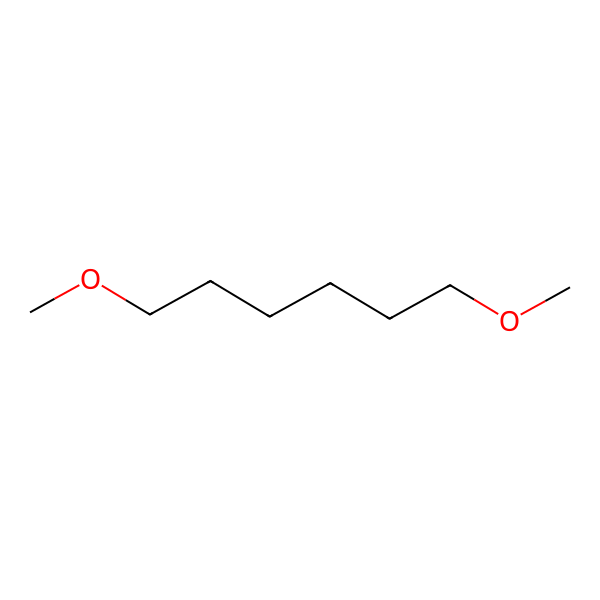
- 相似结构搜索
- 产品信息参考
 ;;
;; - InChIKey: GZHQUHIMIVEQFV-UHFFFAOYSA-N
- InChI=1S/C8H18O2/c1-9-7-5-3-4-6-8-10-2/h3-8H2,1-2H3
- 计算化学: 氢键受体数2.0氢键供体数0可旋转键数7
相似化合物
629-11-8 629-82-3 57021-65-5物理性质
MSDS等安全信息
上下游产品
CAS号67-56-1 甲醇 | CAS号629-11-8 1,6-己二醇 | CAS号616-38-6 碳酸二甲酯 | CAS号629-03-8 1,6-二溴己烷 | CAS号4672-50-8 1-methyl-4-[6-(... | CAS号512-56-1 磷酸三甲酯 | CAS号74-88-4 碘甲烷 | CAS号61542-10-7 1-碘-3-甲氧基丙烷 | CAS号186581-53-3 重氮甲烷 | CAS号124-41-4 甲醇钠 | CAS号629-11-8 1,6-己二醇 | CAS号57021-65-5 6-methoxyhexan-1-ol合成工艺路线路线简述
📜1,6-己二醇置于吡啶,Sodium Methylate体系中,用 二氯甲烷 用作溶剂,化学反应 0.33H,反应生成1,6-二甲氧基己烷
参考文献:Fingerprinting A Transition-Structure Guest By A Building-Block Approach With An Incremental Series Of Catalytic Hosts. Structural Requirements For Glyme And .Alpha.,.Omega.-Dimethoxyalkane Catalyses In N-Methylbutylaminolysis And Butylaminolysis Of 4-Nitrophenyl Acetate In Chlorobenzene
标题:Fingerprinting A Transition-Structure Guest By A Building-Block Approach With An Incremental Series Of Catalytic Hosts. Structural Requirements For Glyme And .Alpha.,.Omega.-Dimethoxyalkane Catalyses In N-Methylbutylaminolysis And Butylaminolysis Of 4-Nitrophenyl Acetate In Chlorobenzene
摘要:Glymes,H-(Ch2och2)N-H,Glm(N),Catalyze Butylaminolysis Of 4-Nitrophenyl Acetate In Chlorobenzene. Values Of K(Cat)/oxy,Where Oxy Is The Number Of Oxygens In The Catalyst,Increase With Oligomer Length Up To Triglyme,Glm(4),And Then Plateau. Optimal Catalysis On A Per Oxygen Basis Requires A-(Ch2och2)4-Fragment,Which Suggests A Four-Point Recognition Of The Secondary Ammonium Ion Of The Zwitterionic Tetrahedral Intermediate (Ti) (J. Org. Chem. 1991,56,2821-2826). Dissection Of Individual Structural Components And Reassembly To The Same Structure Of The Complex Verifies This Model. The Following Kinetic Studies Of 4-Nitrophenyl Acetate In Chlorobenzene Have Accomplished The Task: (A) Methylbutylaminolysis Catalyzed By Glm(N),N = 2-4; (B) Methylbutylaminolysis Catalyzed By Alpha,Omega-Dimethoxyalkanes,Ch3O-(Ch2)N-och3,Dme(N),N = 2-10 And 12; And (C) Butylaminolysis Catalyzed By Dme(N),N = 2-10 And 12. Experiment A Has Revealed That K(Cat)/oxy Is The Same For Glm(2)-Glm(4). Optimal Catalysis For Breakdown Of A Zwitterionic Ti With One Ammonium Proton Only Requires A-(Ch2och2)2-Fragment. Experiment B Has Shown That K(Cat)/oxy Is Largest For Dme(2) With The Values For The Remaining Dmes 2-2.5-Fold Lower. A-Ch2Ch2-Is The Best Spacer Between The Two Oxygens. Thus,Bifurcated Hydrogen-Bond Formation Between The Two Oxygens And The One Ammonium Proton Enhances Catalysis. Experiment C Has Revealed That K(Cat)/oxy For Dme(2) Exceeds The Remaining Dmes By 3-3.6-Fold,Except For Dme(8) And Dme(10),Which Have Values Of K(Cat)/oxy Only 1.7-Fold Slower. Dme(8),The Carba Analogue Of Glm(4),Likely Binds To The Two Ammonium Protons Individually With The Two Oxygens. Dme(10) Behaves Similarly. Glm(4) Catalysis Of Butylaminolysis Identifies-(Ch2och2)4-As An Optimal Size. Dme(8) Catalysis Confirms This Size,Although The Two Catalysts Stabilize The Two-Proton Ammonium Ion Differently. Glm(4) Catalyzes Butylaminolysis By Forming Two Bifurcated Hydrogen Bonds. This Suggested Structure Defines The Size Of The Ammonium Ion,Which Agrees With X-Ray Structural Studies Of Polyether-Ammonium Complexes. Mechanistic Proposals Of Butylaminolysis Of Aryl Esters Require Such An Ion. The Results Of This Study Confirm The Structure Of The Ion In The Rate-Limiting Step. This Building-Block Approach Is A Method For ''Fingerprinting'' Ammonium Ions In Transition Structures Of Ionogenic Reactions.
Doi:10.1021/jo00027A014
海关参考信息
- 2905121000-正丙醇
2905130000-正丁醇
2909199090-其他醚及其衍生物 - 💡 提示:海关信息按照顺序优先匹配,如需确认的海关信息,请参考相关资料。
- 详情请参考:📖 海关编码查询和海关进出口税则
专利信息
专利号:US-10308665-B2
优先权日:2015-06-23
标题 :Method for the synthesis of rapamycin derivatives
发明人:ZABUDKIN OLEKSANDR; SCHICKANEDER CHRISTIAN; MATVIIENKO IAROSLAV; SYPCHENKO VOLODYMYR
权利人:SYNBIAS PHARMA AG
摘要:The present invention relates to a method for the production of a rapamycin derivative of formula (I), the method comprising the preparation of a 2-(tri-substituted silyl)oxyethyl triflate by reacting ethylene oxide and a tri-substituted silyl triflate, reaction of the resulting 2-(tri-substituted silyl)oxyethyl triflate with rapamycin in the presence of a molar excess of organic base, and deprotection to obtain the rapamycin derivative of compound (I).
专利号:US-2019010168-A1
优先权日:2015-06-23
标题:Method for the synthesis of rapamycin derivatives
专利号:EP-3313853-A1
优先权日:2015-06-23
标 题 :Method for the synthesis of rapamycin derivatives
专利号:EP-3313853-B1
优先权日:2015-06-23
标题:Method for the synthesis of rapamycin derivatives
专利号:WO-2015048268-A1
优先权日:2013-09-25
标题 :Synthesis of delta 12-pgj3 and related compounds
专利号:EP-3109250-A1
优先权日:2015-06-23
标题:Method for the synthesis of rapamycin derivatives
供应商参考报价(招募中)
品牌试剂参考报价(招募中)
📌 第三方产品分析报告
合成参考文献
参考文献:10.1007/978-3-031-05484-6_131
摘要:Sun Y, Chen N, Jiang T. Characteristic Analysis of One-Dimensional Isothermal Model of Lithium-Air Battery Based on Intelligent Test System. 2022. In: Lecture Notes on Data Engineering and Communications Technologies.



📝 需求与反馈
尽可能描述清楚需求与问题信息