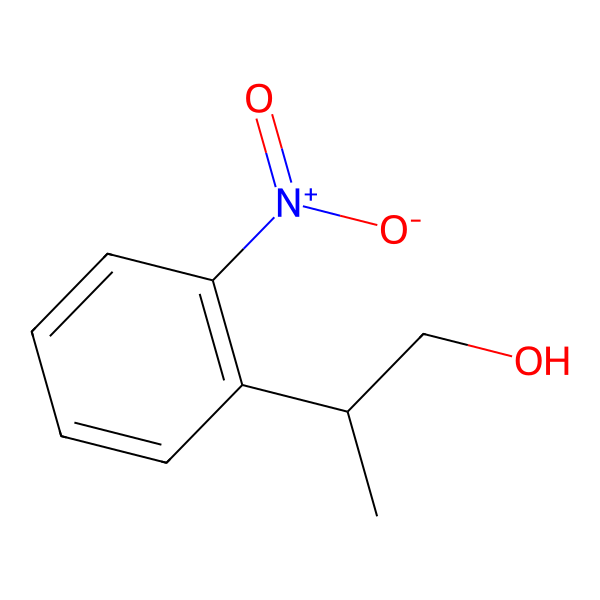
CAS: 64987-77-5; 2-(2-Nitrophenyl)Propan-1-Ol
该化合物是一种硝基替代芳醇,配有分子式C9H11NO3.该化合物的特点是存在一个附属于丙诺基的硝基苯组,使其成为有机合成的多功能中间体,其结构允许进一步功能化,特别是在制备药品,农用化学品和精细化学品方面.硝基化合物组增强了减少和替代反应的回动性,而氢氧基组则提供了衍生的处理器.该化合物在标准条件下具有中等稳定性,便于处理和储存.其合成效用在于它能够成为更复杂的分子的前体,特别是在热循环和手感合成方面.
- 英文名称2-(2-Nitrophenyl)Propan-1-Ol
- 中文名称2-(2-硝基苯基)丙-1-醇
- IUPAC名称2-(2-nitrophenyl)propan-1-ol
- 其它别名2-(2-Nitrophenyl)Propanol; Beta-Methyl-2-Nitro-Benzeneethanol; 2-(2-Nitrophenyl)-Propan-1-Ol; 2-(2-Nitrophenyl)Propan-1-Ol; Civpzpjjpwvvip-Uhfffaoysa-N
- CAS编号64987-77-5
- MFCD编号:MFCD09038679
- 分子式:C9H11NO3分子量:181.19
- 产品CID: 1632716
- 产品分类有机原料→分子砌块→芳环类化合物→苯类化合物
相似化合物
15121-84-3 6526-72-3 20716-26-1物理性质
MSDS等安全信息
上下游产品
formaldehyd 2-nitro(ethylbenzene) 1-bromo-2-ethyl-3-nitrobenzene 2-ethyl-1-iodo-3-nitrobenzene 3-Methylindole 3-(2-aminophenyl)-1-propanol 2-(2-nitrophenyl)propyl chloroformate 2-(2-nitrophenyl)propyl chloride合成工艺路线路线简述
📜1-硝基-2-丙-1-烯-2-基苯置于dimethyl Sulfide Borane,Sodium Hydroxide,双氧水体系中,用 四氢呋喃,水 作为反应溶剂,化学反应 3.0H,反应生成 Beta-甲基-2-硝基-苯乙醇
参考文献:Lipase-Mediated Resolution Of Substituted 2-Aryl-Propanols: Application To The Enantioselective Synthesis Of Phenolic Sesquiterpenes
标题:Lipase-Mediated Resolution Of Substituted 2-Aryl-Propanols: Application To The Enantioselective Synthesis Of Phenolic Sesquiterpenes
摘要:A Comprehensive Study Of The Lipase-Mediated Resolution Of Substituted 2-Aryl-Propanols Is Reported. The Latter Alcohols Were Submitted To The Irreversible Acetylation Catalyzed Either By Ppl,Crl,Or Lipase Ps. The Enantioselectivity Of These Transformations Was Dependent On The Type Of Lipase Used. The Type Of Substituents And Particularly Their Position On The Aromatic Ring Strongly Affected The Selectivity Of The Reaction. The Experiments Described Prove That Ppl Is The More Versatile Lipase Catalyzing The Acetylation With An Enantiomeric Ratio (E) Value That Ranges From 1 Up To 144,Depending On The Substrate Used. Conversely,The Same Transformations Were Catalyzed By Crl And Lipase Ps With An Enantiomeric Ratio Value,Which Is Always Less Than 5. The Remarkable Behavior Of Ppl Was Exploited In The Large Scale Resolution Of Some Substituted 2-Aryl-Propanols Whose Enantiomeric Forms Are Relevant Building Blocks In The Enantioselective Synthesis Of Phenolic Sesquiterpenes. By These Means,The Synthesis Of (S)-Turmeronol B And The Formal Syntheses Of (R)-Curcumene,(R)-Curcuphenol,(R)-Xanthorrhizol,And (R)-Curcuhydroquinone Were Accomplished. (C) 2011 Elsevier Ltd. All Rights Reserved.
DOI:10.1016/j.Tetasy.2011.03.012
海关参考信息
- 2902600000-乙苯
2902700000-异丙基苯
2905121000-正丙醇 - 💡 提示:海关信息按照顺序优先匹配,如需确认的海关信息,请参考相关资料。
- 详情请参考:📖 海关编码查询和海关进出口税则
专利信息
专利号:US-2005101763-A1
优先权日:2003-09-30
标 题 :Synthesis of photolabile 2-(2-nitrophenyl)propyloxycarbonyl protected amino acids
发明人:DELISI CHARLES P; LAURSEN RICHARD A; BHUSHAN KUMAR R
权利人:UNIV BOSTON
摘要:The 2-(2-nitrophenyl)propyloxycarbonyl (NPPOC) group has been introduced as a photolabile amino protecting group for amino acids to be used as building blocks in photolithographic solid-phase peptide synthesis. NPPOC-protected amino acids were found to be cleaved in the presence of UV light about twice as fast as the corresponding o-nitroveratryloxycarbonyl (NVOC)-protected amino acids. The protected amino acids are of particular use in the synthesis of peptide arrays.
专利号:US-2006154256-A1
优先权日:2001-10-25
标 题:Method for covalently attaching nucleosides and/or nucleotides on surfaces and method for determining coupling yields in the synthesis of nucleotides
发明人:STENGELE KLAUS-PETER; KVASSIOUK EVGUENI
权利人:STENGELE KLAUS-PETER; KVASSIOUK EVGUENI
摘要:The present invention relates to a method for covalently attaching nucleosides and/or nucleotides on surfaces having reactive functional groups, where in a first step, the reactive functional groups are made to react with suitable derivatized nucleosides and/or nucleotides, and in a second step, they are converted with a protecting group reagent, so that a reaction product of the consecutive reaction interacts with electromagnetic radiation such that it can be quantitatively determined. The invention also relates to a method for determining the repetitive coupling yields in the synthesis of nucleotides where the free 3′ or 5′ hydroxy group of a selected nucleoside and/or nucleotide is converted with a compound of formula (I) n n nwhere L is a common suitable leaving group, the motif O—PX represents a phosphor amidite, a H-phosphonate a phosphonic acid ester, a phosphotriester, Yâ•?O or S, N is a nucleoside or a nucleotide derivative which subsequently reacts further with a protecting group reagent and the elimination of the leaving group (L), which is subsequently further eliminated. The quantity of the leaving group (L) eliminated in step b) is quantitatively determined in the form of its anion (L − ) by means of otical spectroscopy.
专利号:US-2004203036-A1
优先权日:2001-07-09
标 题 :Multimer polynucleotide synthesis
发明人:STENGELE KLAUS-PETER; PFLEIDERER WOLFGANG
摘要:The present invention relates to a process for the preparation of polynucleotides, whereby under suitable usual conditions the free 5′-hydroxy group, whose terminal 3′-hydroxy group contains a usual protecting group, is reacted with a hydroxy group, derivatized in a previous reaction step to a phosphite amidoester, phosphpotriester or phosphonic acid ester, whereby said hydroxy group is a 3′-hydroxy function of a free or solid phase bound polynucleotide, or a solid phase bound hydroxy function. n Further the present invention relates to a kit for performing a process according to the invention, which contains at least one or more selected oligonucleotides, having a free 5′-hydroxy group and a protected 3′-hydroxy group. Further on, the present invention relates to new oligonucleotides and their use as building blocks for the synthesis of polynucleotides in the process according to the invention. n Furthermore the present invention relates to the use of the process according to the invention or the use of the kits for the preparation of poly/oligonucleotides resp. polynucleotide libraries or nucleic acid chips.
专利号:US-8445734-B2
优先权日:2003-02-21
标 题:Photolabile protective groups for improved processes to prepare oligonucleotide arrays
发明人:BUEHLER SIGRID; OTT MARKUS; PFLEIDERER WOLFGANG
权利人:BUEHLER SIGRID; OTT MARKUS; PFLEIDERER WOLFGANG; NIGU CHEMIE GMBH
摘要:The present invention discloses novel and improved nucleosidic and nucleotidic compounds that are useful in the light-directed synthesis of oligonucleotides, as well as, methods and reagents for their preparation. These compounds are characterized by novel photolabile protective groups that are attached to either the 5′- or the 3′-hydroxyl group of a nucleoside moiety. The photolabile protective group is comprised of a 2-(2-nitrophenyl)-ethyoxycarbonyl skeleton with at least one substituent on the aromatic ring that is either an aryl, an aroyl, a heteroaryl or an alkoxycarbonyl group. The present invention includes the use of the aforementioned compounds in light-directed oligonucleotide synthesis, the respective assembly of nucleic acid microarrays and their application.
专利号:US-2005170281-A1
优先权日:2002-06-21
标题:Method of cleaving labile functional groups from chemical compounds
发明人:STENGELE KLAUS-PETER
摘要:The present invention provides a method of cleaving labile functional groups from molecules by exposure to electromagnetic radiation in which the molecules are contacted with a chemical compound whose triplet state is energetically higher than the triplet state of the labile functional group and are then exposed to electromagnetic radiation, with the labile functional group and the suitable chemical compound having different absorption maxima for electromagnetic radiation. Further, the invention provides a method of manufacturing DNA chips by spatially addressed, light-controlled nucleotide synthesis on solid substrates. In addition, the present invention provides a chemical composition comprising a molecule with a labile functional group and a chemical compound whose triplet state is higher than the triplet state of the labile functional group, with the labile functional group and the chemical compound having different absorption maxima for electromagnetic radiation, and describes the use of the chemical composition in the manufacture of DNA chips.
专利号:US-6153744-A
优先权日:1996-05-20
标 题 :Nucleoside derivatives with photolabile protective groups
发明人:PFLEIDERER WOLFGANG; BUEHLER SIGRID
权利人:WOLFGANG PFLEIDERER
摘要:The invention relates to nucleo-side derivatives with photo-unstable protective groups of the general formula (I) in which R1 is H, NO2, CN, OCH3, halogen, alkyl or alkoxyalkyl with 1 to 4 C atoms, R2 is H, OCH3, R3 is H, F, Cl, Br, NO2 or an aliphatic acyl radical with 2 to 5 C atoms, R4 is H, halogen, OCH3, an alkyl radical with 1 to 4 C atoms or a possibly substituted aryl radical, R5 is H or a conventional functional group for producing oligonucleotides, R6 is H, OH, halogen or XR8, where X is O or S and R8 is a conventional protective group in nucleotide chemistry, B is adenine, cytosin, guanine, thymine, uracil, 2,6-diaminopurin-9-yl, hypoxanthin-9-yl, 5-methylcytosin-1-yl, 5-amino-4-imidazol carboxylic acid amid-1-yl or 5-amino-4-imidazol carboxylic acid amide-3-yl, where, if B is adenine, cytosin or guanine, the primary amino function may have a permanent protective group. These derivatives may be used for the light-controlled synthesis of oligonucleotides on a DNA chip.
供应商参考报价(招募中)
品牌试剂参考报价(招募中)
📌 第三方产品分析报告
合成参考文献
参考文献:10.1055/s-2006-949621
摘要:Bhushan K. Photolabile Peptide Nucleic Acid Monomers: Synthesis and Photodeprotection. Synlett. 2006 Aug;2006(13):2130–2. doi: 10.1055/s-2006-949621.
参考文献:10.1134/s1070428025603176
摘要:Kazantsev DA, Denisov AA, Valova MS, Slepukhin PA, Pestov AV. Synthesis, Molecular Structure, and Spectral Properties of Ethyl 3-Oxo-2-(2,4,6-trinitrophenyl)butanoate. Russ J Org Chem. 2025 Jul;61(7):1199–204. doi: 10.1134/s1070428025603176.



📝 需求与反馈
尽可能描述清楚需求与问题信息